
Twenty-One Hours Against the Tide
On August 25, 1875, Matthew Webb climbed ashore in France, the first person ever to swim the English Channel.
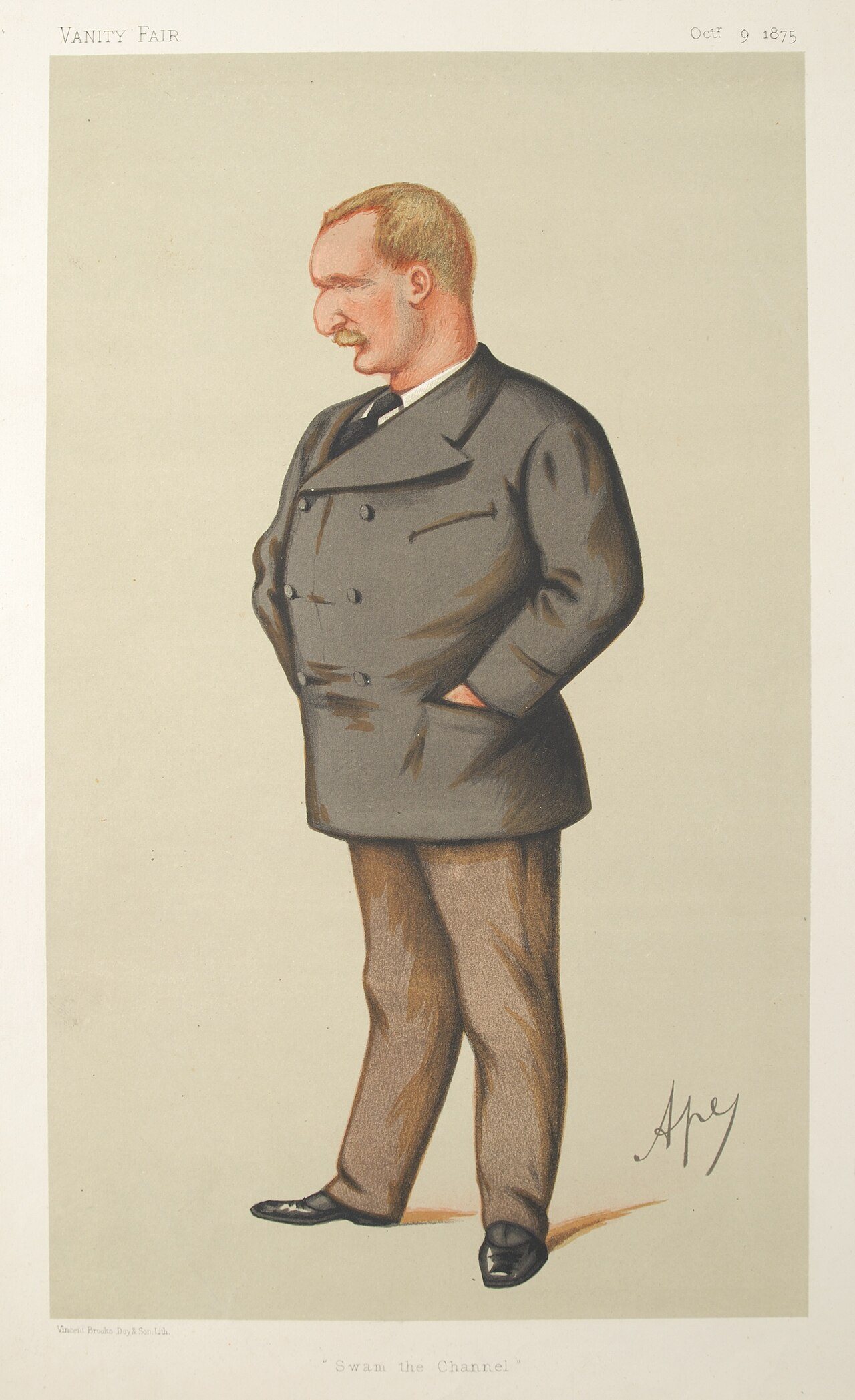
The English Channel had defeated everyone. For years, endurance swimmers had tried to conquer the twenty-one miles of cold, churning water between England and France — and every one had failed. In 1875, a 27-year-old merchant navy captain named Matthew Webb decided to try.
Webb was not known as a fast swimmer. What he had was something better: endurance. One of twelve children, he had learned to swim in the River Severn and joined a merchant training ship at twelve. He had made his mark with brave, dangerous swims at sea — once diving overboard in the Atlantic to save a drowning man. When he read about another swimmer's failed Channel attempt, he quit his job, trained for months along England's south coast, and set his sights on Dover.
That failed swimmer was J. B. Johnson, whose Channel attempt had been beaten back. Webb believed an endurance swimmer — not a sprinter — could finish what Johnson had started.
His first try, on August 12, 1875, ended in failure when a storm made the water impossible. Twelve days later, smeared in porpoise oil against the cold and wearing a red silken swimming costume, he tried again, setting out from Dover's Admiralty Pier on the afternoon of August 24. Followed by three small boats, he swam his finest breaststroke through the night. A jellyfish stung him; he drank brandy, coffee, and beef tea to keep warm. Eight miles from France, the tide turned and forced him to swim five hours just to hold his place along the French coast.
The support boats were his lifeline, feeding him steady doses of brandy, coffee, and beef tea against the cold, the jellyfish stings, and tangled patches of seaweed that threatened to drag him under.
At about ten forty on the morning of August 25, 1875 — after 21 hours and 45 minutes, and the equivalent of 39 miles of swimming against the currents — Captain Matthew Webb waded ashore near Calais. He was the first known person in history to swim the English Channel.
The world went wild. The Daily Telegraph declared him "the best-known and most popular man in the world." Crowds unhitched the horses from his carriage in his hometown of Shropshire and pulled him through the streets themselves. He became the Victorian era's great celebrity daredevil — a fame that would end tragically in 1883, when he died attempting to swim the whirlpool rapids below Niagara Falls. But nothing can undo what he did that August morning: proof that human endurance, measured in hours and miles, could conquer what everyone called impossible.
The Niagara attempt was a desperate gamble. By 1883 Webb's fame had faded and his money was running out; his friends begged him not to try the whirlpool rapids, but he went ahead anyway. On July 24 he leapt from a small boat into the Niagara Gorge — he had even written a will, leaving his property to his wife Madeleine. Within ten minutes the whirlpool had him. His body was recovered four days later, and the autopsy found he had not even drowned: the cause of death was recorded as "crushing," the sheer weight of the water. He was buried at Oakwood Cemetery in Niagara Falls, New York.
Photo: Carlo Pellegrini ("Ape"), Vanity Fair, public domain (via Wikimedia Commons).