Paris Is Ours Again: The Liberation of 1944
On August 25, 1944, the German garrison in Paris surrendered, and Charles de Gaulle arrived to reclaim the capital after four years of Nazi occupation.
For four years, Paris had lived under the swastika. Since June 1940, Nazi flags had flown from the city's grandest buildings, its Jewish families had been rounded up and deported, and its people had endured hunger, curfews, and fear. By the middle of August 1944, though, everything was changing. The Allies had broken out of Normandy, German administrators were fleeing east in long convoys, and the workers of Paris — railwaymen first, then police, postal workers, and metro staff — had gone on strike, paralyzing the occupation.
On August 18, the uprising began in earnest. The French Forces of the Interior, the military arm of the Resistance, plastered the city with posters calling every able-bodied man to arms. The next morning, police officers stormed the Prefecture de Police and raised the French tricolor over the Ile de la Cite. Barricades — more than 600 of them — rose across the city within a day and a half, built from overturned cars, paving stones, and manhole covers. The battle for Paris had begun.
The man charged with holding the city was General Dietrich von Choltitz, the German military governor. He commanded some 16,000 troops and 80 tanks — more than enough to crush the lightly armed insurgents. And he held a terrible order from Adolf Hitler himself: Paris was to be left, in Hitler's words, lying in complete debris. Bridges across the Seine were mined; government buildings were wired with explosives. On August 23, Hitler demanded maximum destruction, barking his infamous question down the telephone line: was Paris burning?
But Paris did not burn. Swedish consul Raoul Nordling spent days shuttling between the two sides, and Choltitz — who later said he could not bring himself to destroy one of the world's great cities — held back the demolition. Meanwhile, General Philippe Leclerc's French 2nd Armored Division was racing for the capital, its lead tanks entering the city on the evening of August 24 after Leclerc disobeyed orders to wait.
On August 25, 1944, Choltitz surrendered the German garrison. That same day, Charles de Gaulle — the tall, stern general who had refused to accept France's defeat in 1940 and had rallied Free France from London — arrived in the capital to take charge as head of the Provisional Government. At the Hotel de Ville, Paris's city hall, he delivered a speech crediting the liberation to the French people themselves, declaring the city freed by its own citizens with the help of the armies of France and its allies.
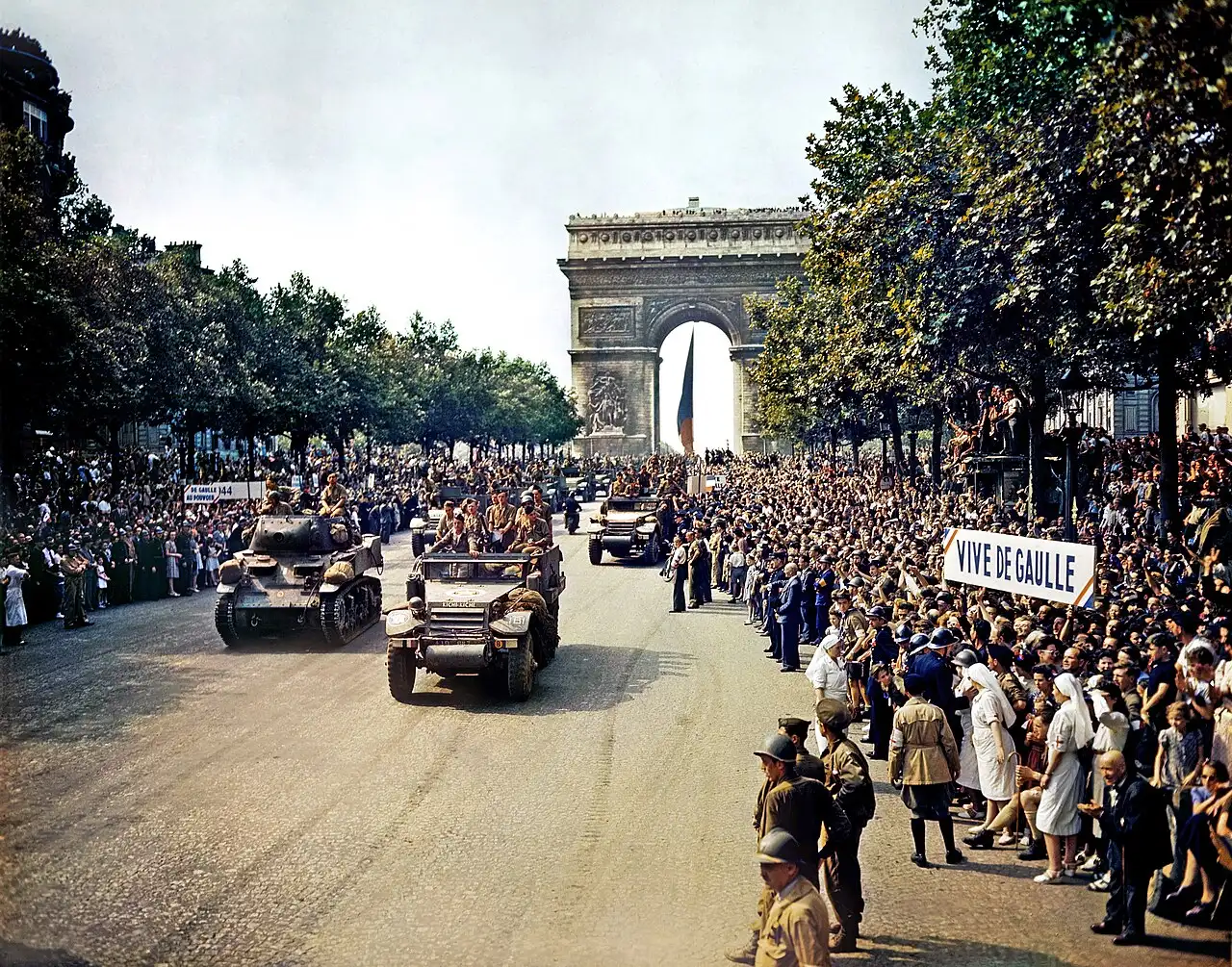
The celebration exploded the next day. De Gaulle led a victory parade down the Champs-Elysees as enormous crowds — the photograph above shows the scene, with banners reading "Vive de Gaulle" — cheered Leclerc's soldiers past the Arc de Triomphe. Gunfire from a few German and militia holdouts sent crowds scattering near the Place de la Concorde, but the day belonged to Paris.
The cost had been real: some 1,600 Resistance fighters and 130 soldiers of the liberation army were killed, while the Germans lost about 3,200 dead and saw 12,800 taken prisoner. In the weeks that followed, the collapse of Vichy authority unleashed a wave of reprisals against suspected collaborators before formal courts were established that autumn.
The liberation of Paris changed the war's meaning. It proved that France had freed itself rather than simply being rescued, and it gave de Gaulle's provisional government the legitimacy to lead the nation. Paris was outraged, Paris was broken, Paris was martyred — but on August 25, 1944, Paris was free.
Photo: Jack Downey, U.S. Office of War Information (via the Library of Congress and Wikimedia Commons), public domain.