Three Men and a Compass: The Dash to the South Magnetic Pole
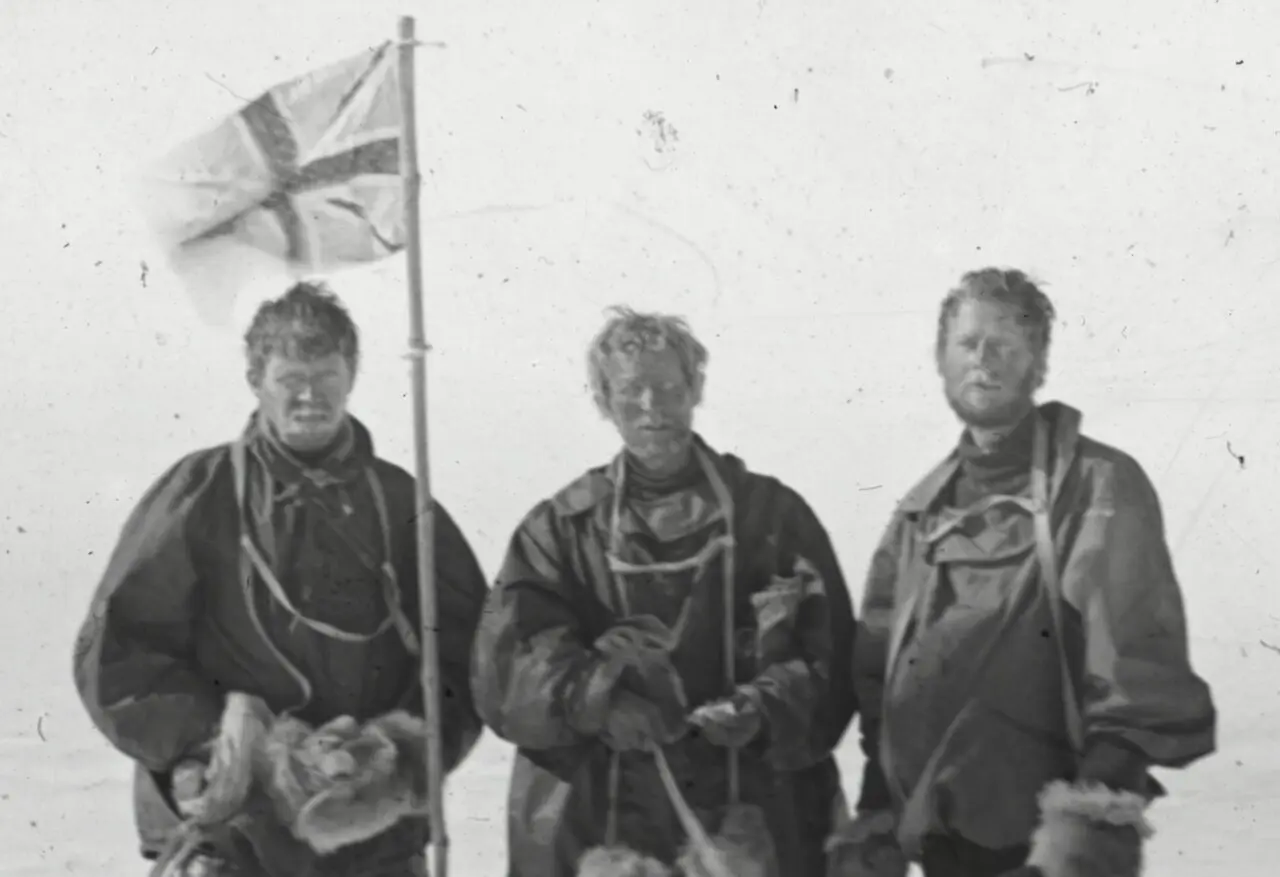
On January 16, 1909, three men from Shackleton's Nimrod expedition planted the Union Jack at the South Magnetic Pole after hauling their sledges some 1,260 miles across Antarctica.
The compasses had gone strange — and that was how they knew they were close.
By the middle of January 1909, three men were walking through a white nothingness at the bottom of the world, guided by instruments that grew less trustworthy with every mile. Professor Edgeworth David kept stopping to take magnetic readings, and each reading told the same story: the needle dipped steeper, tugging more insistently downward. They were closing in on one of the oddest destinations on Earth — a place with no marker, no flag, no feature at all, where the planet's magnetic field plunges straight down into the ice.
The men were the Northern Party of Ernest Shackleton's Nimrod Expedition, the British Antarctic Expedition of 1907–09. While Shackleton himself led a party south toward the geographic South Pole, David — a 50-year-old geology professor — commanded a second party with a different prize in mind: the South Magnetic Pole. With him were Douglas Mawson, a 26-year-old Australian geologist, and Alistair Forbes Mackay, a Scottish naval surgeon. They had set out from the expedition's base at Cape Royds on October 5, 1908, hauling their own sledges across the ice — no dogs, no ponies, just three men and the ropes.
It was a journey of some 1,260 miles, and it nearly killed them several times over. They man-hauled up the treacherous Drygalski Glacier and through a maze of crevasses. At one point David plunged into a hidden crevasse and was hauled out by Mawson, frostbitten and shaken but alive. They lived on dwindling rations, slept in reindeer-skin bags that froze solid overnight, and navigated by compass bearing toward a point that was, in a sense, invisible.
On January 16, 1909, their instruments told them they had arrived: 72°15′ South, 155°16′ East, at an elevation of 7,260 feet on the Antarctic plateau. In a brief, muted ceremony, the three exhausted men raised the Union Jack, and David formally claimed the area for King Edward VII. They were the first human beings ever to stand at a magnetic pole.
The distinction matters. The geographic South Pole is a fixed point — the bottom of the Earth's axis. The magnetic pole is where the planet's magnetic field lines dive vertically into the ground: the place every compass needle on Earth is trying to point toward. It drifts over time, but on that January day in 1909 it stood on that high plateau — and three frostbitten men stood on it with it.
The triumph was almost overshadowed. Just a week earlier, on January 9, Shackleton himself had been forced to turn back a mere 97 nautical miles from the geographic South Pole, judging — correctly — that pushing on meant death. On the desperate retreat he gave his own daily biscuit ration to the ailing Frank Wild, an act of leadership that became legend. Shackleton returned to Britain a hero and was knighted; Mawson went on to become Australia's greatest Antarctic explorer, leading his own expedition within a few years.
The Northern Party's feat was a landmark of the Heroic Age of Antarctic Exploration: proof that disciplined science could be done at the ends of the Earth, and a reminder that exploration's greatest prizes are not always the most famous ones. The South Pole gets the glory. But on January 16, 1909, three nearly forgotten men reached the pole that moves, planted a flag in thin air, and walked home through the ice to tell the tale.
Photo: Alistair Mackay, Edgeworth David and Douglas Mawson at the South Magnetic Pole on January 16, 1909 — photographed by a member of the expedition party (attributed to Professor Edgeworth David) — public domain, via the State Library of New South Wales and Wikimedia Commons.