"This Is the Right Place": The Pioneers Reach Salt Lake
On July 24, 1847, an ailing Brigham Young looked out over the Salt Lake Valley from a wagon and declared 'This is the right place. Drive on.' — ending an exile and beginning a city.
He was too sick to walk, so they propped him up in the back of a wagon.
Brigham Young, the 46-year-old leader of the Latter-day Saints, had been ill for much of the journey — a serious fever contracted on the trail. For weeks, his friend Wilford Woodruff had been driving him west in a wagon, while the vanguard company of Mormon pioneers wound its way across the plains from Illinois toward the Rocky Mountains.
They were exiles. Driven from their homes in the Midwest by violent persecution, the Latter-day Saints had spent the winter at a camp they called Winter Quarters and then set out in the spring of 1847 for a place far beyond the reach of their enemies: the Great Basin, then part of Mexico, a desert valley ringed by mountains that few American settlers had ever seen.
On July 21, scouts Erastus Snow and Orson Pratt rode ahead and became the first of the company to look down into the Salt Lake Valley. Pratt wrote that he and Snow "could not refrain from a shout of joy" at the sight. The next day, the pioneers explored the valley, investigated its streams and hot springs, and made camp. On July 23, Pratt offered a prayer dedicating the land; the company broke ground, dug irrigation ditches, and planted potatoes and turnips in the dry soil.
Then, on July 24, 1847, Brigham Young finally saw it for himself. Woodruff drove the wagon to a rise at the mouth of Emigration Canyon, the canvas cover was pulled back, and the ailing leader was propped up to look out over the wide valley below. According to Woodruff's account — written down decades later — Young studied the scene and declared: "This is the right place. Drive on."
Young later said he had seen the valley in a vision and recognized it, including a distinctive peak. Whether vision or judgment, the decision held. Within days, he had chosen the site for a temple and laid out a plan for a city. The pioneers threw themselves into the work: felling timber, building homes, and coaxing crops from the desert with irrigation. By December 1847, more than two thousand Latter-day Saints had completed the journey, and tens of thousands more would follow in the years ahead, turning the valley into Salt Lake City.
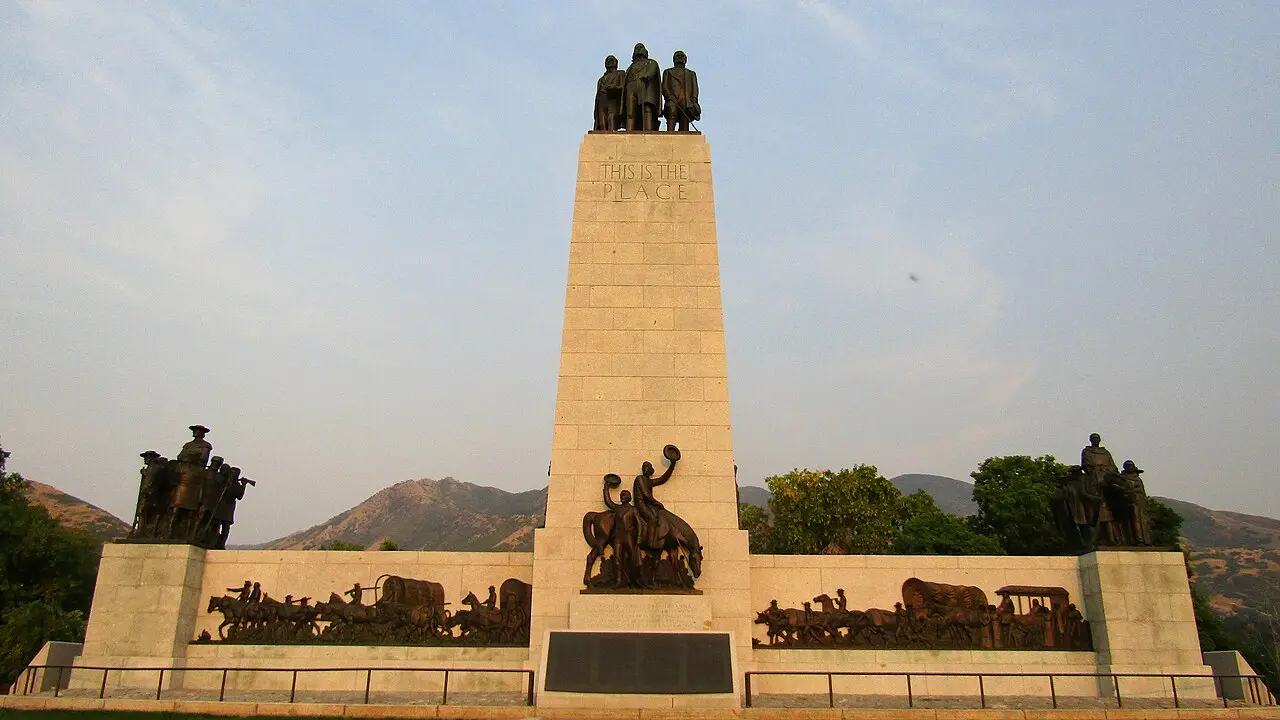
Every year since, Utah has celebrated Pioneer Day on July 24 — a state holiday honoring not only the Mormon pioneers but the courage of all the settlers of the American West. At the mouth of Emigration Canyon stands the great This Is the Place Monument, sculpted by Mahonri Young — Brigham Young's own grandson — and dedicated on the hundredth anniversary, July 24, 1947.
Why it matters: the pioneers' arrival is one of the great migration stories in American history — a community that lost everything, crossed more than a thousand miles of wilderness, and built a thriving city in a desert. It is a story about what displaced people can do when they refuse to stop moving, and about how a single sentence, spoken from the back of a sick man's wagon, can name a place for all time.
Photo: The This Is the Place Monument in Salt Lake City, Utah, honoring the pioneers of 1847. Photograph by Ben P L, licensed under CC BY-SA 2.0 via Wikimedia Commons.