The Cold War Argument That Started in a Kitchen
On July 24, 1959, Vice President Richard Nixon and Soviet leader Nikita Khrushchev squared off in a model kitchen in Moscow — and their impromptu 'Kitchen Debate' aired in both nations.
The two most powerful men in the world were arguing about washing machines.
It was July 24, 1959, opening day of the American National Exhibition in Moscow's Sokolniki Park — a six-week showcase of American life, built under a 1958 U.S.-Soviet cultural exchange agreement. The centerpiece was a full-size model American home, sliced open so visitors could peer inside, stocked with every labor-saving marvel General Electric could provide. The Americans claimed any U.S. family could afford it: the house cost about $14,000.
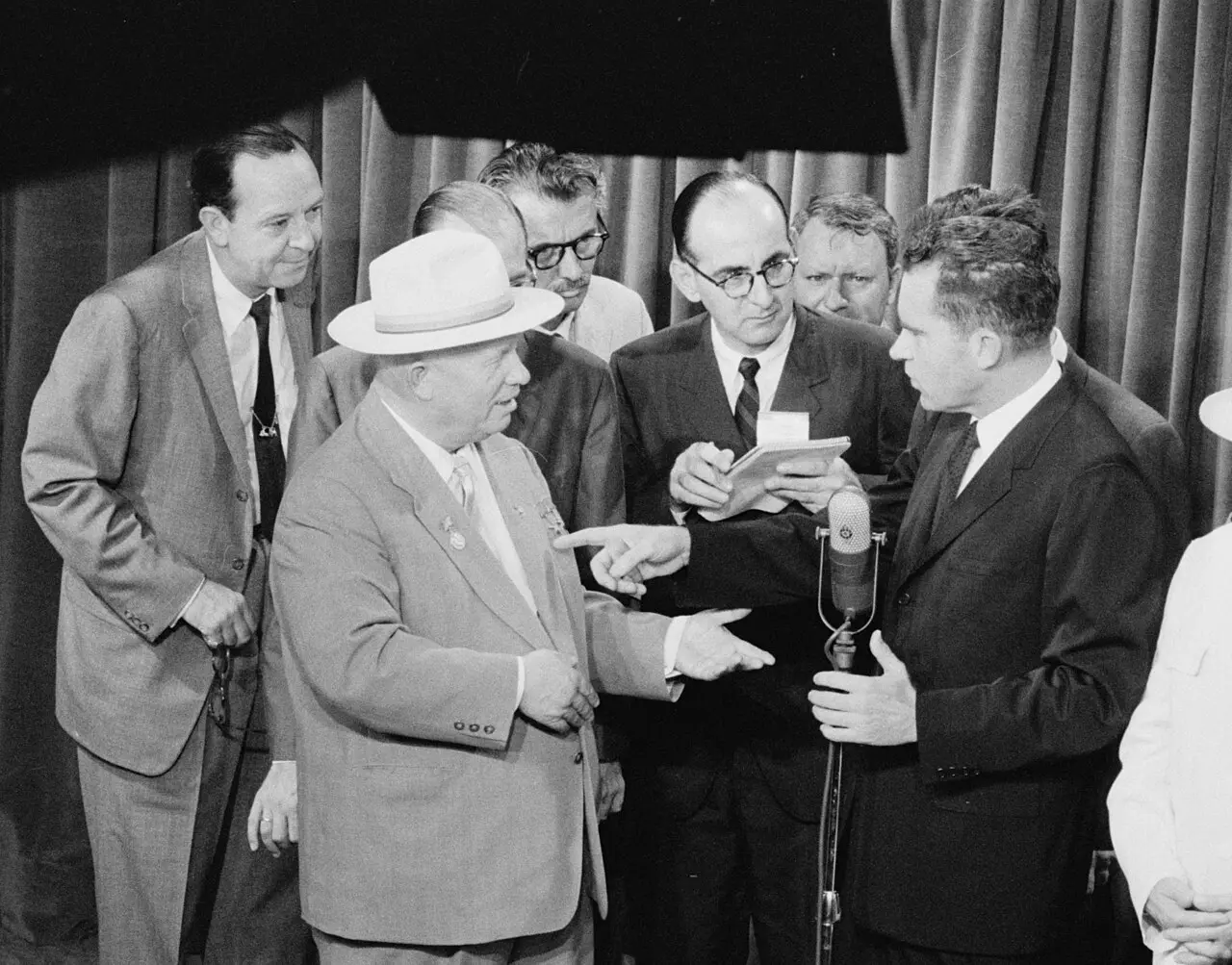
Vice President Richard Nixon, 46, was on hand to open the exhibition. Soviet leader Nikita Khrushchev, 65, came along for the tour. As they stood in the model kitchen, surrounded by reporters, interpreters, and Politburo members, the small talk turned into something nobody had planned: an impromptu, gloves-off debate about which system — capitalism or communism — served ordinary people better.
Nixon opened with the dishwasher. "This is our newest model," he told Khrushchev. "This is the kind which is built in thousands of units for direct installations in the houses. In America, we like to make life easier for women..."
"Your capitalistic attitude toward women does not occur under Communism," Khrushchev shot back.
Nixon pressed on: "I think that this attitude towards women is universal. What we want to do, is make life more easy for our housewives." He pointed out that an American steelworker — then on strike, earning $3 an hour — could buy the $14,000 house for about $100 a month. Khrushchev countered that Soviet workers could afford such houses too, and that American houses were "built to last only 20 years so builders could sell new houses at the end. We build firmly. We build for our children and grandchildren."
The argument wandered from kitchens to color television to rockets — Khrushchev boasted the Soviets were ahead in space — and finally to the terrifying heart of the Cold War itself. Nixon warned that with modern weapons, "it does not make any difference if war comes. We both have had it." The whole exchange was captured on color videotape — a brand-new technology — and broadcast in both countries, so tens of millions of Americans and Soviets watched their leaders spar.
The press dubbed it the "Kitchen Debate." It was not a formal summit and it settled nothing. But it mattered enormously. Here were the two superpowers, at the height of their rivalry, choosing to compete with model kitchens and television sets instead of missiles. Nixon came home a hero to many Americans for standing up to Khrushchev on Soviet soil; the moment boosted his standing ahead of his 1960 presidential run. The exhibition itself drew some three million Soviet visitors, who lined up to see blue jeans, dishwashers, and a vision of American daily life.
Why it matters: the Kitchen Debate was soft power in action — the idea that a nation's strength can be measured not just in warheads, but in how its ordinary citizens live. In an era when the world lived under the shadow of nuclear war, two rivals stood in a fake kitchen and argued about the future with words instead of weapons. That, in 1959, felt like progress. It still does.
Photo: Richard Nixon and Nikita Khrushchev face off at the American National Exhibition in Moscow, July 1959. Photograph by Thomas J. O'Halloran, U.S. Information Agency (public domain, via Wikimedia Commons).