The Washington Monument Is Dedicated
On February 21, 1885, the 555-foot Washington Monument was formally dedicated in the nation's capital after nearly four decades of fits and starts.
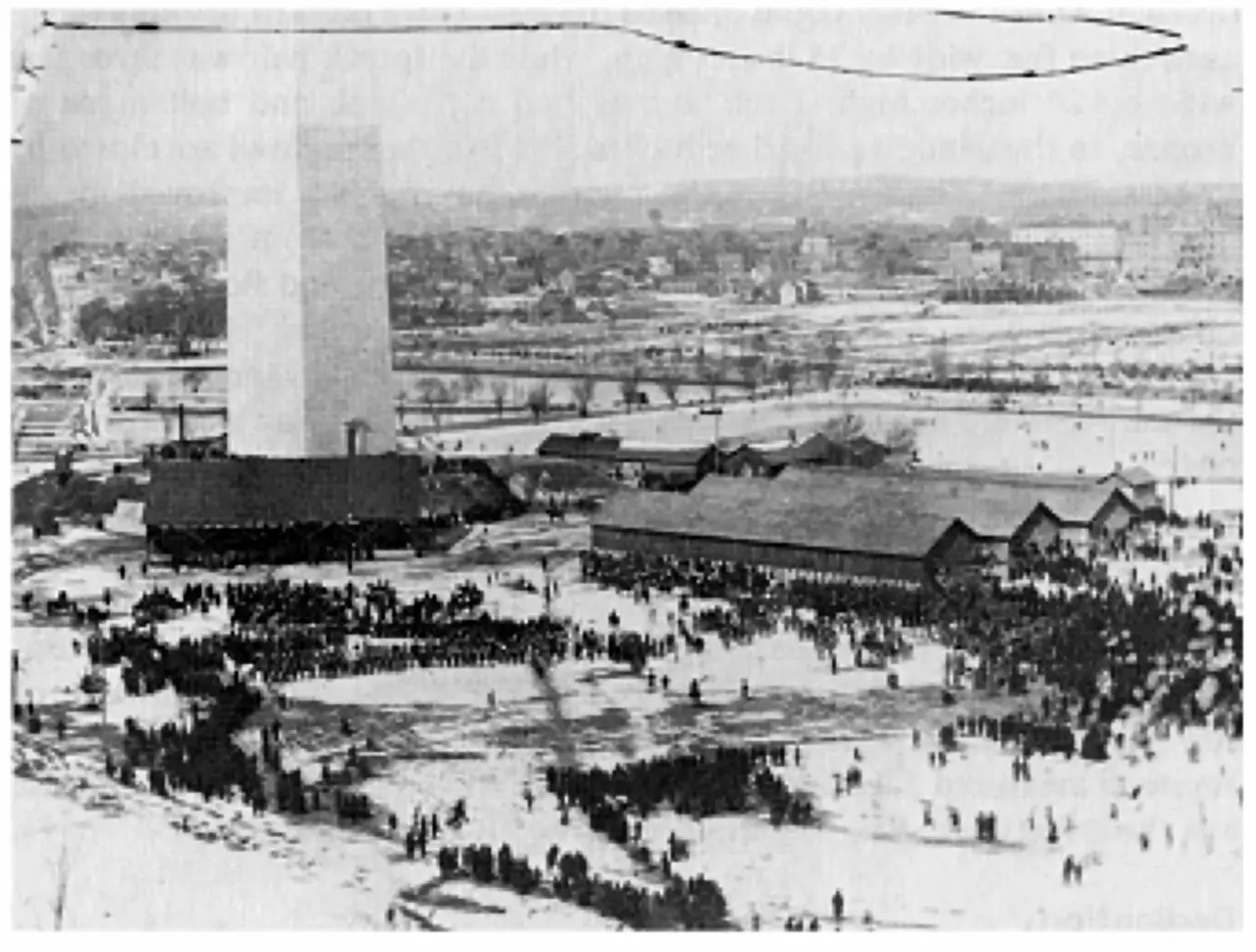
For years it had been a national embarrassment: a half-finished marble stump rising from a cattle pasture, abandoned mid-construction. Mark Twain called it "the ungainly old chimney" and declared it "an eyesore to the people" that "ought to be either pulled down or built up and finished." On February 21, 1885 — the day before George Washington's 153rd birthday — it was finally built up and finished, and the Washington Monument was formally dedicated in a grand ceremony.
The monument had been proposed as early as 1783 and chartered to a private society in 1832, but money was always short. Construction began anyway on July 4, 1848, with architect Robert Mills' elegant design — an Egyptian-style obelisk rising from an elaborate colonnade. By 1854, with funds exhausted and the society hijacked by the anti-Catholic Know-Nothing party (which had stolen a stone donated by Pope Pius IX and thrown it into the Potomac), work stopped at 152 feet. The Civil War intervened, and the stump stood untouched for two decades. Mills' colonnade was scrapped; as he sniffed, an unadorned obelisk would look like "a stalk of asparagus."
After the war, supporters rallied Congress to finish the job, and in 1876 — the nation's centennial — $200,000 was appropriated. The Army Corps of Engineers took over, rebuilt the foundation, and raced through the remaining two-thirds of the shaft. On December 6, 1884, workers set a 100-ounce aluminum capstone — then a rare and precious metal — at the very top. At 555 feet, it was briefly the tallest structure in the world.
The dedication was a spectacle: speeches by President Chester A. Arthur, who was nearing the end of his term, a parade down Pennsylvania Avenue, fireworks, and more than 800 invited guests. You can still see where the work stopped and started again — about 150 feet up, the marble changes shade where builders resumed with stone from a different quarry. The interior was not finished for several more years, and the monument did not open to the public until October 1888.
The Eiffel Tower surpassed it in 1889, but the Washington Monument remains the world's tallest predominantly stone structure and one of America's defining landmarks — a testament, perhaps fittingly, to a national project that took 40 years, a civil war, a stolen papal stone, and one very expensive aluminum pyramid to finish.
Photo: unknown photographer, public domain, via the National Park Service (via Wikimedia Commons).