The Treaty That Drew a Line Across Europe
On August 24, 1949, the North Atlantic Treaty took effect, binding twelve nations to defend one another — the alliance still standing today.
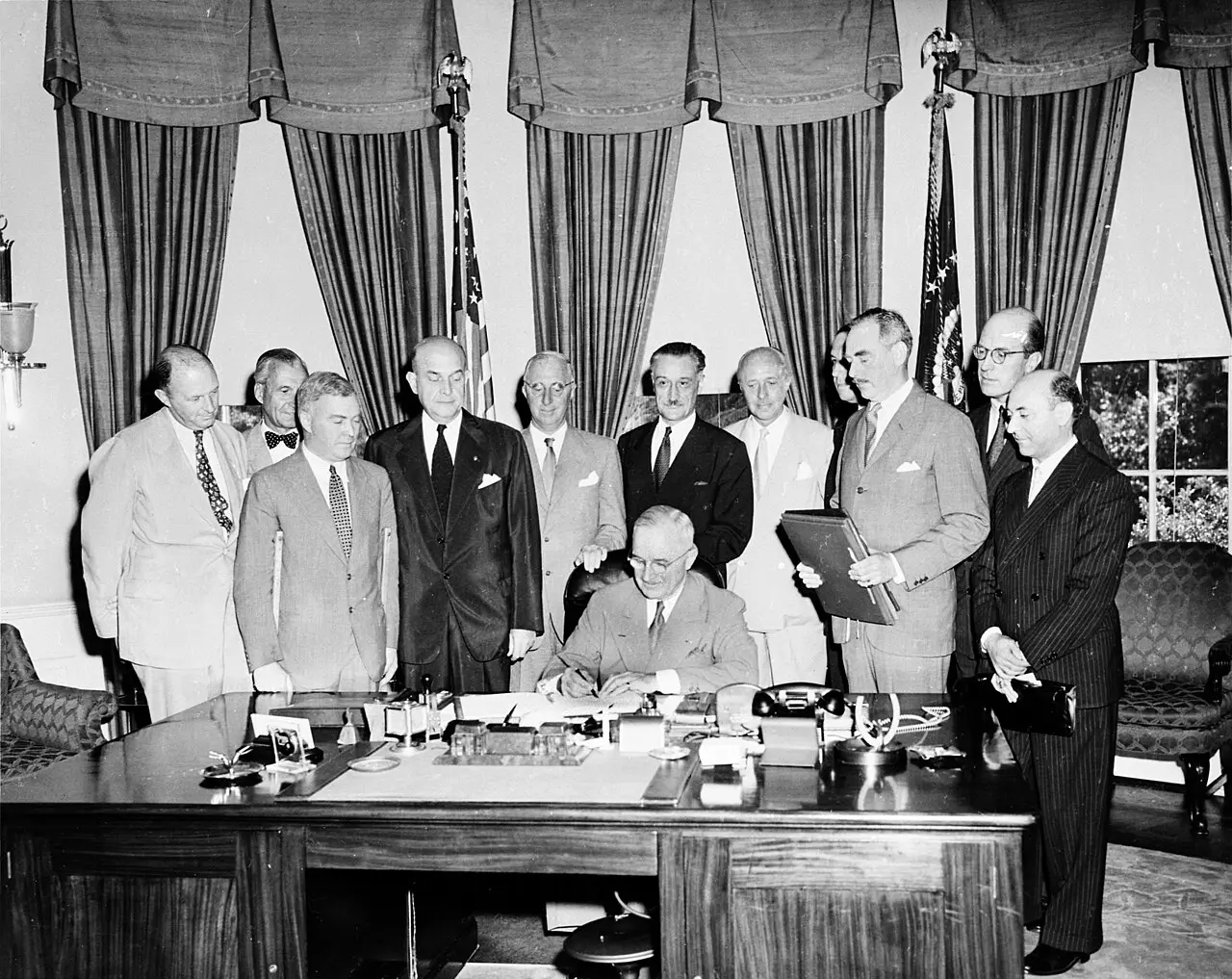
The treaty had been signed in spring. It became real in summer. On August 24, 1949, in the Oval Office, President Harry S. Truman formally accepted the instruments of ratification from America's allies and announced that the North Atlantic Treaty was in effect. Twelve nations were now bound together in the most powerful peacetime military alliance the world had ever seen.
The road there had been short and urgent. The treaty itself was signed on April 4, 1949, in Washington by the foreign ministers of twelve countries — the United States, Canada, Britain, France, Italy, and seven others. The U.S. Senate gave its advice and consent on July 21; President Truman ratified it on July 25; and once every signatory had deposited its ratification, the treaty could take effect. Its heart was a single revolutionary promise: an armed attack against one member would be considered an attack against them all. Behind it lay the rubble of World War II and the shadow of a new threat: the Soviet Union's tightening grip on Eastern Europe, the Berlin blockade, the communist coup in Czechoslovakia. Western Europe was rebuilding with American help through the Marshall Plan; now it would defend itself with American arms.
The timing was no accident. The ink on the treaty was barely dry when the Soviet blockade of West Berlin forced the Allies to supply a city of more than two million people entirely by air for nearly a year. The alliance was born into crisis — and built for exactly that kind of test.
Truman's words that day in the Oval Office set the tone: “By this treaty, we are not only seeking to establish freedom from aggression and from the use of force in the North Atlantic community, but we are also actively striving to promote and preserve peace throughout the world.”
The alliance grew — Greece and Turkey joined in 1952, West Germany in 1955 — and it endured. It outlasted the Cold War, expanded to 32 members, and its mutual-defense pledge has been invoked only once in history, after the September 11 attacks. France stepped out of the military command structure in 1966 and returned in 2009; the treaty itself never wavered.
What began with twelve signatures on April 4 became a living commitment on August 24 — a line drawn across the map of Europe, and a promise that has held for more than 75 years.
Photo: Abbie Rowe, public domain (via Wikimedia Commons).