The Day the Solar System Lost a Planet
On August 24, 2006, astronomers in Prague voted to strip Pluto of its planet status — and the world has been arguing about it ever since.
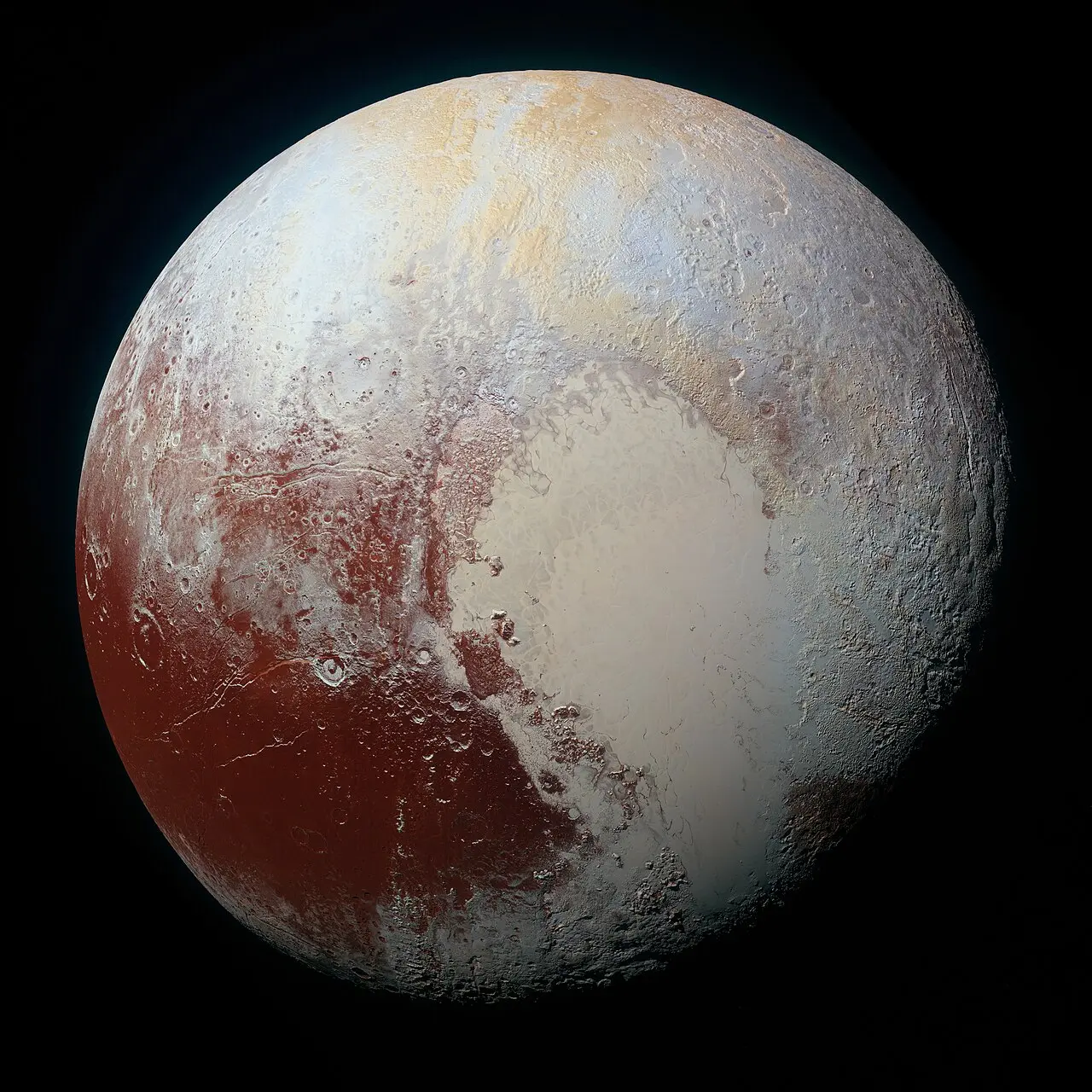
For 76 years, every schoolchild knew the order: Mercury, Venus, Earth, Mars, Jupiter, Saturn, Uranus, Neptune, Pluto. Nine planets, end of list. Then, on August 24, 2006, in a conference hall in Prague, the world's astronomers voted one of them out.
The trouble had been brewing for years. Pluto — discovered in 1930 by 24-year-old Clyde Tombaugh at Lowell Observatory — was always the oddball: tiny, with a tilted, eccentric orbit, cruising through a swarm of icy debris beyond Neptune called the Kuiper Belt. Then, in 2005, Caltech astronomer Mike Brown discovered Eris, a Kuiper Belt world slightly more massive than Pluto. If Pluto was a planet, then Eris had to be one too — and so, eventually, would dozens of others.
So the International Astronomical Union did what it had never done before: it defined the word “planet.” After a week of sometimes heated debate at its General Assembly — where one early proposal would have kept Pluto and added three new planets, Eris, Ceres, and Pluto's moon Charon — 424 astronomers voted on the final day. That was a fraction of the world's roughly 10,000 professional astronomers, and the small turnout became part of the controversy. A planet, they decided, must orbit the Sun, must be round from its own gravity, and must have “cleared the neighborhood” around its orbit. Pluto passed the first two tests and failed the third — it shares its orbital zone with countless Kuiper Belt objects. By a wide margin, Pluto was reclassified as a dwarf planet. The solar system had eight planets for the first time since 1930.
The public reaction stunned the scientists. “Plutoed” — to demote or devalue — became the American Dialect Society's 2006 Word of the Year. State legislatures declared Pluto Days. And many planetary scientists never accepted the verdict at all, arguing that a world with glaciers, mountains, and an atmosphere — as NASA's New Horizons probe revealed when it flew past Pluto in 2015 — deserves the name regardless of what shares its orbit.
Twenty years on, the debate still hasn't settled. But the vote in Prague did something no telescope could: it reminded millions of people that science isn't a list of facts in a textbook — it's an argument, conducted in public, about how to describe the universe. And somewhere out in the dark, Pluto keeps orbiting, utterly unbothered by what we call it.
Photo: NASA / Johns Hopkins University Applied Physics Laboratory / Southwest Research Institute, public domain (via Wikimedia Commons).