The Titanic's Sister Sinks Too
On November 21, 1916, the HMHS Britannic — sister ship of the Titanic and the world's largest hospital ship — struck a mine in the Aegean and sank in just 55 minutes.
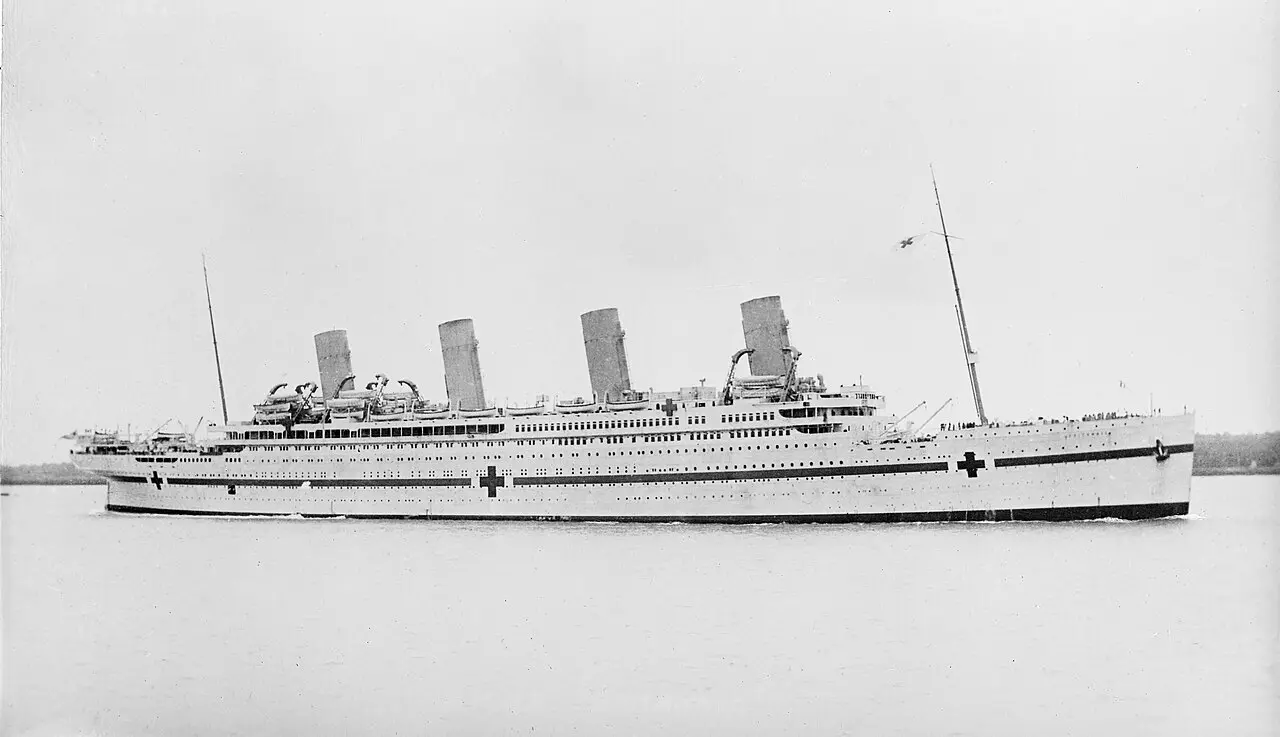
She was supposed to be the safe one. The Britannic was the third and final vessel of White Star Line's Olympic class — younger sister of the Olympic and the Titanic — built at Harland & Wolff in Belfast and launched on February 26, 1914. She was redesigned with the hard lessons of the Titanic disaster: a double hull, more lifeboats, higher watertight bulkheads. She was meant to carry passengers across the Atlantic in greater safety and luxury than either of her sisters.
War had other plans. In November 1915 the Britannic was requisitioned and completed as a hospital ship — painted white, striped green, marked with great red crosses, and fitted with 3,309 beds. Her grand first-class dining rooms became operating theaters. On December 23, 1915, she sailed her maiden voyage from Liverpool to the Greek island of Lemnos, to bring home sick and wounded soldiers — the first of five successful voyages between Britain and the Dardanelles. She would shuttle sick and wounded soldiers between Britain and the Dardanelles, and she would never carry a single paying passenger. At the time she was the largest hospital ship in the world.
On the morning of November 21, 1916, on only her sixth voyage, a tremendous explosion tore open her bow in the Kea Channel near the Greek island of Kea: a German naval mine. The ship that had been built to survive the Titanic's fate sank in 55 minutes.
Of the 1,066 people aboard, 30 died — most of them in two lifeboats that were lowered too soon and drawn into the propellers, which were still turning as the ship drove forward. Portions of the crew had left portholes open for ventilation, which let the sea in faster — a small human detail in a disaster of scale. The remaining 1,036 were pulled from the water and the lifeboats by British warships, a French tug, and a Greek fishing boat.
The Britannic was the largest ship lost in the First World War — and the largest vessel ever built in Ireland. After the war, White Star was compensated for her loss with the German liner Bismarck, which entered service as the Majestic. In 1975, Jacques Cousteau located her wreck in the Aegean, resting upright at a depth of about 120 meters — the largest intact passenger ship on the seabed in the world, lying where she fell that November morning. She was bought by a private owner in 1996, maritime historian Simon Mills, who keeps her as a protected memorial.
Two sisters, two sinkings, four years apart. The third, the Olympic, would sail on for decades — the one ship of the trio to live out a full life.
Photo: Allan C. Green, public domain (via Wikimedia Commons).