The Bridge That Spanned the Impossible
On November 21, 1964, New York opened the Verrazzano-Narrows Bridge, whose 4,260-foot main span made it the longest suspension bridge in the world.
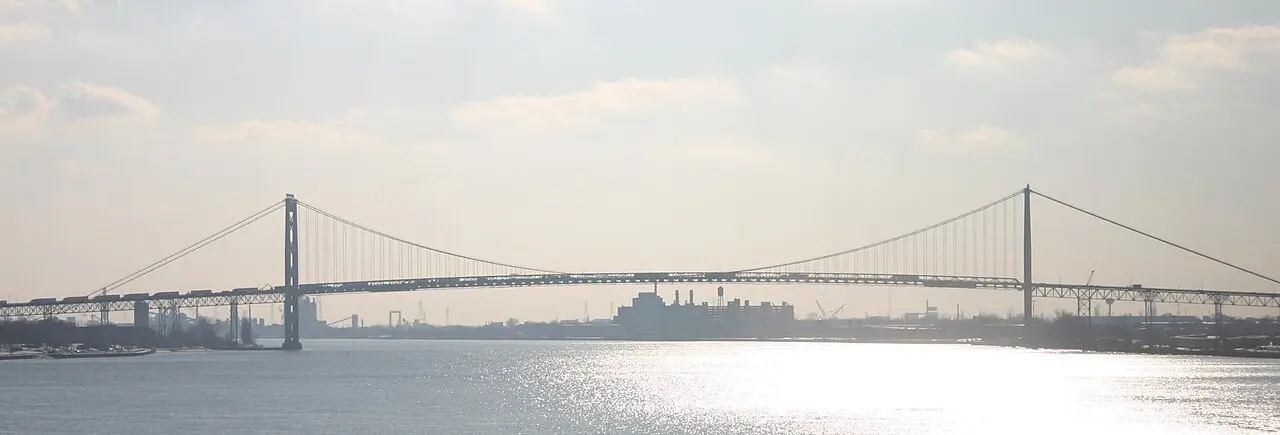
It was Robert Moses's grand finale and Othmar Ammann's last masterpiece. The bridge was the final link in Moses's plan to connect all of New York City by automobile: a double-decked suspension bridge across the Narrows — the mile-wide gateway to New York Harbor — joining Staten Island to Brooklyn. Its designer, the Swiss-American Ammann, had already given the city the George Washington Bridge; at 85, the Narrows span would be his farewell.
On November 21, 1964, the bridge opened to traffic — the upper deck first; the lower level would not open until 1969, bringing the total to thirteen lanes across two decks. Its center span stretched 4,260 feet, the longest suspension span on Earth, a record it held until Britain's Humber Bridge surpassed it in 1981. It remains the longest suspension bridge in the Americas.
The engineering is full of quiet marvels. The two towers rise 693 feet, and their tops stand 1-5/8 inches farther apart than their bases — because over 4,260 feet, even the curvature of the Earth has to be accounted for. Construction began in August 1959 and cost $320 million. The bridge was built so the roadway drops about 12 feet in summer heat compared with winter, as the great cables expand and contract with the seasons.
Not everyone celebrated. Hundreds of families in Bay Ridge, Brooklyn, were displaced to make room for the massive Brooklyn anchorage, and Staten Islanders feared the bridge would end their island's rural quiet. As former resident Tom Goff told the New York Times on opening day: "It was all woods. I picked my first potato on Staten Island."
The bridge was named for Giovanni da Verrazzano, the first European to sail into New York Harbor, in 1524 — though the name as first spelled on the bridge dropped one of the explorer's two z's, a quirk that survived on the signs for more than half a century. The Italian Historical Society of America had suggested the honor, and Governor Nelson Rockefeller publicly backed the name on Verrazano Day in April 1959. For Ammann, it was a crowning achievement: the man who had begun his New York career in 1927 working with architect Cass Gilbert on the George Washington Bridge had now spanned the city's other great waterway — the last major crossing in Moses's plan to link every corner of New York by road.
The lower deck opened on June 28, 1969, completing the double-decked span Moses had envisioned. More than sixty years on, the bridge still carries over 200,000 vehicles a day — more than 80 million in 2023 alone — and remains, as the MTA puts it, the longest suspension bridge in the Americas: the last great work of an engineer who taught New York how to reach across its own waters.
Photo: Roland Arhelger, CC BY-SA 4.0 (via Wikimedia Commons).