The Taped Door That Toppled a President
On June 17, 1972, five burglars were caught inside Washington's Watergate complex — the break-in that ended a presidency.
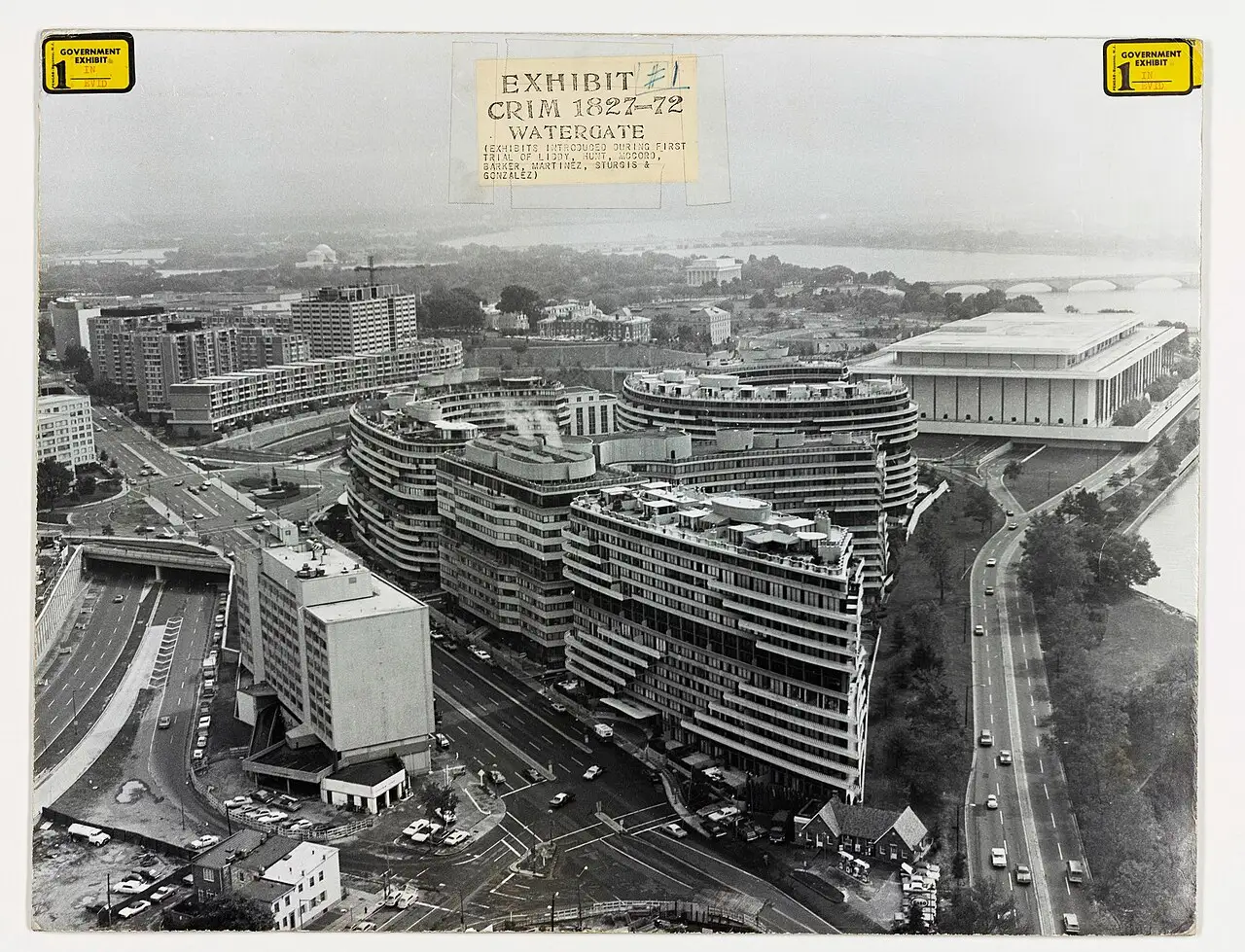
It started with a strip of tape. In the early hours of June 17, 1972, Frank Wills, the security guard on duty at the Watergate office complex in Washington, D.C., was making his rounds when he noticed tape over the latches of several stairwell doors — the kind of trick that keeps a door from locking. He pulled it off. When he came back around 2 a.m., the doors had been re-taped. This time he called the police.
Officers arrived and found five men inside the offices of the Democratic National Committee headquarters. They were wearing surgical gloves and carrying walkie-talkies, cameras, lock-picks, and electronic eavesdropping equipment — plus nearly $2,300 in cash, most of it in $100 bills with serial numbers in sequence. They had come to bug the Democrats' phones and photograph their files. The men — James McCord, Frank Sturgis, Bernard Barker, Virgilio Gonzalez, and Eugenio Martinez — were arrested at about 2:30 a.m. and charged with attempted burglary and wiretapping.
At first it looked like nothing. White House press secretary Ron Ziegler dismissed it as a "third-rate burglary," and President Richard Nixon denied any knowledge. But reporters Bob Woodward and Carl Bernstein of The Washington Post kept digging, and the FBI kept investigating. The threads led somewhere explosive: McCord was the security director for Nixon's own re-election committee, and campaign money was traced to the operation. The break-in had been planned by former intelligence operatives E. Howard Hunt and G. Gordon Liddy as part of a campaign espionage effort.
Nixon won re-election in a landslide that November, but the cover-up kept unraveling. Senate hearings, televised nationally, exposed the White House's obstruction. In the summer of 1973, an aide revealed that Nixon had secretly recorded his own Oval Office conversations — tapes that would eventually prove his involvement. Facing certain impeachment, Richard Nixon resigned the presidency in August 1974, the only American president ever to do so.
Watergate became the textbook case for why no one is above the law. It transformed American journalism, inspired a generation of investigative reporters, and gave the language a new suffix — every political scandal since gets called a "-gate." But its deepest lesson is simpler and older: a democracy survives on accountability, and sometimes accountability begins with one security guard who notices a piece of tape and refuses to look the other way.
Photo: Aerial view of the Watergate complex used as a U.S. government court exhibit in the Watergate trial, public domain (via Wikimedia Commons).