Liberty in 214 Crates: The Day the Statue of Liberty Reached New York
On June 17, 1885, the French ship Isère steamed into New York Harbor carrying the Statue of Liberty in 350 pieces, packed in 214 wooden crates.
In the summer of 1884, a colossus stood complete in a Paris courtyard, towering over the neighborhood rooftops. Within months, that giant had been taken apart, piece by numbered piece, and packed into wooden crates for the most ambitious flat-pack delivery in history.
The statue was a gift from the people of France to the people of the United States — officially titled "Liberty Enlightening the World" — designed by French sculptor Frédéric-Auguste Bartholdi. Its copper skin, hammered by hand over wooden molds, hung on an iron skeleton engineered by Gustave Eiffel, who would later build Paris's famous tower. The project was meant to commemorate the American Revolution and the friendship between the two nations, and France paid for the statue itself. Americans were responsible for the pedestal, and fundraising on both sides dragged on for years: auctions, lotteries, even boxing matches were held to pay the bills. The arm and torch arrived a decade early, displayed at the 1876 Centennial Exposition in Philadelphia and then at Madison Square Park to drum up donations.
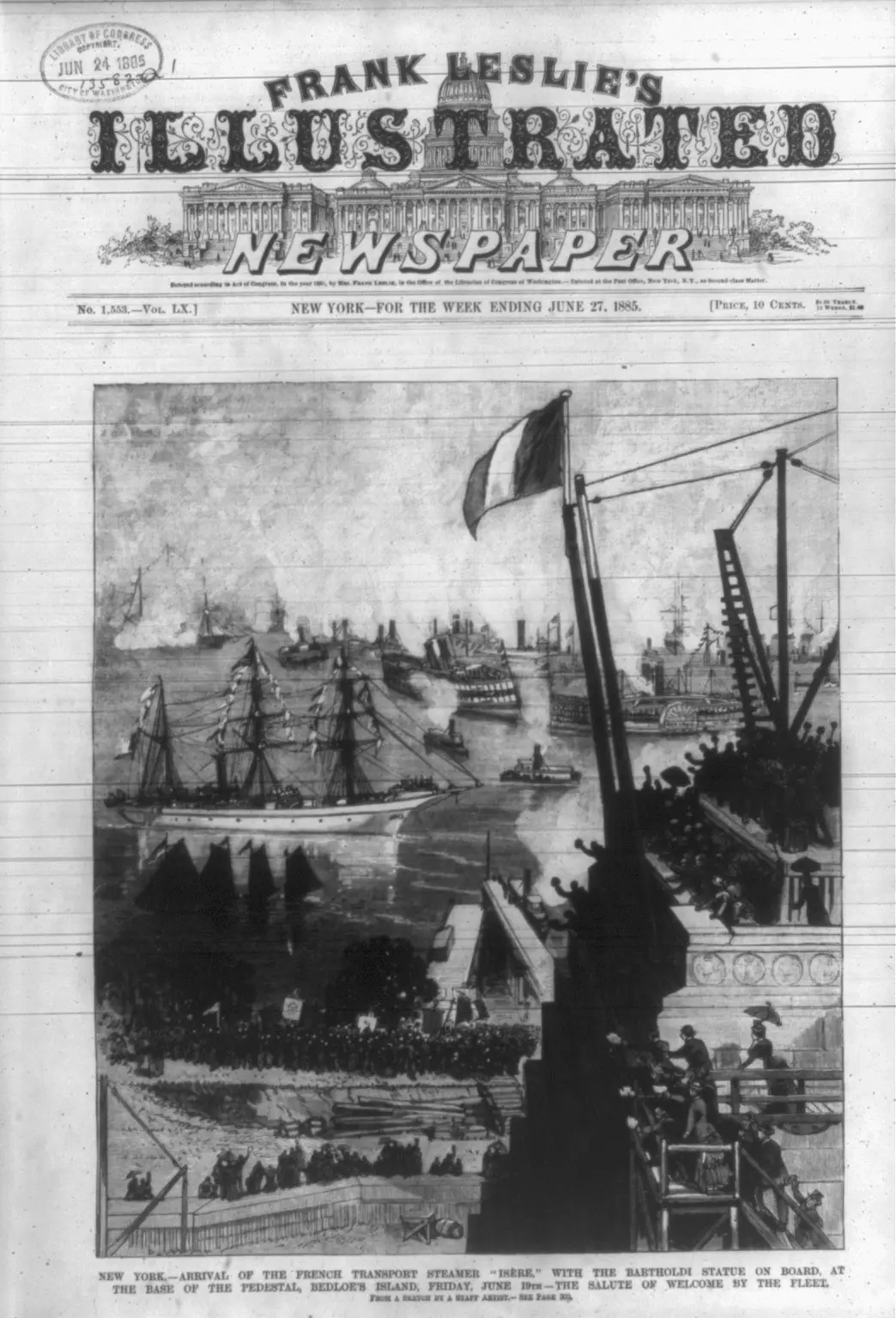
Finally, on June 17, 1885, the French naval vessel Isère steamed into New York Harbor carrying the rest of her: some 350 pieces of copper and iron in 214 crates. Workers had numbered every fragment so the whole thing could be reassembled like a set of instructions. The ship anchored off Bedloe's Island, where the pedestal was still under construction, and the city gave the arriving vessel a salute of welcome.
Reassembly began in the summer of 1886, and on October 28, 1886, President Grover Cleveland dedicated the finished monument. At more than 305 feet from the foundation of its pedestal to the tip of its torch, it was the tallest structure in New York City — and at 450,000 pounds, it was not going anywhere.
She arrived copper-colored, the bright sheen of fresh pennies. Over the decades, oxidation — a natural color-change process called patination — turned her the greenish-blue we know today. In 1892, Ellis Island opened next door as America's chief immigration station, and for the next 62 years Lady Liberty watched over more than twelve million immigrants sailing into the harbor. In 1903, a plaque bearing Emma Lazarus's sonnet "The New Colossus" — written years earlier for the pedestal fundraiser — was placed inside the pedestal. Its words, "Give me your tired, your poor, your huddled masses yearning to breathe free," became the statue's unofficial voice.
Why it matters: before she was a postcard, the Statue of Liberty was a shipping problem — the largest, most delicate delivery of the nineteenth century. That she arrived at all, in pieces, and rose over the harbor on schedule is a story about patience, generosity, and the kind of friendship between nations that literally comes with assembly instructions.
Photo: an 1885 engraving of the French transport steamer Isère arriving at Bedloe's Island with the statue aboard (note: the print depicts the salute of welcome; portrait orientation); public domain, Library of Congress, via Wikimedia Commons.