The Spiral Museum on Fifth Avenue
On October 21, 1959, Frank Lloyd Wright's spiral museum opened on Fifth Avenue — six months after the architect's death.
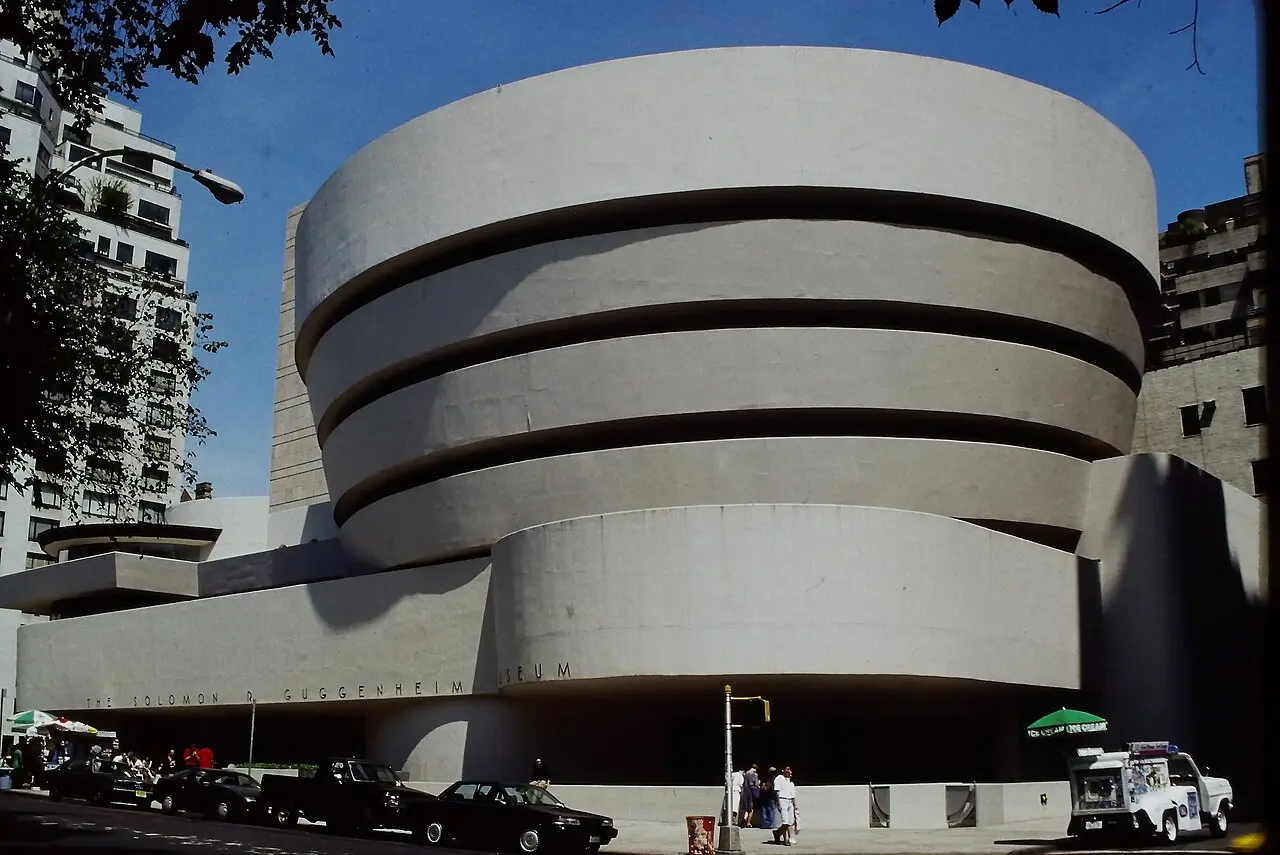
On October 21, 1959, the doors opened on the strangest building Fifth Avenue had ever seen. Crowds filed into a great white spiral of concrete — a six-story ramp curling upward beneath a glass dome, like the inside of a nautilus shell. The Solomon R. Guggenheim Museum was open, and architecture would never be quite the same.
The building had been sixteen years in the making. In 1943, mining magnate Solomon Guggenheim and the artist Hilla Rebay, who had guided his passion for abstract art, wrote to Frank Lloyd Wright — then 76 and America's most famous architect — asking him to design a museum for the collection. Rebay told Wright she wanted "a temple of spirit, a monument." Wright, who felt no museum had ever been properly designed, accepted with delight.
What followed was a saga: more than 700 sketches and six full sets of working drawings; delays from wartime shortages and rising costs that doubled the budget; arguments over everything from the lighting to the sloping walls. Wright never saw it finished — he died in April 1959, six months before the opening.
The result was radical. Visitors were meant to ride the elevator to the top and stroll down the quarter-mile ramp, viewing art along one continuous spiral. Some of the artists whose work would hang on the tilted walls protested — paintings, they said, belong on flat walls. But the public was enchanted, and critics came around. The critic Paul Goldberger later wrote that in making such an expressive museum acceptable, "almost every museum of our time is a child of the Guggenheim."
The building's fame has only grown: it became a New York City landmark in 1990, and in 2019 it was inscribed as a UNESCO World Heritage Site as part of Wright's collected works. The nautilus on Fifth Avenue still stops traffic.
Wright called his design organic architecture — the building growing from its purpose like a living thing. The ramp was the gallery; there were no separate rooms, just one continuous unfolding space beneath the great skylight dome. A later annex, added in the early 1990s, gave the museum more room without touching Wright's spiral.
Why it matters: the Guggenheim proved a museum could be a work of art itself — that the container could be as bold as the contents. Every swooping, improbable museum built since owes it a debt.
Photo note: the Guggenheim's spiral facade on Fifth Avenue. Photograph: Bmzuckerman, CC BY 4.0, via Wikimedia Commons.