Magellan Finds the Strait at the End of the World
On October 21, 1520, Ferdinand Magellan's fleet entered the strait at the tip of South America, opening the first known sea passage to the Pacific.
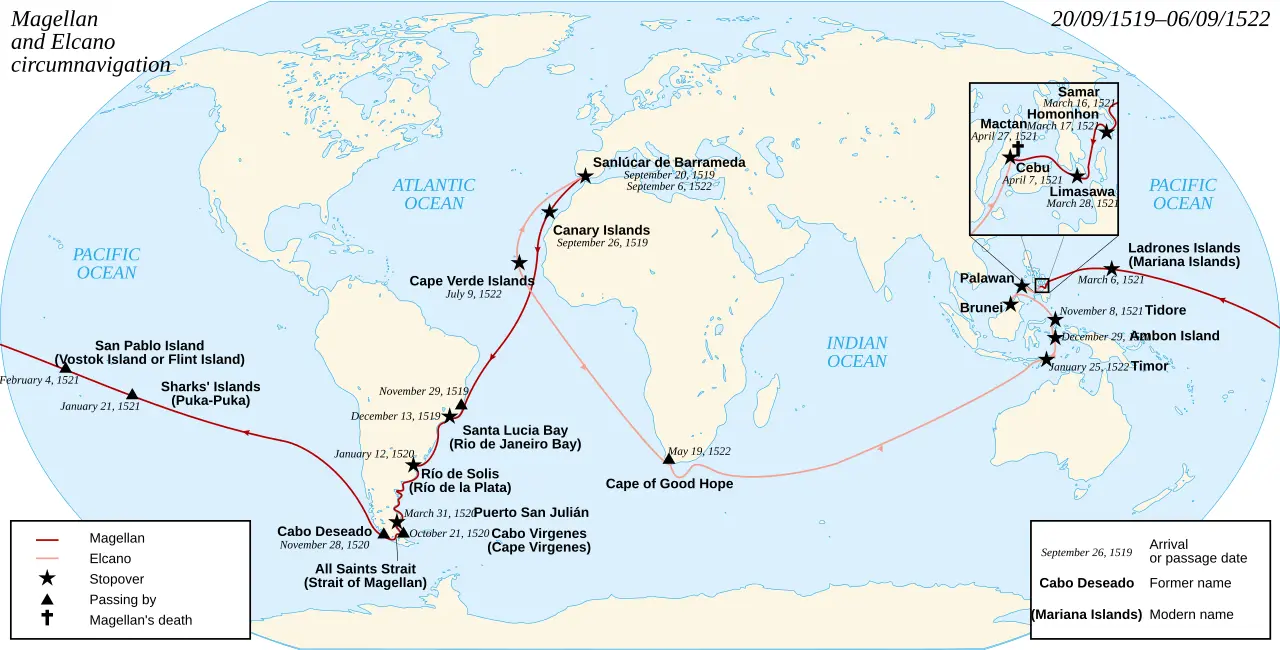
On October 21, 1520, after more than a year at sea, Ferdinand Magellan's battered fleet nosed into a narrow, twisting channel at the bottom of the world. For weeks his captains had probed dead-end bays along the Patagonian coast. This time the water ran deep and kept going. Magellan had found it: the strait through South America to the Pacific — the passage he named the Strait of All Saints.
The expedition had sailed from Spain in 1519: five ships and some 270 men, seeking a westward route to the Spice Islands. It had been a brutal voyage — a mutiny at Port St. Julian that winter, one ship wrecked on the rocks, morale in ruins. Now, with three ships, the fleet committed itself to the strait, feeling its way through fog and crosscurrents for 38 days.
Not everyone stayed. The San Antonio, the largest ship, deserted in the night and sailed back to Spain. The remaining three — Trinidad, Concepción, and Victoria — pressed on, and on November 28 they emerged into open ocean. Magellan, weeping with relief by one account, named it the Pacific — the peaceful sea — for its calm after the strait's storms.
The crossing that followed was a nightmare of hunger and scurvy, lasting more than three months. The fleet reached the Philippines in March 1521, where Magellan — who had survived mutiny, storms, and starvation — was killed on April 27 in a skirmish on the island of Mactan. He never saw home again. But his second-in-command, Juan Sebastián Elcano, carried on: the Victoria sailed west across the Indian Ocean and reached Spain in September 1522, completing the first circumnavigation of the Earth.
The strait itself was a maze: some 350 miles of winding channels, glaciers, and sudden gales splitting the southern tip of the continent. For 38 days the little fleet crept through it, sending boats ahead to sound the depths, never certain the passage would not close into another dead-end bay.
Why it matters: Magellan's strait proved the Americas were a separate continent with an ocean beyond — and revealed the Pacific's true, staggering size. The voyage redrew every map in Europe and proved, once and for all, that the world could be sailed around. The strait still bears his name.
Photo note: the route of the first circumnavigation, with the fleet's entry into the strait marked October 21, 1520. Map: Sémhur, CC BY-SA 3.0, via Wikimedia Commons.