The Night the Light Bulb Stayed Lit
On October 21, 1879, a carbonized cotton thread filament burned for 13½ hours in Thomas Edison's Menlo Park laboratory, proving the practical light bulb.
On the evening of October 21, 1879, in a laboratory in Menlo Park, New Jersey, a thin loop of carbonized cotton thread inside a glass bulb began to glow — and kept glowing. Hour after hour, through the night, the little filament burned: thirteen and a half hours in all. Thomas Edison and his team had done it. The practical electric light bulb was real.
Edison was 32, already famous as the inventor of the phonograph and known as the "Wizard of Menlo Park." His laboratory was something new in itself: the first industrial research lab, a team of machinists, chemists, and experimenters working systematically toward inventions. Electric light was the great prize — arc lamps existed, but they were blinding, flickering, and dangerous; homes still burned gas. What the world needed was a bulb that glowed softly, lasted, and could be made by the thousand.
The team had tested hundreds of materials. The breakthrough was a filament of carbonized cotton thread, sealed in a glass bulb from which nearly all the air had been pumped — the vacuum kept the filament from burning up. On October 21 it burned for 13½ hours, far longer than anything before. Edison filed his patent on November 4, and on New Year's Eve he put on a public demonstration at Menlo Park, drawing crowds by train to see streets and buildings lit by electricity.
One caution belongs to the story: Edison did not invent the light bulb single-handedly. In England, Joseph Swan was developing his own incandescent lamp at the same time, and others had made glowing filaments before him. What Edison achieved — and what the October 21 test proved — was the first practical, long-lasting bulb as part of a complete system: generators, wiring, and meters that could light a city. Genius, in this case, was making it work at scale.
The laboratory itself was part of the invention. Edison's Menlo Park complex — machine shop, chemistry lab, library, and a team working in shifts — was among the first places dedicated to systematic invention, a model that modern research labs descend from. The bulb was its first great product.
Why it matters: the Menlo Park test lit the fuse of electrification. Within a few years Edison's Pearl Street station was powering lower Manhattan; within decades, electric light had remade cities, factories, and daily life. And the laboratory model Edison pioneered — organized teams attacking big problems — became the engine of modern invention.
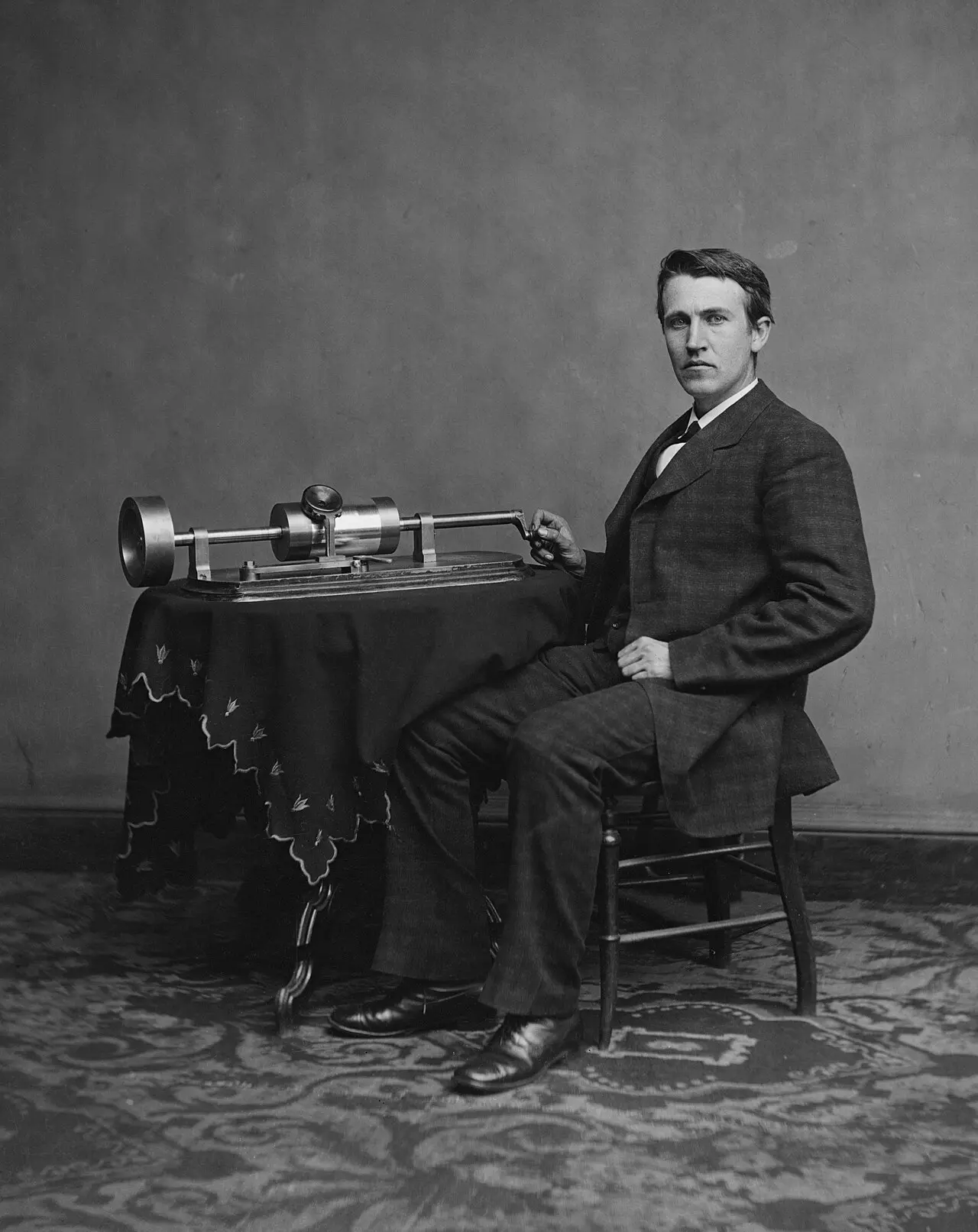
Photo note: Edison with his phonograph, photographed at Menlo Park by Levin C. Handy around 1878, a year before the famous bulb test. Photograph: public domain via the Library of Congress.