The Song That Toppled a Dictatorship
On April 25, 1974, two coded songs on Portuguese radio launched the Carnation Revolution, ending nearly 50 years of dictatorship in under a day.
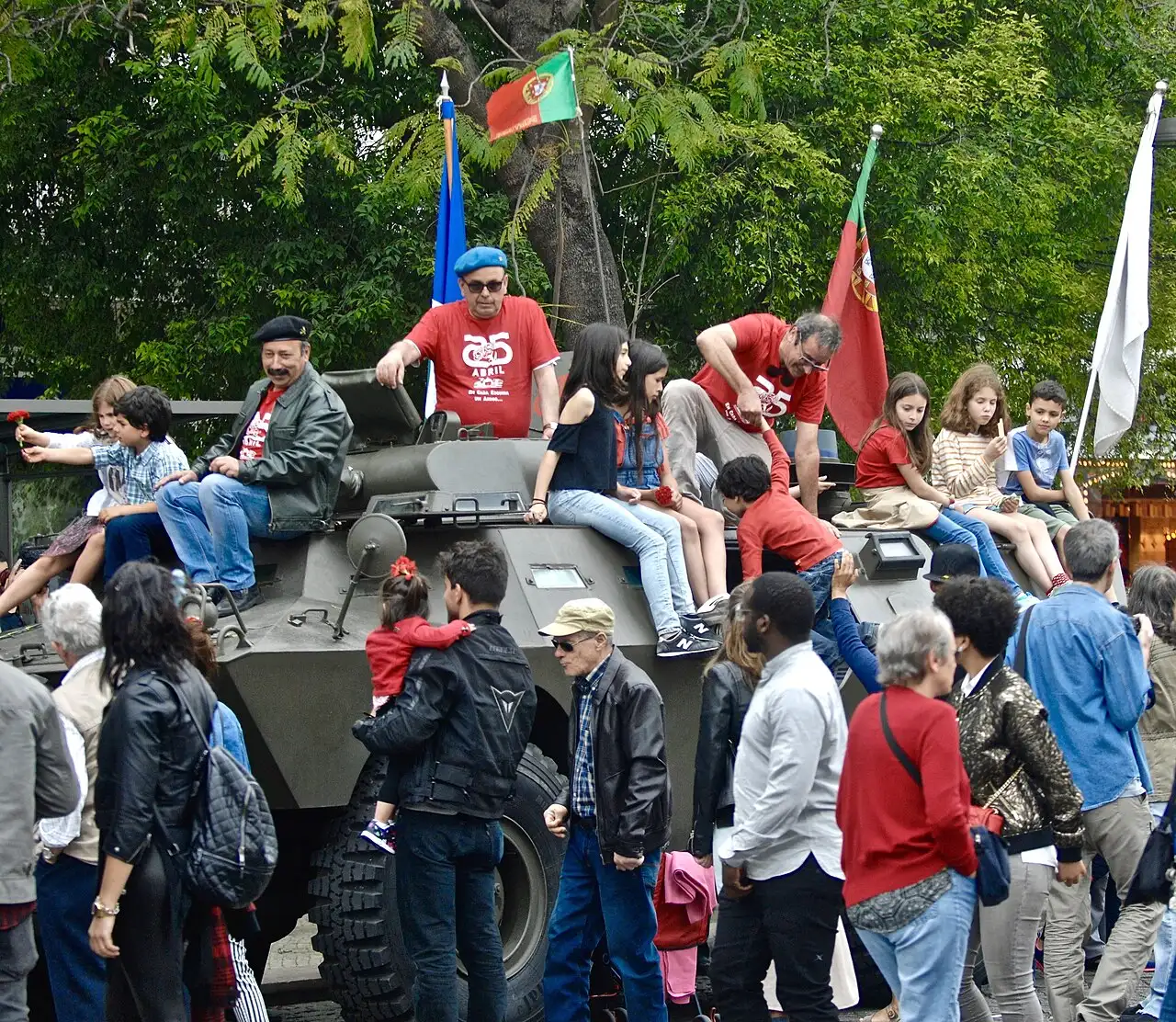
The signal to overthrow a dictatorship was a love song and a banned folk ballad, played back to back on the radio.
Portugal in 1974 was ruled by the Estado Novo, Western Europe's longest-running authoritarian regime. Built by António Salazar, who became prime minister in 1932, it had banned free unions and opposition parties, kept a feared secret police, and was fighting unwinnable colonial wars in Angola, Mozambique, and Guinea-Bissau. When Salazar was incapacitated in 1968, his successor Marcello Caetano changed almost nothing — and the wars ground on, bleeding a generation of young officers.
Those junior officers, later called the April Captains, had had enough. Organized as the Armed Forces Movement (Movimento das Forças Armadas, or MFA), they hatched a plan — codenamed Operation Historic Turn and drawn up by Captain Otelo Saraiva de Carvalho — to seize the country in a single night. But hundreds of soldiers had to move at the same moment, so the conspirators needed a signal everyone could hear. They chose music.
The first signal came at 10:55 on the night of April 24, when a Lisbon station played "E Depois do Adeus," Paulo de Carvalho's gentle ballad and Portugal's entry in that year's Eurovision Song Contest. It told the rebel captains to get ready. The second came just after midnight on April 25, when Rádio Renascença broadcast "Grândola, Vila Morena," a folk song by José "Zeca" Afonso whose lyrics celebrate fraternity and equality. That was the order to move.
Troops rolled into Lisbon and Porto and seized ministries, radio and television stations, and the airport. Ministers were arrested. Despite radio appeals begging civilians to stay home, thousands poured into the streets and mobbed the rebel convoys. It was the season for carnations, and Lisbon's flower market was full of them. A waitress named Celeste Caeiro began handing red carnations to the soldiers, who tucked them into the barrels of their rifles — an image broadcast around the world that gave the revolution its name.
By the evening of April 25, it was over. Caetano, barricaded in the National Republican Guard barracks, surrendered and went into exile. In less than 24 hours, nearly half a century of authoritarian rule had ended. The day's only bloodshed came when the regime's secret police fired on a crowd outside their headquarters, killing four people — a somber footnote to what was otherwise a near-bloodless revolution.
What followed was messy — decolonization, political turmoil, and years of argument before Portugal settled into democracy with free elections in 1975 and a new constitution in 1976. But the Carnation Revolution endures as proof that a dictatorship can fall to flowers instead of bullets. Every April 25, Portugal celebrates Freedom Day in its memory.
Photo: Pedro Ribeiro Simões, CC BY 2.0 (via Wikimedia Commons).