
Released Into the Dark: Hubble's First Day in Orbit
On April 25, 1990, the crew of Space Shuttle Discovery released the Hubble Space Telescope into orbit, opening humanity's clearest window on the cosmos.
For one shining day, it was the greatest telescope ever built. Then it nearly became a $1.5 billion joke.
The dream was old. In 1946, astrophysicist Lyman Spitzer Jr. argued that a telescope above Earth's atmosphere could see the universe without the blur of air — and could catch wavelengths blocked from the ground. In 1962 a National Academy of Sciences study group urged NASA to build one. Congress approved funding in 1977, the telescope was named for astronomer Edwin Hubble in 1983, and the Challenger disaster pushed its launch from 1986 to 1990.
On April 24, 1990, Space Shuttle Discovery roared off the pad on mission STS-31, climbing to a record shuttle altitude of about 600 kilometers. Aboard were Commander Loren J. Shriver, Pilot Charles F. Bolden Jr., and Mission Specialists Steven A. Hawley, Bruce McCandless II, and Kathryn D. Sullivan.
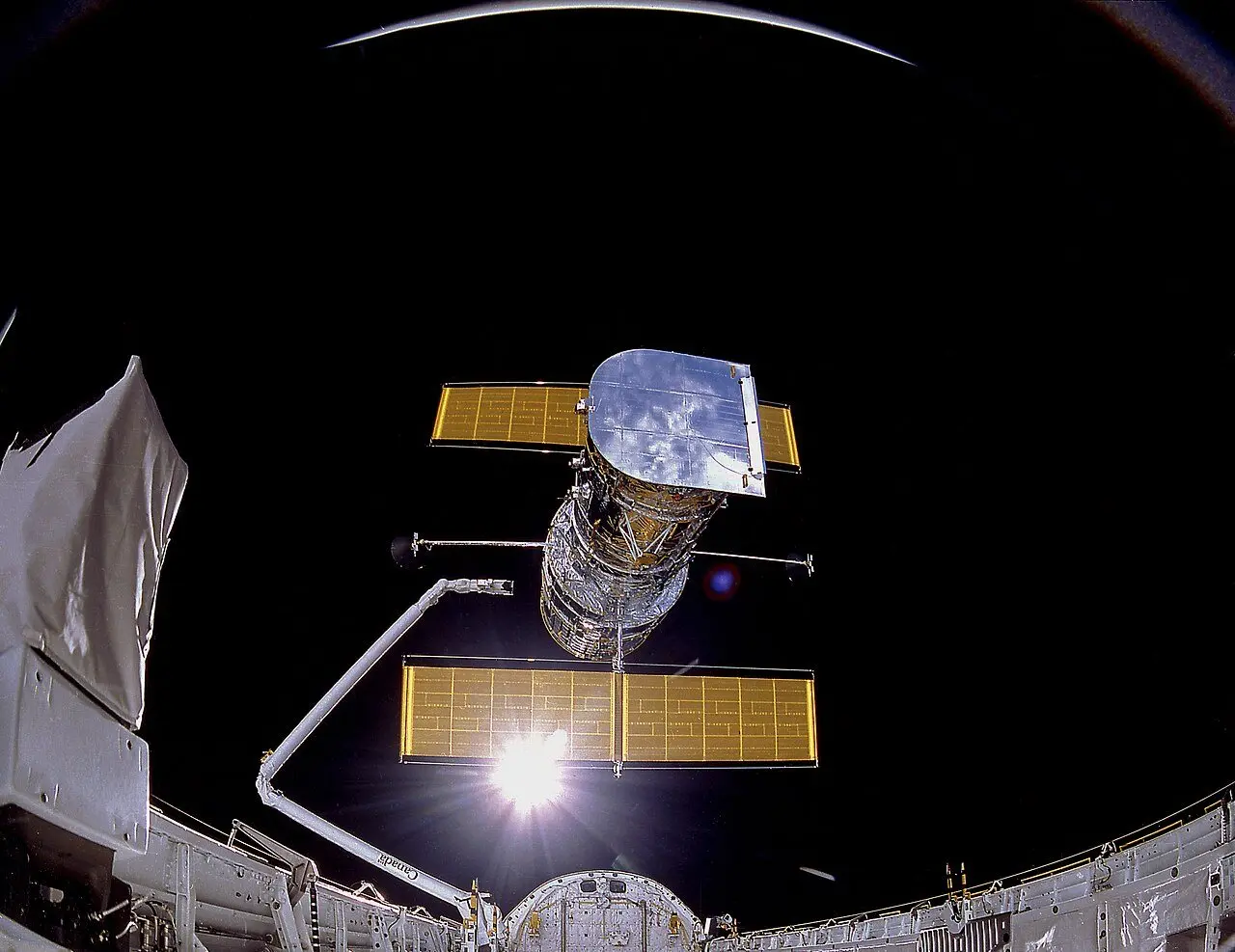
Then came April 25. Hawley, at the controls of Discovery's robotic arm, lifted the 43-foot telescope out of the payload bay. Its glittering solar arrays and antennae unfolded, and the school-bus-sized observatory drifted free above Earth — deployed 353 miles up, higher than any shuttle had ever flown.
The world watched its first images arrive on June 25. And gasped: every image was blurred. Hubble's great mirror, ground to exquisite precision, suffered from spherical aberration — its shape was off by about one-fiftieth the thickness of a sheet of paper, smearing starlight into fuzzy halos. The newspapers were merciless.
But Hubble had a design feature no mountaintop telescope could match: it could be serviced in orbit. In December 1993, astronauts aboard the shuttle Endeavour flew Servicing Mission 1 and installed the Corrective Optics Space Telescope Axial Replacement — COSTAR, a set of five small mirror pairs that acted as eyeglasses for the telescope — while replacing the original Wide Field/Planetary Camera with a new version that had the correction built into its optics. The before-and-after images of the galaxy M100 proved the fix had worked spectacularly.
Freed to see clearly, Hubble went to work. Circling Earth every 96 minutes, it helped determine the rate of the universe's expansion, and its famous 1995 Deep Field image — a portrait of a tiny, seemingly empty patch of sky — revealed thousands of previously unseen galaxies stretching back billions of years. It watched a comet smash into Jupiter, gave astronomers their first direct looks at distant worlds, and produced the images that rewrote textbooks — and, arguably, the public's sense of wonder.
Still working more than three decades after its release, Hubble remains the observatory that taught us to see. It all started on April 25, 1990, when a human hand let go of it in the dark.
Photo: NASA, public domain (via Wikimedia Commons).