The Sickly Boy Who Became the Strenuous Life
On October 27, 1858, Theodore Roosevelt was born a sickly, asthmatic boy in Manhattan — and grew up to remake the American presidency.
The man who would become the most energetic president in American history began life as a child who could barely breathe.
Theodore Roosevelt Jr. was born on October 27, 1858, in a brownstone at 28 East 20th Street in Manhattan, the second of four children of businessman Theodore Roosevelt Sr. and Martha "Mittie" Bulloch. His family called him "Teedie." And Teedie was, by every account, a wreck of a child: scrawny, nearsighted, plagued by colds and fevers, and — worst of all — tormented by terrifying asthma attacks that struck without warning and left him gasping through endless nights. "I was a sickly, delicate boy, suffered much from chronic asthma, and frequently had to be taken away on trips to find a place where I could breathe," he recalled in his autobiography. His parents feared he might not survive childhood.
What Teedie lacked in lungs, he made up for in ferocity of curiosity. At seven, he saw a dead seal at a market, talked his way into keeping its head, and — with his cousins — founded the "Roosevelt Museum of Natural History" in his bedroom, stuffing it with specimens he caught or collected himself. At nine he was writing papers with titles like "The Natural History of Insects." He read voraciously, devoured Darwin by his early teens, and taught himself taxidermy.
And then, as a teenager, he made the decision that defined his life. After being roughed up by older boys on a trip — and discovering on a family hike in the Alps that hard exercise eased his asthma — he resolved, in his words, to "make his body." He took up boxing (hiring a coach specifically to learn to defend himself), gymnastics, weightlifting, wrestling, riding, and swimming. The sickly boy rebuilt himself into a physical dynamo, and the creed he forged in the process — the gospel of the "strenuous life" — never left him.
The rest is the most crowded biography in American public life. New York state assemblyman at 23. Dakota cattle rancher. Assistant Secretary of the Navy. Colonel of the Rough Riders, charging up Kettle Hill in Cuba in the Spanish-American War. Governor of New York. And then, in 1901, at 42 — the youngest president in American history — the 26th president of the United States.
As president he was a human whirlwind: trust-buster, Square Deal reformer, builder of the Panama Canal, mediator of the peace that ended the Russo-Japanese War (for which he won the 1906 Nobel Peace Prize), and — the cause closest to his naturalist's heart — the great conservationist who protected some 230 million acres of public land, creating national parks, forests, and wildlife refuges. The teddy bear was named for him, after a 1902 hunting trip on which he famously refused to shoot a captured bear.
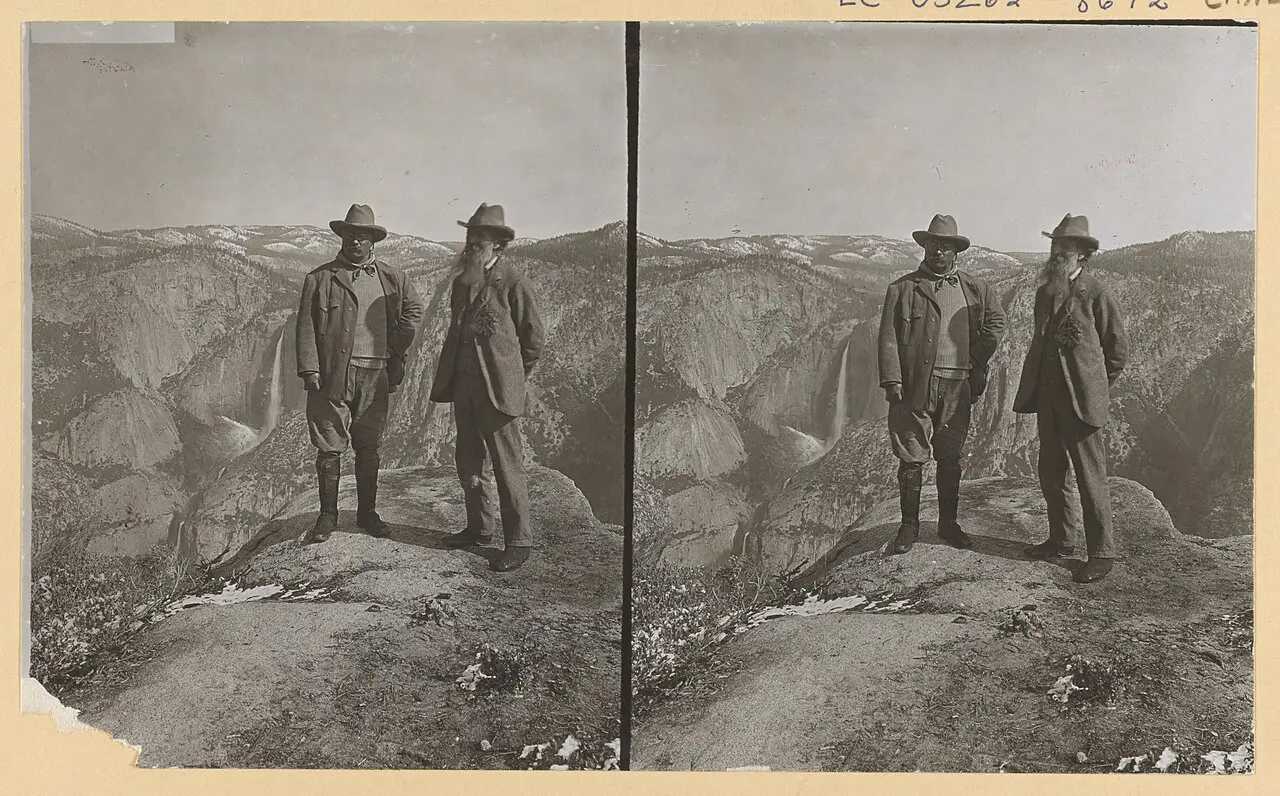
The photograph with this story shows Roosevelt in 1903 at Yosemite with the naturalist John Muir — the trip on which the two men camped under the stars and talked conservation deep into the night, a journey that helped inspire the expansion of Yosemite and the national park idea itself. It is a fitting image for a man born gasping for air in a Manhattan brownstone, who grew up to give the whole country room to breathe.
Image: Theodore Roosevelt (left) with naturalist John Muir on Glacier Point overlooking Yosemite Valley, California, 1903 — a stereoscopic photograph by Underwood & Underwood, public domain (via Wikimedia Commons).