The Seagull's Flight: How Valentina Tereshkova Became the First Woman in Space
On June 16, 1963, a 26-year-old textile worker and amateur parachutist launched from Baikonur and became the first woman in space.
Two years after Yuri Gagarin became the first human in space, the Soviet Union decided the next "space first" should be a woman. The candidates had to be skydivers — because every Vostok capsule's cosmonaut had to eject and parachute to Earth at the end of the flight. One of the finalists was a 26-year-old factory worker from Yaroslavl who had spent her spare time jumping out of airplanes for fun.
Valentina Tereshkova was born in 1937, the daughter of a tractor driver who died in the Winter War and a textile-plant worker. She left school at sixteen to work the assembly line beside her mother, continuing her studies by correspondence. At eighteen she joined a local aviation club and fell in love with parachuting, racking up jump after jump. In 1962 the Soviet space program recruited her as one of five women trainees, and she spent eighteen months preparing for a mission no woman had ever attempted.
On the morning of June 16, 1963, Tereshkova and her backup were dressed in their spacesuits and driven to the pad at Baikonur. Vostok 5, carrying cosmonaut Valery Bykovsky, had launched two days earlier and was still in orbit — the plan was a joint flight, with the two capsules passing near each other. After a two-hour countdown, Vostok 6 lifted off, and Valentina Tereshkova became the first woman in space.
Flying under the call sign Chaika — Russian for "Seagull" — she radioed down to Earth in her first orbit, describing the horizon as blue with a dark strip and marveling at the beauty of the planet below. Her capsule and Vostok 5 came within about five kilometers of each other, close enough for the two cosmonauts to exchange words by radio. Cameras inside the spacecraft broadcast live television images of her to Soviet viewers. She kept a flight log and photographed the horizon, and those photographs were later used by scientists to study layers of aerosols in the atmosphere.
She orbited the Earth 48 times over just under three days — more flight time in a single mission than all American astronauts combined had accumulated to that point. On June 19 she ejected from her capsule, as planned, and parachuted safely to the steppe. She remains the only woman ever to have flown a solo mission in space, and at twenty-six she is still the youngest woman to have reached orbit.
The world celebrated her. She was named a Hero of the Soviet Union, toured the globe, and later became a cosmonaut instructor and engineer, rising to the rank of major general. An asteroid — 1671 Chaika — carries her call sign. The next woman in space, Soviet cosmonaut Svetlana Savitskaya, would not fly until 1982, and the first American woman, Sally Ride, followed in 1983, almost exactly twenty years after Tereshkova's flight.
Why it matters: Tereshkova's flight proved that space was not men's territory alone. Long before women were commanding space stations, a factory worker who jumped out of planes for fun rode a rocket into history and showed a generation of girls that the sky — literally — was not the limit.
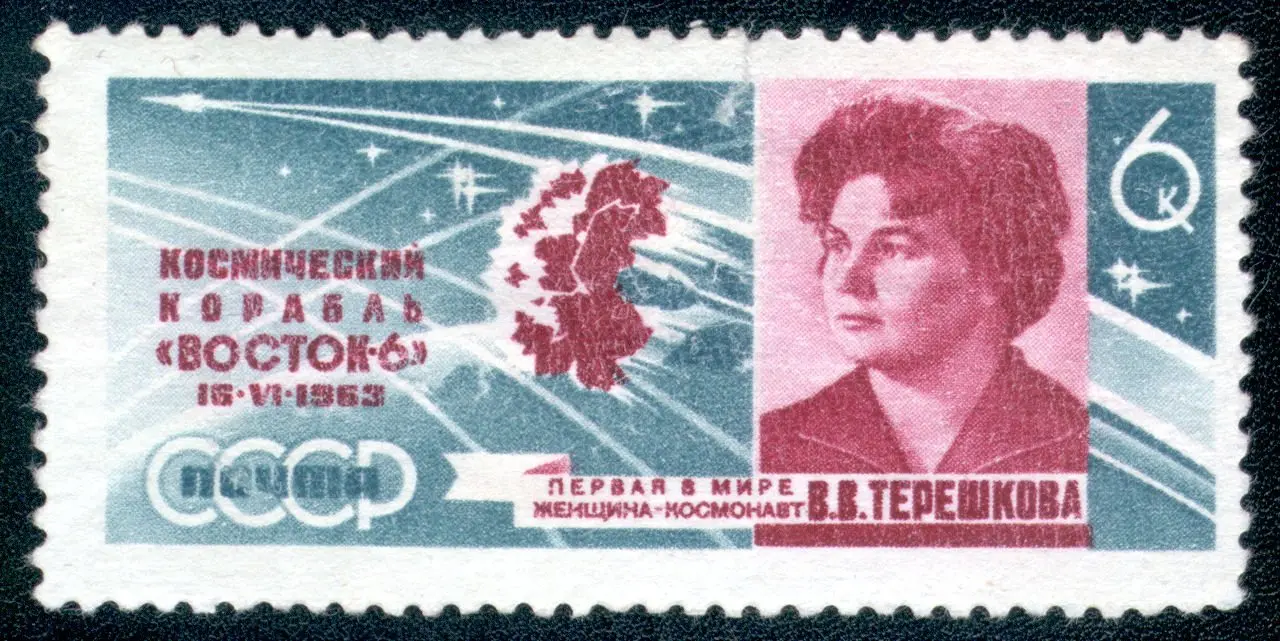
Photo: a 1963 Soviet postage stamp commemorating Valentina Tereshkova and the Vostok 6 mission, issued by the Post of the Soviet Union (artist I. L. Levin); public domain via Wikimedia Commons.