The Quiet Professor Who Built Middle-earth Said Farewell
J.R.R. Tolkien died on September 2, 1973, the Oxford professor who invented Elvish languages and, to give them somewhere to be spoken, the world of Middle-earth.
On September 2, 1973, the man who invented an entire world died quietly in Bournemouth, England, at the age of 81.
His name was John Ronald Reuel Tolkien. Most of the world knew him as the author of The Hobbit and The Lord of the Rings. His colleagues at Oxford knew him as a professor of Anglo-Saxon, a scholar of Beowulf and ancient languages. But Tolkien himself would probably have said his real life's work was something stranger: he built languages first, and then invented a world for them to be spoken in.
Tolkien was born in 1892 in Bloemfontein, South Africa, and raised near Birmingham after his father's death. He served in the trenches of the First World War, survived the Somme, and then settled into academic life at Oxford — first at Pembroke College, then at Merton. The Hobbit, published in 1937, began as stories he told his own children. The Lord of the Rings, published in 1954 and 1955, was its vast, dark sequel — the story of a small hobbit carrying a terrible ring across a doomed and beautiful world called Middle-earth.
He did not work alone. Tolkien belonged to the Inklings, an informal circle of Oxford writers that included his close friend C. S. Lewis. They read their manuscripts aloud to each other in pubs, and Lewis's encouragement helped push The Lord of the Rings into print.
The world he built was unprecedented. Elvish was not a scattering of invented words but a complete language, with grammar and history — and around it grew thousands of years of legend: the creation of the world, the wars of elves and dark lords, the rise and fall of kingdoms. No author had ever built anything on that scale.
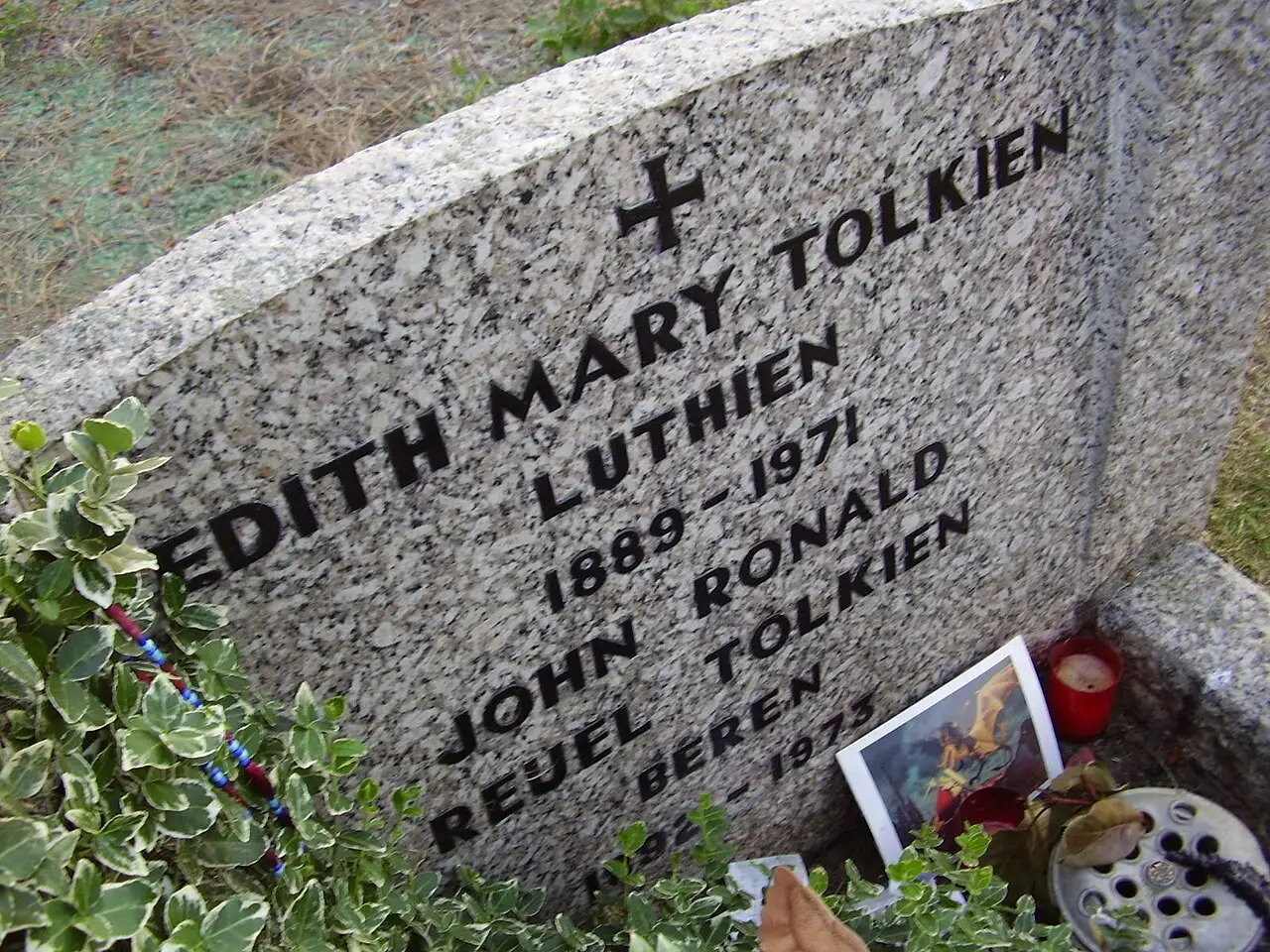
Tolkien's wife Edith, the love of his life since they were both orphaned teenagers, died in 1971. When Tolkien followed her two years later, he was buried beside her at Wolvercote Cemetery in Oxford. Their gravestone carries names from his legendarium: she is Lúthien, he is Beren — the elf-maiden and the mortal man whose love story is the most tender tale in all his mythology.
After his death, his son Christopher spent years assembling his father's unfinished writings into The Silmarillion and other volumes, so the legendarium kept growing.
Why it matters: Tolkien is called the father of modern fantasy for a reason. Before him, invented worlds were curiosities; after him, they became an industry — books, films, and games that all walk roads he paved. He proved that a made-up language could become literature, and that a professor's daydream could outlive empires.
Photo: Álida Carvalho, public domain (via Wikimedia Commons).