A Baker's Oven Spark Burned London for Four Days
On September 2, 1666, a spark in a Pudding Lane bakery set off a four-day inferno that destroyed 13,200 houses and 87 churches — and remade London.
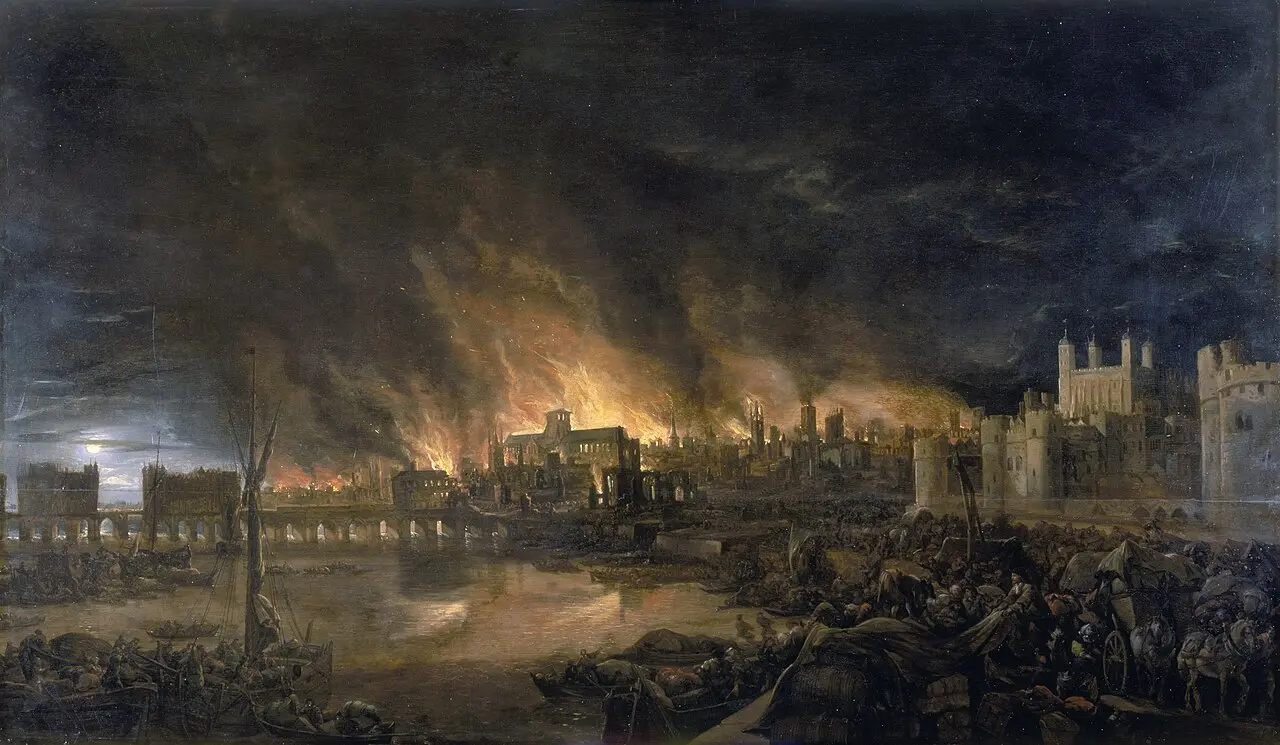
It began, as the greatest disasters often do, with something small: a spark in a baker's oven, at about two in the morning on a Sunday.
The baker was Thomas Farriner, who baked for the king. His bakery stood on Pudding Lane, a narrow street near London Bridge, in a city built almost entirely of timber. Sometime in the small hours of September 2, 1666, a fire started in his bakehouse. Farriner and his family escaped through an upstairs window into the neighboring house. His maid, too frightened to make the climb, stayed behind — the fire's first victim.
Across the city, the diarist Samuel Pepys was woken at 3 a.m. by a servant shouting about a fire. He looked out the window, decided it was far enough away, and went back to bed. By the time he rose, hundreds of houses were gone. He climbed the Tower of London and watched the flames sweep across London Bridge — and realized the fire was coming for everything. Like many Londoners that day, he scrambled to save his treasures: he buried his wine in the garden and sent his wife out of town with the family gold.
London was a tinderbox. Its houses were timber-framed and coated in flammable pitch; its streets were so narrow that the upper floors of opposite houses nearly touched, turning alleys into chimneys. A long, dry summer had baked the wood, and a strong easterly wind drove the flames from street to street. The only real defense was to pull down houses to make firebreaks — but the Lord Mayor hesitated, worried about the cost of the demolished buildings. The delay proved fatal.
For four days the fire raged. When it finally burned itself out on September 6, some 13,200 houses, 87 parish churches, and old St. Paul's Cathedral — its wooden scaffolding caught fire and its lead roof melted and flowed through the streets — were gone. Around 70,000 of London's 80,000 residents were homeless. The official death toll was recorded as astonishingly low, though historians believe the true number was higher.
Then London did what London does: it rebuilt. Sir Christopher Wren designed a magnificent new St. Paul's Cathedral. New rules required brick and stone instead of timber, and wider streets. And near Pudding Lane, Wren and the scientist Robert Hooke raised the Monument — a stone column 61 meters tall, exactly the distance from its base to Farriner's bakery, with 311 steps to a viewing platform. It still stands today.
Why it matters: the Great Fire made modern London. It gave the city its stone buildings, its building codes, and its cathedral dome. And it taught every growing city since a lesson written in ash: build against fire, or fire will rebuild you.
Photo: Unknown artist, 17th century, public domain (via Wikimedia Commons).