A Signature That Ended the World's Deadliest War
On September 2, 1945, aboard the battleship USS Missouri in Tokyo Bay, Japan's formal surrender brought World War II to an official end.
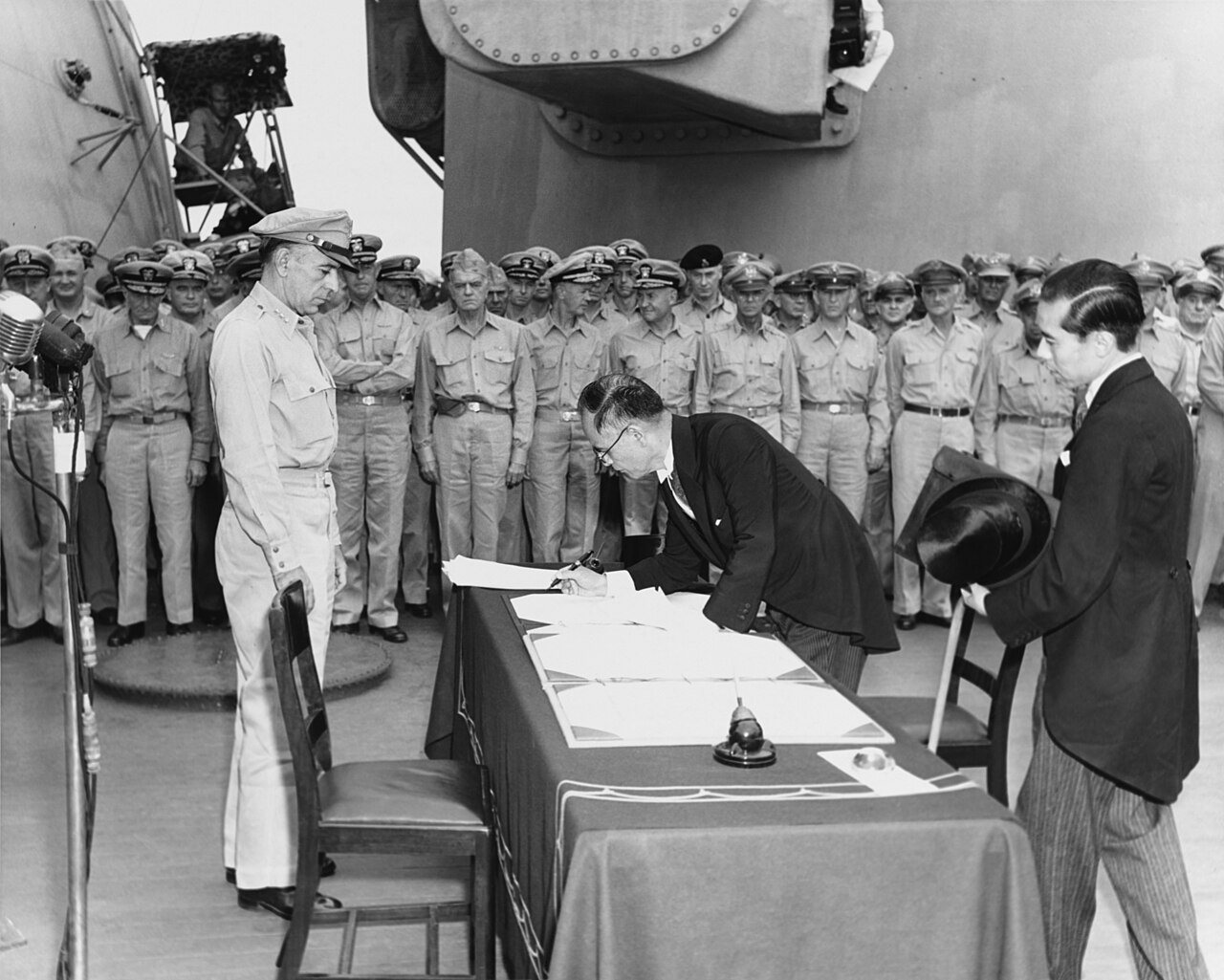
The deadliest war in human history ended not with a battle, but with a pen.
On the morning of Sunday, September 2, 1945, more than 250 Allied warships lay at anchor in Tokyo Bay. The flags of the United States, Britain, the Soviet Union, and China flew above the deck of the battleship USS Missouri — named for President Harry Truman's home state, and chosen by him as the stage for the moment the world had waited years to see.
There was a quiet poetry in the setting. Ninety-two years earlier, in 1853, Commodore Matthew Perry had sailed into these same waters and forced Japan to open itself to the world. On this morning, the American flag Perry had flown hung above the Missouri's deck, watching over the closing of the circle.
Just after nine o'clock, the Japanese delegation came aboard. Foreign Minister Mamoru Shigemitsu, in a top hat and morning coat, signed the Instrument of Surrender on behalf of Japan's government. General Yoshijirō Umezu, grim-faced in full uniform, signed for the Japanese armed forces.
Then General Douglas MacArthur, Supreme Commander for the Allied Powers, stepped forward. "It is my earnest hope and indeed the hope of all mankind that from this solemn occasion a better world shall emerge out of the blood and carnage of the past," he said, and signed.
Fleet Admiral Chester Nimitz signed for the United States. Then, one by one, representatives of China, Britain, the Soviet Union, Australia, Canada, France, the Netherlands, and New Zealand added their names. In about twenty minutes, it was over — and the Second World War was officially, formally finished.
When the last signature was dry, the clouds over Tokyo Bay broke and sunlight poured onto the deck. The war that had begun six years earlier in a Polish harbor at dawn was over by mid-morning on a battleship's deck — finished, as MacArthur had put it, with the solemn hope that a better world would emerge from it.
MacArthur had deliberately waited until September 2 so that representatives of every major Allied power could be present. The delay was worth it: this was not one nation's victory being recorded, but the world's.
Why it matters: the surrender closed a war that had killed tens of millions of people across the globe and touched nearly every family on earth. It ended the bloodiest chapter of the twentieth century and opened the long, difficult work of rebuilding — Japan would be rebuilt, enemies would become allies, and MacArthur's hope for a better world would be tested in the decades to come.
Photo: U.S. Army Signal Corps (Lt. Stephen E. Korpanty), public domain (via Wikimedia Commons).