
The Purple Heart: Born on August 7, 1782, for the Common Soldier
On August 7, 1782, George Washington created America's first military decoration — a purple cloth heart honoring ordinary soldiers, not officers.
By the summer of 1782, the American Revolution was winding down. The British had surrendered at Yorktown the previous October, but the Continental Army still camped restlessly, unpaid and under-supplied, waiting for peace to be made official. From his headquarters at Newburgh, New York, General George Washington faced a problem every commander knows: how do you keep an exhausted army together when you have nothing to give them?
On August 7, 1782, Washington found an answer in his general orders. He created the Badge of Military Merit: a small, heart-shaped patch of purple cloth or silk, edged with narrow lace, to be sewn onto the uniform of any soldier or non-commissioned officer who had shown "not only instances of unusual gallantry in battle, but also extraordinary fidelity and essential service." It was, in the Army's telling, the first time in history that ordinary enlisted soldiers — not generals, not officers — could receive a military decoration.
Washington sensed the anger simmering at that very headquarters. His officers were owed years of back pay, and the lifetime half-pay pensions Congress had promised in 1780 remained unfunded. The discontent hardened into the Newburgh Conspiracy: in March 1783, anonymous circulars urged the officers to mutiny and refuse to disband. Washington summoned them on March 15 and, in his famous Newburgh Address — pausing to put on his spectacles, noting he had grown almost blind in the country's service — talked them down. Congress soon funded five years' full pay.
Only three soldiers of the Revolution ever received it: Sergeants Elijah Churchill and William Brown, and Sergeant Daniel Bissel, all honored in the spring of 1783. After the war, the badge quietly fell out of use, never abolished but never awarded again.
The three honorees' deeds were recorded in detail. Elijah Churchill, a sergeant of the 2nd Continental Light Dragoons, earned his badge for gallantry in two daring raids behind British lines — one on Long Island, one in the contested "neutral ground" near Tarrytown — his citation praising his "great gallantry, firmness, and address." William Brown of the 5th Connecticut Regiment was honored for valor in the assault on the British redoubts at Yorktown. Daniel Bissell received his on June 10, 1783, for months of intelligence-gathering while posing as a deserter inside enemy lines.
It waited 150 years. In 1932, on the 200th anniversary of Washington's birth, Army Chief of Staff Douglas MacArthur revived the award as the Purple Heart — redesigned as an enameled medal bearing Washington's own profile, drawn up by Army heraldic specialist Elizabeth Will. In 1942, President Franklin D. Roosevelt extended it to all branches of service and authorized it posthumously for those killed in action. What had begun as a reward for gallantry became the decoration for service members wounded or killed by the enemy — a visible record of sacrifice.
The original badges had remarkable afterlives. The "Book of Merit" listing every recipient was lost, so only these three are verified. Churchill's badge survives, displayed at the New Windsor Cantonment State Historic Site. Brown's badge was rediscovered in a New Hampshire barn in the 1920s and is claimed by the American Independence Museum in Exeter — though some sources dispute it. Bissell's badge was reportedly destroyed when his house burned in July 1813.
Today it is America's oldest military decoration still in use, awarded in the name of the President to those wounded or killed in action. Every August 7 is observed as National Purple Heart Recognition Day — the anniversary of the day Washington decided that courage in the ranks deserved its own badge of honor. And the little purple heart has become one of the most awarded decorations in American history: the National Purple Heart Hall of Honor estimates about 1.8 million have been awarded, the heaviest tolls coming from World War II, Korea, and Vietnam.
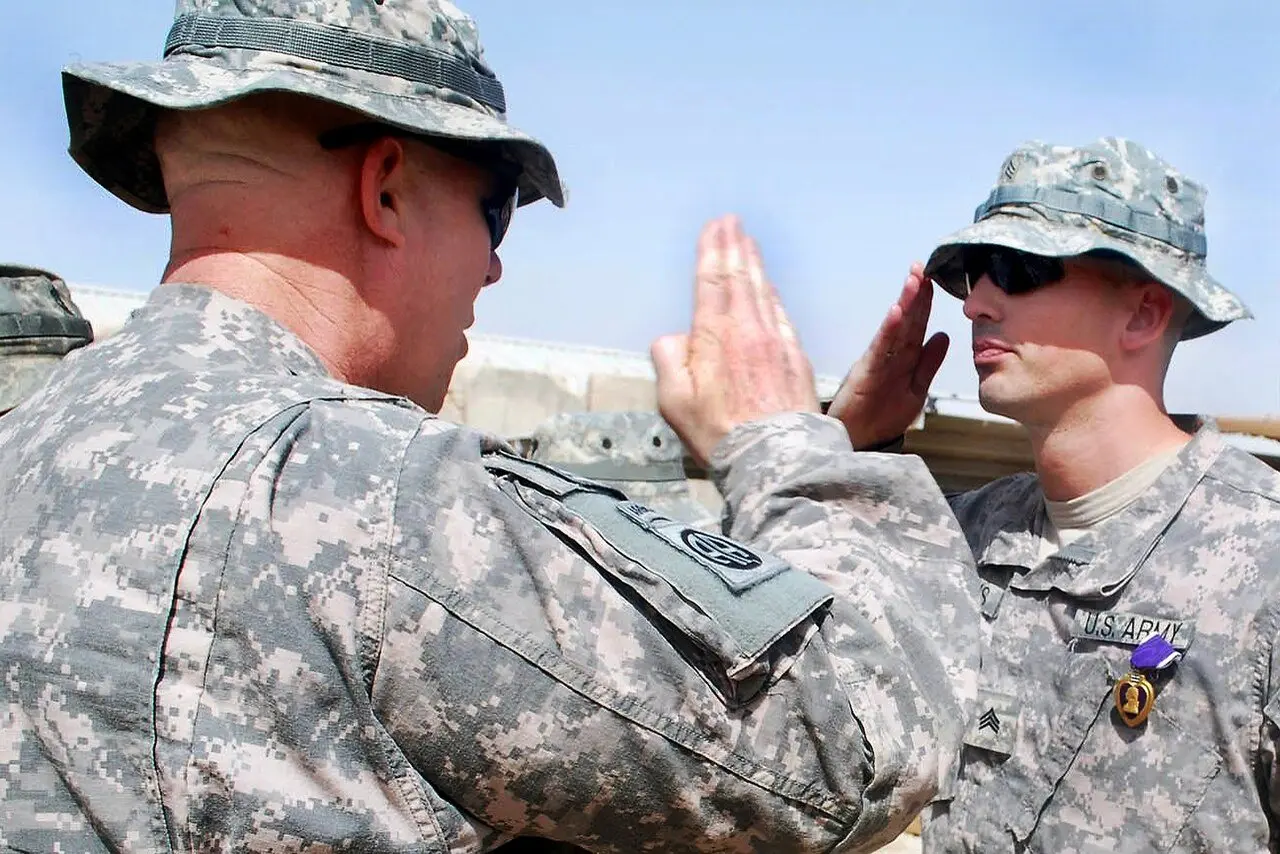
Photo: The U.S. Army, public domain (via Wikimedia Commons).