Six Men, Nine Logs, 4,300 Miles: The Kon-Tiki Wrecks Onto History
On August 7, 1947, Thor Heyerdahl's balsa-wood raft Kon-Tiki smashed onto a Pacific reef after 101 days at sea — proving an ancient design could cross an ocean.
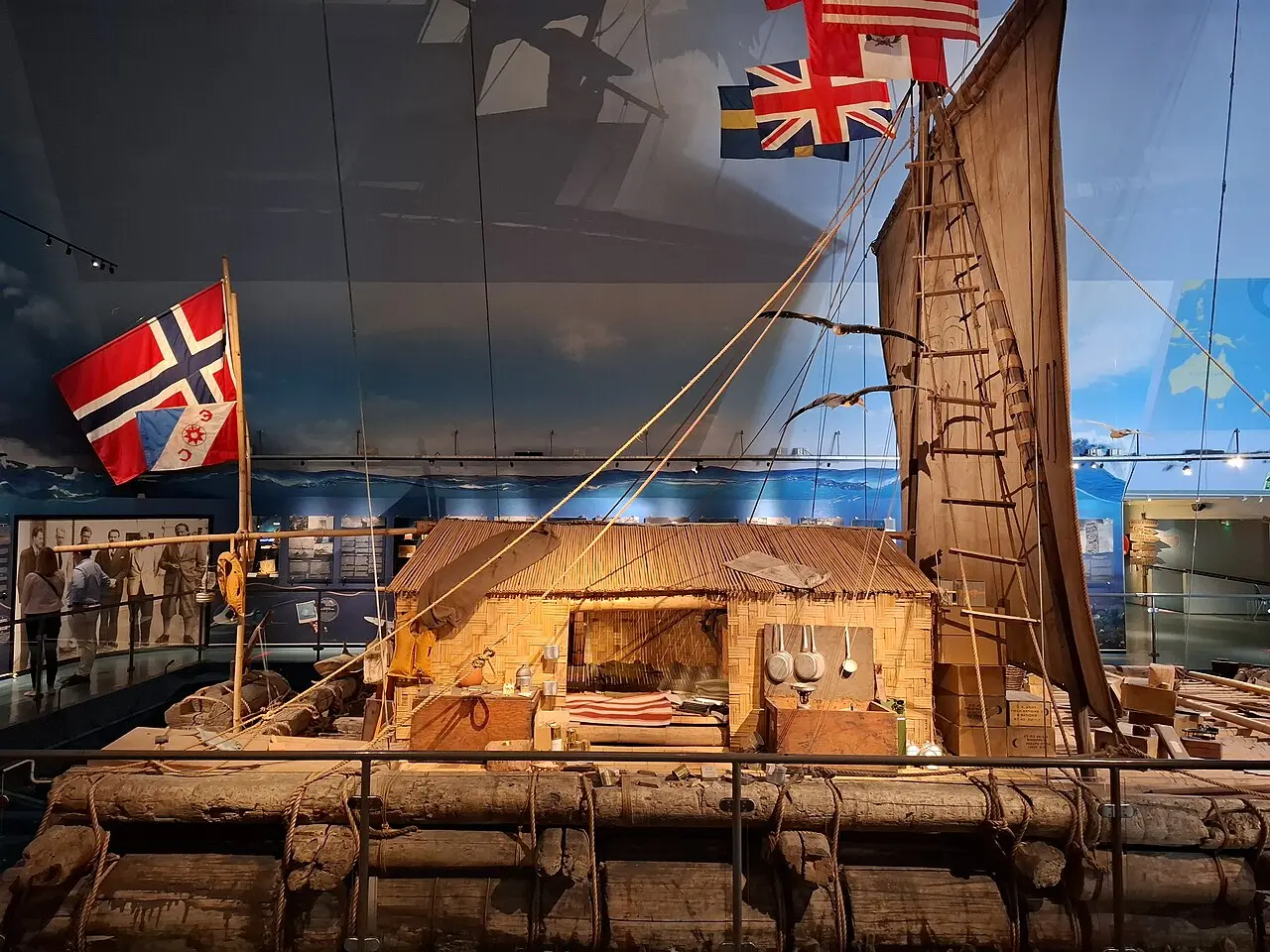
For 101 days they had drifted west with the current, living on nine balsa logs lashed with hemp rope beneath a square reed sail. Now, on August 7, 1947, the Pacific was done being gentle. Breakers hurled the raft Kon-Tiki onto a coral reef off Raroia, an atoll in the Tuamotu Archipelago near Tahiti. The logs held. All six men made it ashore alive.
Their leader was Thor Heyerdahl, a 32-year-old Norwegian anthropologist with a theory most scholars considered absurd: that the Polynesian islands had been settled not from Asia, as the evidence suggested, but from South America — by people drifting west on ocean currents aboard rafts like this one. To prove the voyage was at least possible, he would recreate it with the materials of the ancient world.
Built at Callao, Peru, from balsa logs gathered in Ecuador, the 45-foot Kon-Tiki was lashed together without nails or modern fasteners, modeled on the rafts of early South American Indians. The expedition set sail on April 28, 1947. The crew rode the Humboldt Current into the South Equatorial Current and kept going — through storms, past sharks and whales, fishing for flying fish and tuna along the way, filming everything.
The wreck at Raroia made Heyerdahl famous. His book about the expedition became an international bestseller translated into 65 languages, and the documentary film assembled from the crew's footage won an Academy Award. The original raft now rests in the Kon-Tiki Museum in Oslo.
The scientific establishment never bought the underlying theory — most archaeological, linguistic, and genetic evidence still points to settlers arriving from the west, from Island Southeast Asia, though research has since confirmed some South American contact with Polynesia. But Heyerdahl never claimed to have proved his theory; he claimed only that the crossing was possible. And on that narrower claim, the reef at Raroia was his vindication.
The Kon-Tiki voyage was experimental archaeology at its most daring — a reminder that a wild idea, tested honestly, can be worth more than a safe one. On August 7, 1947, six men proved that the ocean the experts called impassable had been crossable all along.
The voyage had roots a decade earlier. In 1937, Heyerdahl and his first wife had lived primitively for a year on Fatu Hiva in the Marquesas Islands, studying the local plant and animal life. The experience convinced him that the islands' first inhabitants had drifted in on ocean currents from the east — from South America — a view that ran against the scholarly consensus that the original settlers had arrived from Asia.
The expedition itself was a shoestring operation, funded by private loans along with donations of equipment from the United States Army. The crew did carry some modern gear — a radio, watches, charts, a sextant, metal knives — but Heyerdahl insisted these were incidental to the real question: whether the raft itself, built only as the ancients would have built it, could make the journey. One hundred and one days later, the reef at Raroia answered.
Photo: Wikipek, CC0 (via Wikimedia Commons).