The Province That Bet Everything on a Railway
On July 20, 1871, British Columbia became Canada's sixth province after Ottawa promised to absorb the colony's debt and build a transcontinental railway.
In 1871, the colony of British Columbia made one of the boldest bets in Canadian history. It agreed to join a country whose capital was three thousand miles away, on the strength of a promise: Canada would swallow the colony's massive debt and build a railway across an entire continent to the Pacific — within ten years. The railway didn't exist. The route barely existed. British Columbia signed anyway.
The colony had been founded in 1858 in the frenzy of the Fraser River Gold Rush, then merged with the neighboring colony of Vancouver Island in 1866. When the gold ran out, the economy collapsed — and the bills remained. Meanwhile, the United States had just bought Alaska in 1867, and many in the colony worried that American annexation was only a matter of time. A group of reformers — Amor De Cosmos, Robert Beaven, and John Robson — formed the Confederation League to push for union with Canada, partly for the money, partly for responsible government, and partly to stay British.
Negotiations dragged for nearly two years. The governor, Anthony Musgrave, pressed by London to get the deal done, finally secured the terms: Canada would assume British Columbia's debt and build the transcontinental railway. On July 20, 1871, both the B.C. assembly and the federal Parliament passed the terms, and the colony became Canada's sixth province. De Cosmos would become its second premier.
Canada kept its word — barely. The Canadian Pacific Railway wasn't finished until November 7, 1885, when the Last Spike was driven, years late but complete: a steel thread from Montreal to the Pacific. The railway's western terminus became the city of Vancouver, founded the next year, which would grow into Canada's great Pacific port.
It's worth saying plainly what the celebrations of 1871 left out. The First Nations who had lived in the region for at least 14,000 years were not consulted, and the new province refused to negotiate treaties or recognize Indigenous land title — leaving most of British Columbia on unceded land to this day.
British Columbia's entry completed the dream of a Canada stretching from sea to sea — a mari usque ad mare, the motto on the country's coat of arms. Without that July gamble, Canada might have ended at the Rockies, and the Pacific coast might have flown a different flag entirely.
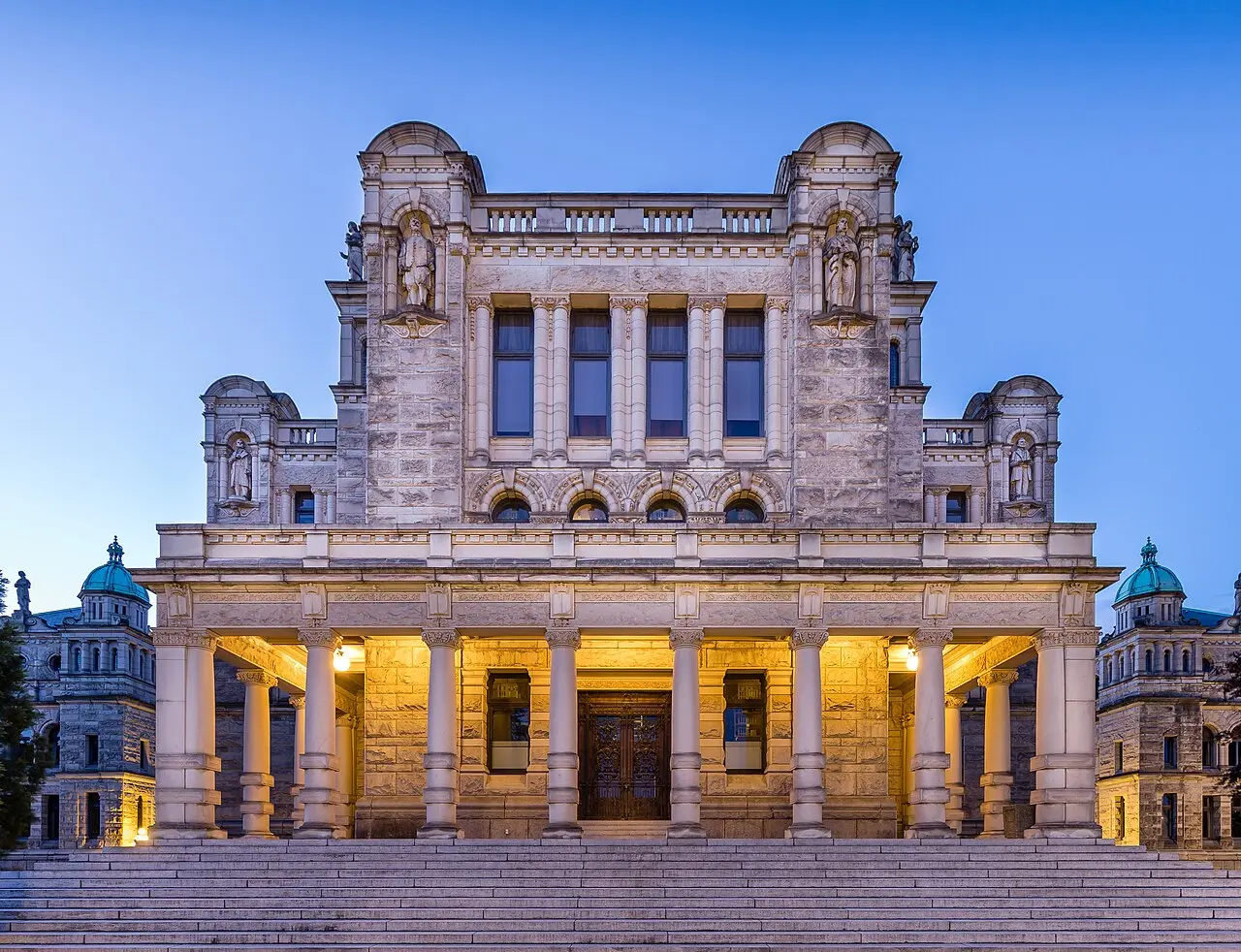
Image: The British Columbia Parliament Buildings in Victoria at dusk, photographed by Michal Klajban, licensed CC BY-SA 4.0 via Wikimedia Commons.