The Patent That Owned the Sky: The Wrights' Flying Machine
On May 22, 1906, the Wright brothers were granted U.S. Patent 821,393 for their flying machine — the three-axis control system that made powered flight truly controllable.
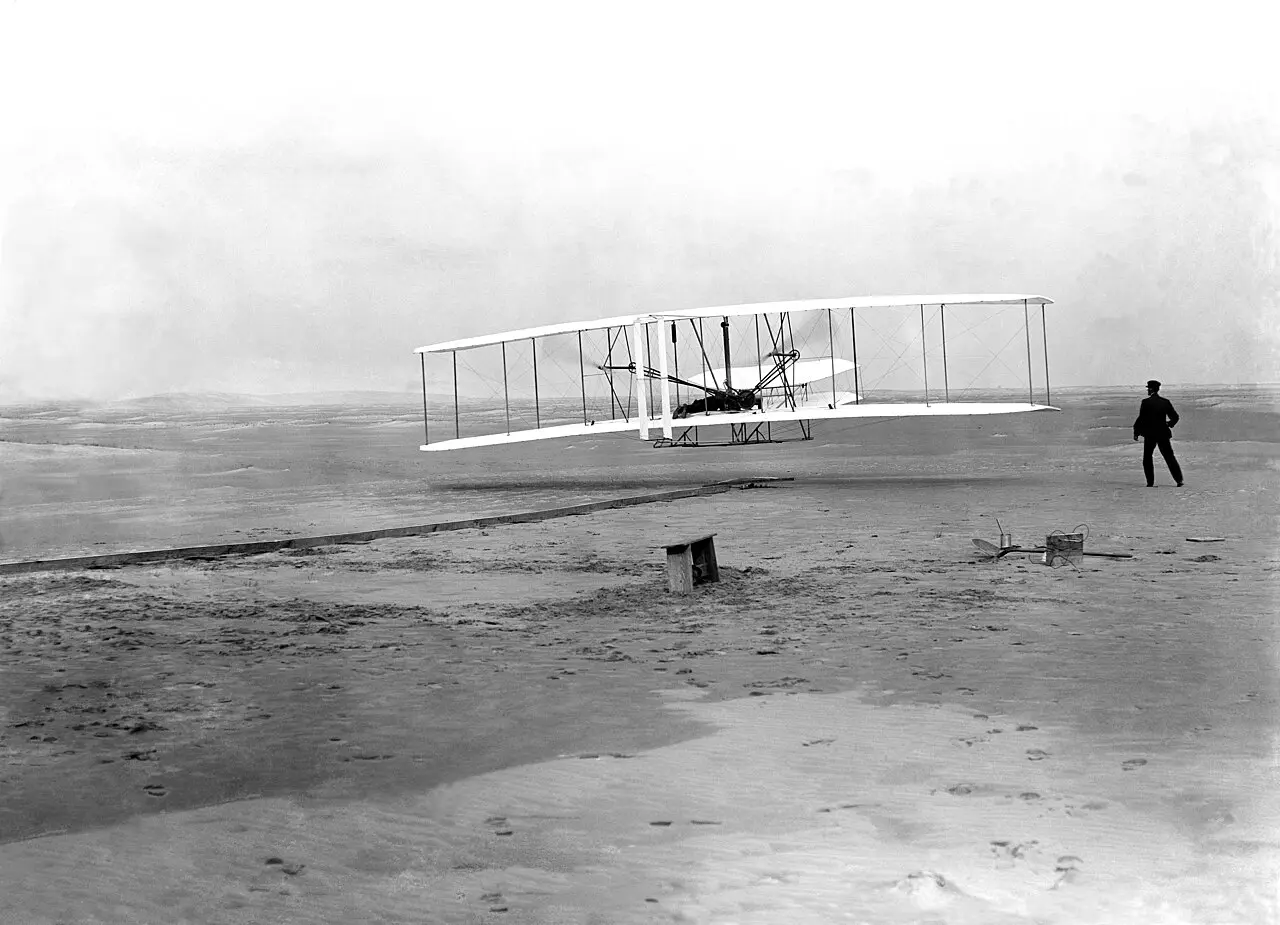
The Wright brothers had already flown. By the morning of May 22, 1906, two and a half years had passed since Orville Wright lifted off the sand at Kitty Hawk on December 17, 1903 — twelve seconds, 120 feet — with Wilbur making three more flights that same day. Yet in the eyes of the United States Patent Office, their great invention did not legally exist until that May morning, when the brothers were finally granted U.S. Patent 821,393 for a "Flying Machine."
What the patent covered was not the airplane as a machine, but the thing that made it flyable: control. During their glider experiments in 1902, the Wrights had solved the problem that had defeated so many early aviators — how to steer an aircraft in all three axes of flight. Pitch, the nose-up-and-down motion, was managed by a forward elevator. Roll, the banking motion, came from "wing-warping": twisting the outer portions of the wings to different angles on the right and left sides. Yaw, the turning motion, was handled by a rear rudder. The simultaneous use of wing-warping for roll and a rudder for yaw was their breakthrough discovery.
Getting the patent had taken years. The brothers wrote their application themselves and filed it on March 23, 1903 — months before the famous first flight — and the Patent Office rejected it. Early in 1904 they hired Henry Toulmin, an Ohio patent attorney, who rewrote the claims in language that captured not just wing-warping but, crucially, any method of adjusting a wing's outer portions for lateral control — wording that courts would later read to cover ailerons as well. After three years of waiting, the patent issued on May 22, 1906.
The Wrights then defended it ferociously. Their chief target was Glenn Curtiss, the rival American aviator, and the ensuing patent war consumed the young American aviation industry in lawsuits. Wilbur Wright, writing to the aviation pioneer Octave Chanute in January 1910, put the brothers' view bluntly: "It is not disputed that every person who is using this system today owes it to us and to us alone." The litigation drove up the cost of building airplanes in America so severely that, with war raging in Europe, the U.S. government eventually pressured the industry to pool its patents so production could proceed.
Today every airplane still flies on the Wrights' insight: that flight is not about lift alone but about control. The patent file itself had its own adventure — misplaced for 36 years after being lent to the Smithsonian in 1978, it was only recently recovered and returned to the National Archives. The piece of paper granted on May 22, 1906, did not just protect an invention. In law, it defined who owned the science of staying aloft.
Photo: John T. Daniels, public domain (via Wikimedia Commons).