
The Ground That Shook the World: The 1960 Chile Earthquake
On May 22, 1960, a magnitude 9.5 earthquake off Chile — the largest ever recorded — devastated Valdivia and sent tsunamis across the Pacific.
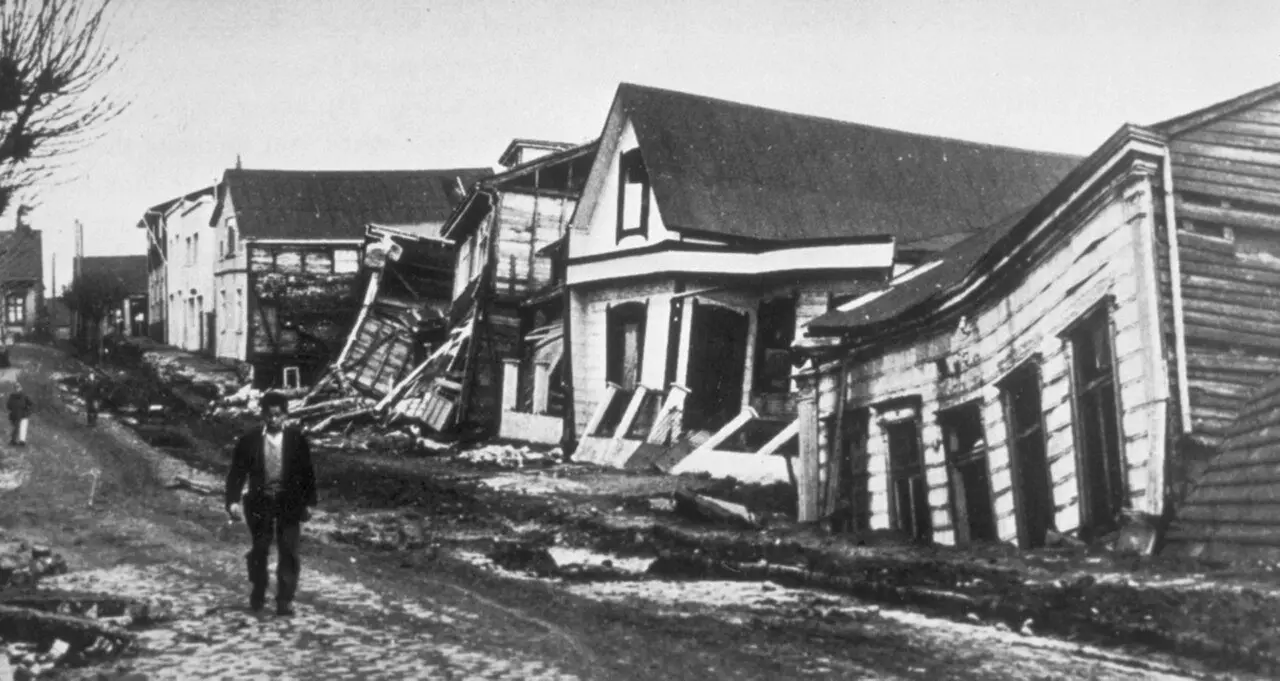
It was a quiet Sunday afternoon in southern Chile. Families were out in the autumn air of Valdivia, markets were open, and radios played weekend music. Then, at 3:11 p.m. local time on May 22, 1960, the ground began to move — and it did not stop for nearly ten minutes.
What struck that afternoon was the Great Chilean Earthquake, also called the Valdivia earthquake: magnitude 9.5 on the moment magnitude scale, the largest earthquake ever recorded by modern instruments. Off the coast, the Nazca Plate lurched beneath the South American Plate along a rupture stretching some 560 to 620 miles — roughly a thousand kilometres of fault breaking in one violent, sustained release of centuries of pent-up pressure. Entire coastlines rose and fell. Rivers changed course. In Valdivia, nearly half the buildings were left uninhabitable, and the coastal town of Puerto Montt visibly sank. Two days later, the nearby Cordón-Caulle volcano erupted, a final exclamation mark on a disaster that seemed to have no end.
But the shaking was only the beginning. The quake shoved the seafloor upward and set off a tsunami that hammered the Chilean coast with waves as high as 25 metres (82 feet). Then the great wave crossed the entire Pacific Ocean. Fifteen hours later it devastated Hilo, Hawaii, where waves of 10.7 metres — about 35 feet — were recorded more than 10,000 kilometres from the epicentre. The tsunami went on to strike Japan, the Philippines, eastern New Zealand, and the Aleutian Islands of Alaska. In Hawaii alone it killed 61 people and caused over $23.5 million in damage (in 1960 dollars); it killed people on the U.S. West Coast, in Japan, and in the Philippines as well.
The human cost in Chile remains uncertain to this day. Estimates of the dead range from about 490 to 5,700, and the Chilean government reported two million people left homeless, with damage then estimated around $550 million. That wide uncertainty is itself a measure of the chaos: whole towns were cut off, records lost, and families simply vanished into the sea and the rubble.
The disaster forced the world to think differently about the ocean. Because one earthquake's waves had reached every shore of the Pacific, nations created what became the Pacific Tsunami Warning and Mitigation System, the first international effort to detect a tsunami at sea and warn distant coastlines before the water arrived. Scientists, meanwhile, gained the largest natural experiment in seismology ever recorded — the data from 1960 still underpins how we understand subduction zones, the same kind of fault that ruptured off Japan in 2011 and Sumatra in 2004.
The ground in Valdivia has long since been rebuilt. But the earthquake of May 22, 1960, remains the measuring stick against which every quake since has been judged — a reminder that the most powerful force most of us will ever hear about is the quiet, patient grinding of the earth beneath our feet.
Photo: Pierre St. Amand, public domain (via Wikimedia Commons).