The Patent That Built the Wild West: Samuel Colt's Revolver, Feb. 25, 1836
On February 25, 1836, Samuel Colt received the U.S. patent for his revolving-cylinder pistol, the invention that became the Colt Paterson and changed firearms forever.
On February 25, 1836, the United States government granted patent number 138 — later renumbered 9430X — to a 21-year-old inventor for what the paperwork called a "revolving gun." The inventor was Samuel Colt, and his patent would reshape the American frontier.
The idea had come to Colt years earlier, on a long sea voyage to Calcutta. According to legend, the teenage sailor spent hours watching the ship's steering wheel spin and lock into place, and imagined a pistol that worked the same way: a cylinder that rotated to bring a fresh, loaded chamber behind a single barrel. Back home, he carved the design in wooden models and funded his experiments in an unusual way — touring as a showman giving laughing-gas demonstrations under the stage name "the Celebrated Dr. Coult of New-York, London and Calcutta."
Colt was not the first to imagine a revolving firearm. Decades earlier, Boston inventor Elisha Collier had patented a revolving flintlock. But Colt's design was the first practical one: a percussion-cap pistol with a revolving cylinder, a locking pawl that held each chamber precisely in line with the barrel, and what the patent described as greater "facility in loading," a steadier grip, and "great rapidity in the succession of discharges." Where a single-shot muzzleloader took the better part of half a minute to reload, a Colt could fire five or six shots in seconds.
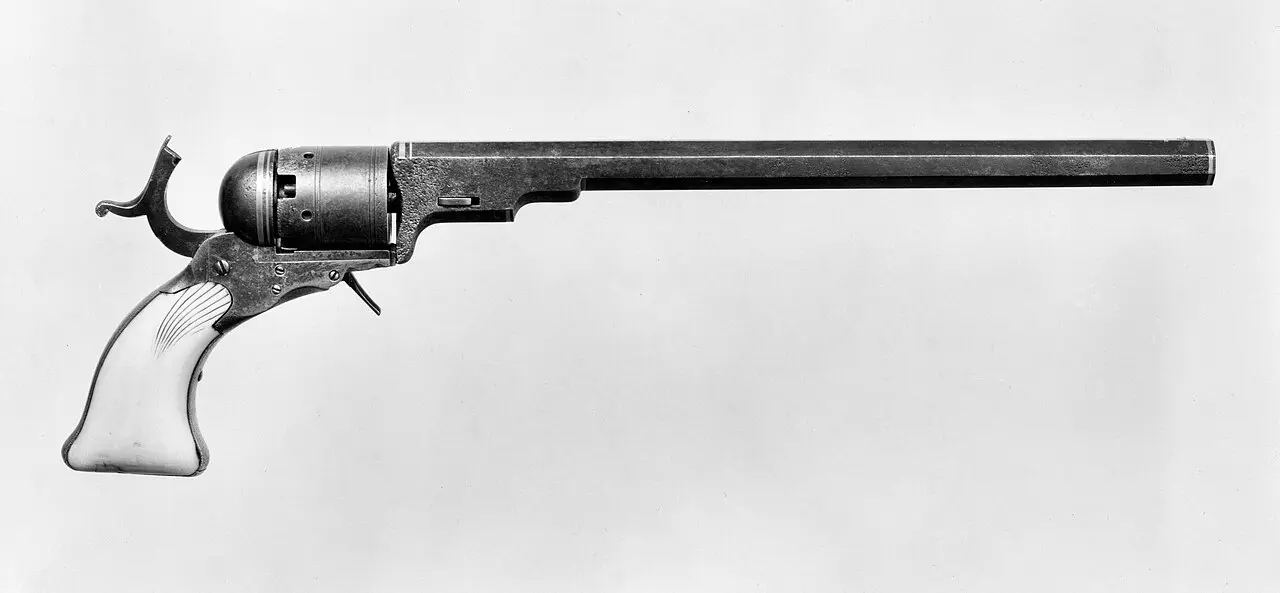
Colt secured his British patent in October 1835, then came home and won the American one on February 25, 1836, with a second U.S. patent following that August. Weeks later, on March 5, the New Jersey legislature chartered his Patent Arms Manufacturing Company in Paterson — and the Colt Paterson, the first commercial repeating firearm with a revolving cylinder, went into production. The early models were five-shot pistols with a folding trigger that tucked away until the hammer was cocked.
Success did not come easily. Sales were shaky, money ran short, and the Paterson company eventually collapsed. But glowing reports from the Mexican-American War front created a surge of demand, and Colt rebuilt — moving his factory to Hartford, Connecticut, in 1847, where he pioneered interchangeable parts and the assembly line. In its first 25 years, his company turned out more than 400,000 revolvers, and by his death in 1862 Colt was one of the richest men in America.
The revolver became the defining tool of 19th-century westward expansion — carried by soldiers, lawmen, settlers, and pioneers — and the Colt name became so synonymous with the weapon that "Colt" was used generically for any revolver. More than a gun, Colt's patent helped invent modern mass manufacturing: the idea that complex machines could be built from identical, interchangeable parts on a production line. That idea outlived the frontier and shaped the industrial century that followed.
Photo: Metropolitan Museum of Art, CC0 (via Wikimedia Commons)