The Housewife Who Toppled a Dictator: Corazon Aquino, Feb. 25, 1986
On February 25, 1986, Corazon Aquino was sworn in as president of the Philippines, capping the peaceful People Power Revolution that ended Ferdinand Marcos's two-decade rule.
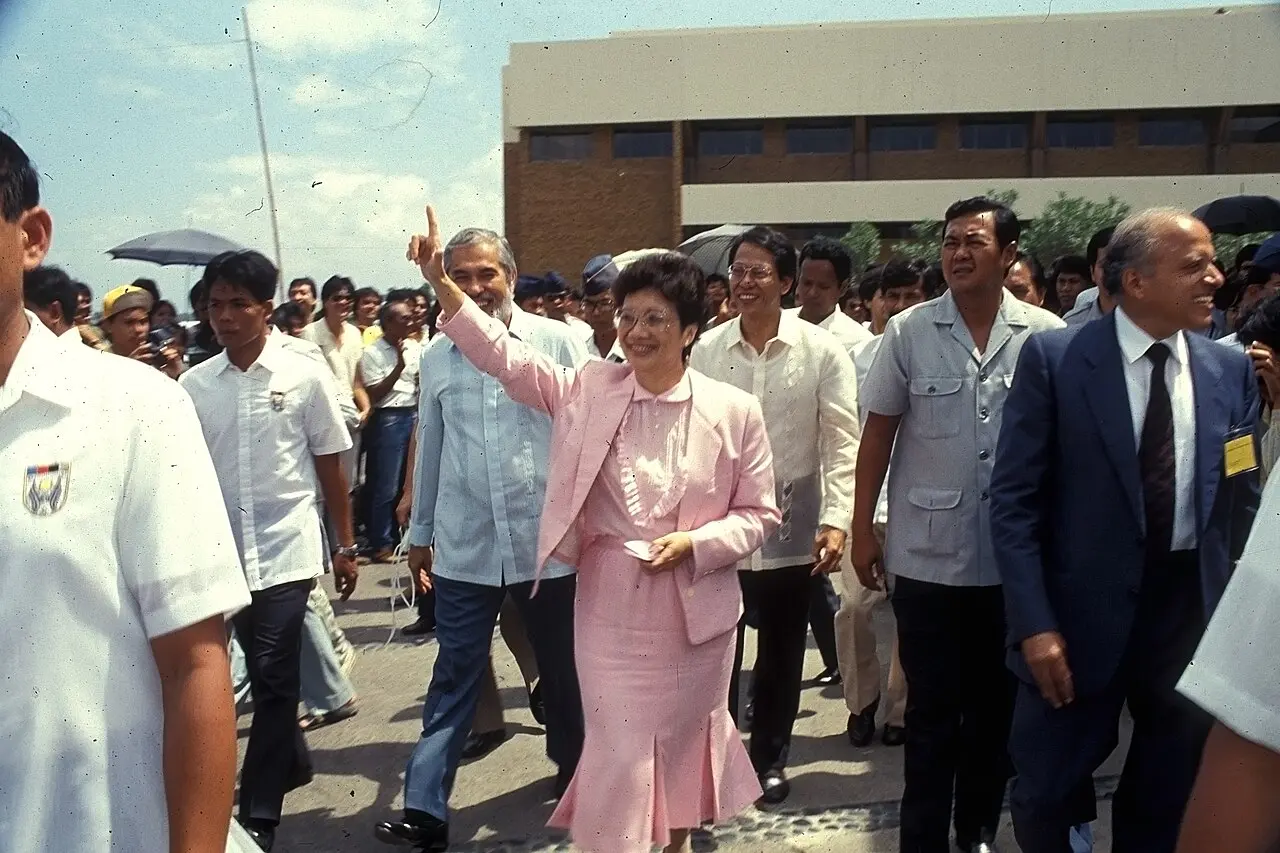
She called herself a plain housewife. On the morning of February 25, 1986, that housewife took an oath that ended a dictatorship.
Corazon "Cory" Aquino had never held political office. She was the widow of Benigno "Ninoy" Aquino Jr., the most prominent critic of Philippine president Ferdinand Marcos. When Ninoy stepped off a plane at Manila airport on August 21, 1983, returning from exile in the United States, he was assassinated on the tarmac. Millions of Filipinos mourned, and Cory — a self-described housewife and mother of five — became the face of the opposition.
In late 1985, a confident Marcos called a snap presidential election. Marcos reportedly dismissed his challenger as "just a woman." She ran anyway, with former senator Salvador Laurel as her running mate. When the votes were counted on February 7, 1986, the government-controlled Batasang Pambansa declared Marcos the winner. The opposition, international observers, and much of the Filipino public cried fraud. Aquino called for massive civil disobedience.
The breaking point came on February 22. Defense Minister Juan Ponce Enrile and Armed Forces Vice Chief of Staff Fidel Ramos defected, barricading themselves in two military camps in Quezon City and calling on Marcos to resign. Cardinal Jaime Sin went on the Catholic station Radio Veritas and urged ordinary Filipinos to protect the defectors. Hundreds of thousands answered — nuns, students, families — pouring onto Epifanio de los Santos Avenue and forming human barricades of their own bodies between the soldiers and the tanks. The troops, ordered to clear the crowds, refused to fire. Remarkably, through four days of revolution, the protests stayed peaceful.
On the morning of February 25, Aquino took the presidential oath at Club Filipino in San Juan, administered by Supreme Court Associate Justice Claudio Teehankee. Marcos took his own oath at Malacañang Palace the same day — but his presidency was already over. Across the Pacific, President Ronald Reagan had sent word through Senator Paul Laxalt that it was time for Marcos to "cut, and cut cleanly." That evening, the United States helped Marcos flee to exile in Hawaii. By nightfall, crowds had stormed the empty Malacañang Palace and seen for themselves the staggering wealth the Marcos family had amassed.
Aquino — the 11th president of the Philippines, and the first woman to hold the office — served until 1992. She oversaw a new constitution, survived multiple coup attempts, and in September 1986 delivered an address to a joint session of the U.S. Congress that left the chamber on its feet; House Speaker Tip O'Neill called it "the finest speech I've ever heard in my 34 years in Congress."
The People Power Revolution became a blueprint. A movement with no guns, led by a widow who had never wanted power, showed the world that a dictatorship could fall to rosaries, radio broadcasts, and ordinary people standing in the street. Time magazine named Aquino its Woman of the Year for 1986, and Filipinos still call her the Mother of Democracy.
Photo: IRRI Images, CC BY 2.0 (via Wikimedia Commons)