The Night Rock and Roll Crowned Its Founders
On January 23, 1986, the first Rock and Roll Hall of Fame induction ceremony at New York's Waldorf-Astoria honored Chuck Berry, Elvis Presley, and the other founders of rock.
On the evening of January 23, 1986, the grand ballroom of New York's Waldorf-Astoria hotel filled with the loudest royalty in American music. The Rock and Roll Hall of Fame, founded only three years earlier, was inducting its very first class, and the founders of rock and roll had come to claim their crowns.
The inaugural class read like a jukebox of the 1950s: Chuck Berry, James Brown, Ray Charles, Sam Cooke, Fats Domino, the Everly Brothers, Buddy Holly, Jerry Lee Lewis, Little Richard, and Elvis Presley. Behind the scenes, the hall also honored the architects of the sound: Sun Records founder Sam Phillips and disc jockey Alan Freed, widely credited with coining the phrase "rock and roll," entered as non-performers, while bluesman Robert Johnson, country pioneer Jimmie Rodgers, and boogie-woogie pianist Jimmy Yancey were recognized as early influences. Legendary talent scout John Hammond, the man who had discovered Billie Holiday, Aretha Franklin, Bob Dylan, and Bruce Springsteen, received the hall's first lifetime achievement award.
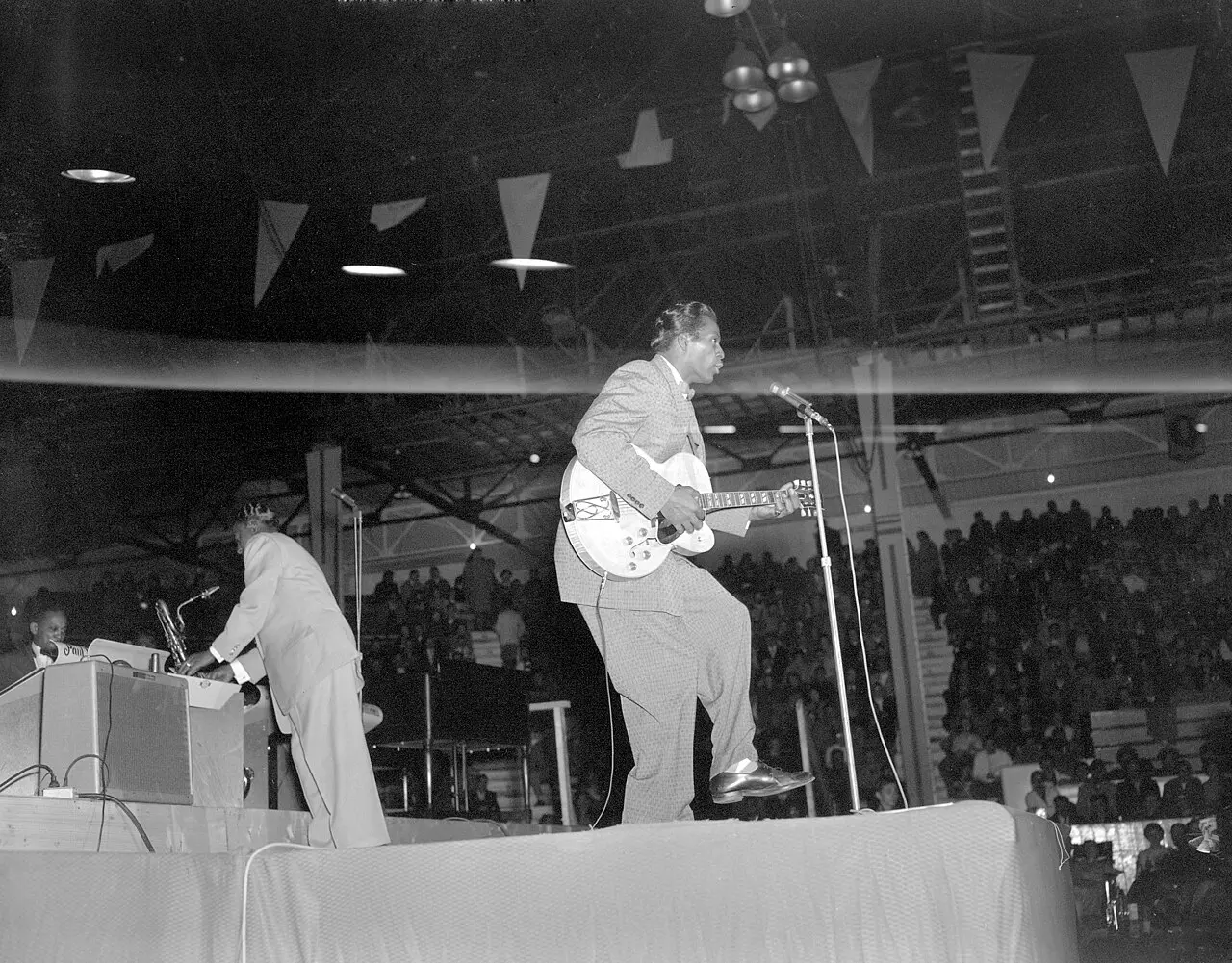
The night belonged to the musicians, and to the younger stars who had come to pay their debts. Keith Richards of the Rolling Stones inducted Chuck Berry, who went in first, the names being called in alphabetical order. Richards told the crowd, in so many words, that he had lifted every guitar lick he ever played from Berry, and Berry answered with his famous duck-walk across the stage. John Lennon's sons Julian and Sean appeared to salute their late father's hero, Elvis Presley. Billy Joel spoke for Fats Domino, Steve Winwood for James Brown, Neil Young for the Everly Brothers, and Hank Williams Jr. for Jerry Lee Lewis, each describing how the founders had built the road the rest of them traveled.
Then came the first all-star jam, a tradition that would define every induction ceremony to follow. The inductees were joined onstage by Winwood, John Fogerty, Billy Joel, and ZZ Top, backed by Paul Shaffer and the World's Most Dangerous Band from Late Night with David Letterman. They played deep into the night: Berry's "Roll Over Beethoven," "Johnny B. Goode," and "Little Queenie," Jerry Lee Lewis pounding through "Great Balls of Fire" and "Whole Lotta Shakin' Goin' On," plus "Proud Mary," "The Twist," and "Gimme Some Lovin'."
The Hall of Fame itself had been an idea in search of a home. It would be nearly a decade before its gleaming pyramid-shaped museum opened on the shore of Lake Erie in Cleveland in 1995. But the music needed no building. What mattered that night was the recognition: that rock and roll, born in Memphis studios and Louisiana roadhouses barely thirty years earlier, was an American art form with founders worthy of a hall of fame.
Why does it matter? Every January, the announcement of new Hall of Fame inductees still sparks the same arguments about who belongs and who was snubbed. That debate began on this night in 1986, when ten performers and a handful of pioneers took the stage at the Waldorf and rock and roll officially got its history, written by the people who made it.
Photo: Provincial Archives of Alberta, no known copyright restrictions (via Wikimedia Commons). Chuck Berry performing at a 1957 concert in Edmonton, Alberta, in the era that made him rock and roll's founding guitarist.