
Seven Miles Down: The Voyage to the Bottom of the World
On January 23, 1960, Jacques Piccard and Don Walsh rode the bathyscaphe Trieste to the floor of the Challenger Deep, the deepest known point on Earth.
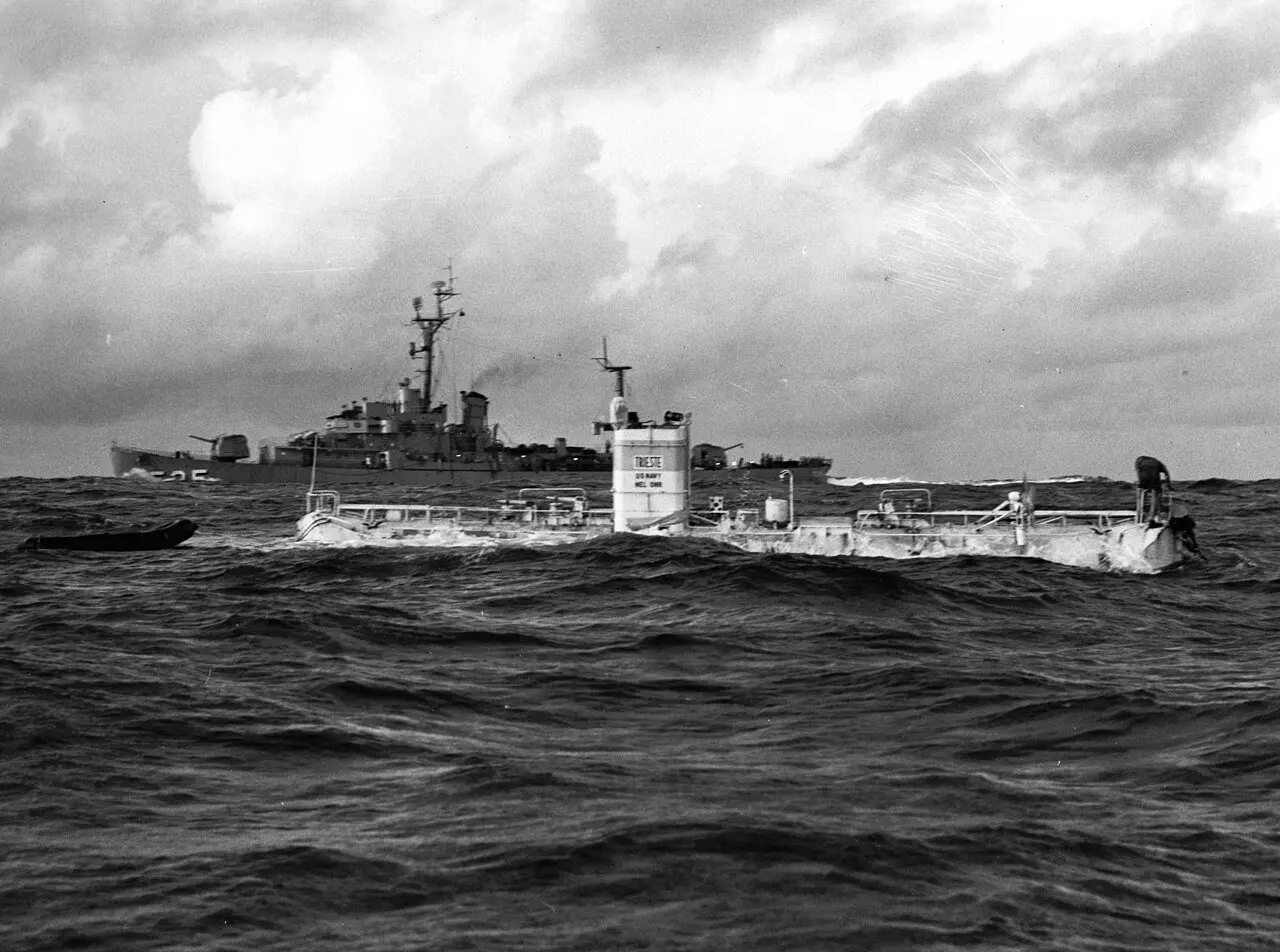
Imagine sinking into an ocean so deep that no sunlight has ever reached it, where the pressure would crush an ordinary submarine like an empty can. Then imagine doing it in a steel ball barely wider than a bathtub, with one other person, for nearly five hours.
That is what Jacques Piccard and U.S. Navy Lieutenant Don Walsh did on January 23, 1960, when they rode the bathyscaphe Trieste to the floor of the Challenger Deep, the deepest known spot in the world's oceans, at the bottom of the Mariana Trench in the Pacific.
The Trieste was a strange and brilliant machine, designed by Jacques's father, the Swiss physicist Auguste Piccard. A small, thick-walled steel sphere carrying the two-man crew hung beneath a huge float filled with gasoline for buoyancy, like an underwater balloon. The U.S. Navy's Office of Naval Research had bought the craft from the Swiss in 1958 to explore the deep ocean, and after months of test dives off Guam in a program called Project Nekton, the Navy decided to go for the bottom.
The morning began with the escort ship USS Lewis hunting for the exact spot. Its depth-finder could not reach that far, so sailors located the trench by dropping more than 300 explosive charges over the side and timing the echo. Then the Trieste's tanks were flooded and the descent began.
About 30,000 feet down, a sharp crack shook the whole vessel. One of the outer plexiglass window panes had cracked under the pressure. Piccard and Walsh faced a terrible choice: abort, or keep going. They reasoned that if the hull itself were failing, they would already be dead, so they kept descending. Nearly five hours after leaving the surface, they touched down at a depth of roughly 36,000 feet, about 11 kilometers, deeper than Mount Everest is tall.
They spent twenty minutes on the bottom, shivering in a cabin just 7 degrees Celsius, munching chocolate bars for strength. A sonar voice link crackled back to life, and to their astonishment they could hear the support ship USS Wandank, each message taking seven seconds to travel up through the water. They saw little, a cloud of silt stirred up by their landing blocked the view, and then they released ballast and rose back toward the light.
No crewed or uncrewed vessel had ever reached the deepest point of the ocean before, and no humans would go back for more than half a century, until explorer James Cameron made a solo descent in 2012. Walsh would later give full credit to the Navy's research office: "They were the ones that rolled the dice buying the Trieste from the Swiss."
Why does it matter? The Trieste proved that human courage and engineering could reach literally the most extreme place on Earth, and it opened deep-ocean science to serious exploration. Every deep-sea robot and submersible working today descends in the wake of two men who refused to turn back at 30,000 feet.
Photo: U.S. Navy, public domain (via Wikimedia Commons).