The Night Radio Learned to Sing
On Christmas Eve 1906, Reginald Fessenden transmitted what is remembered as the first radio broadcast of music and voice from Brant Rock, Massachusetts.
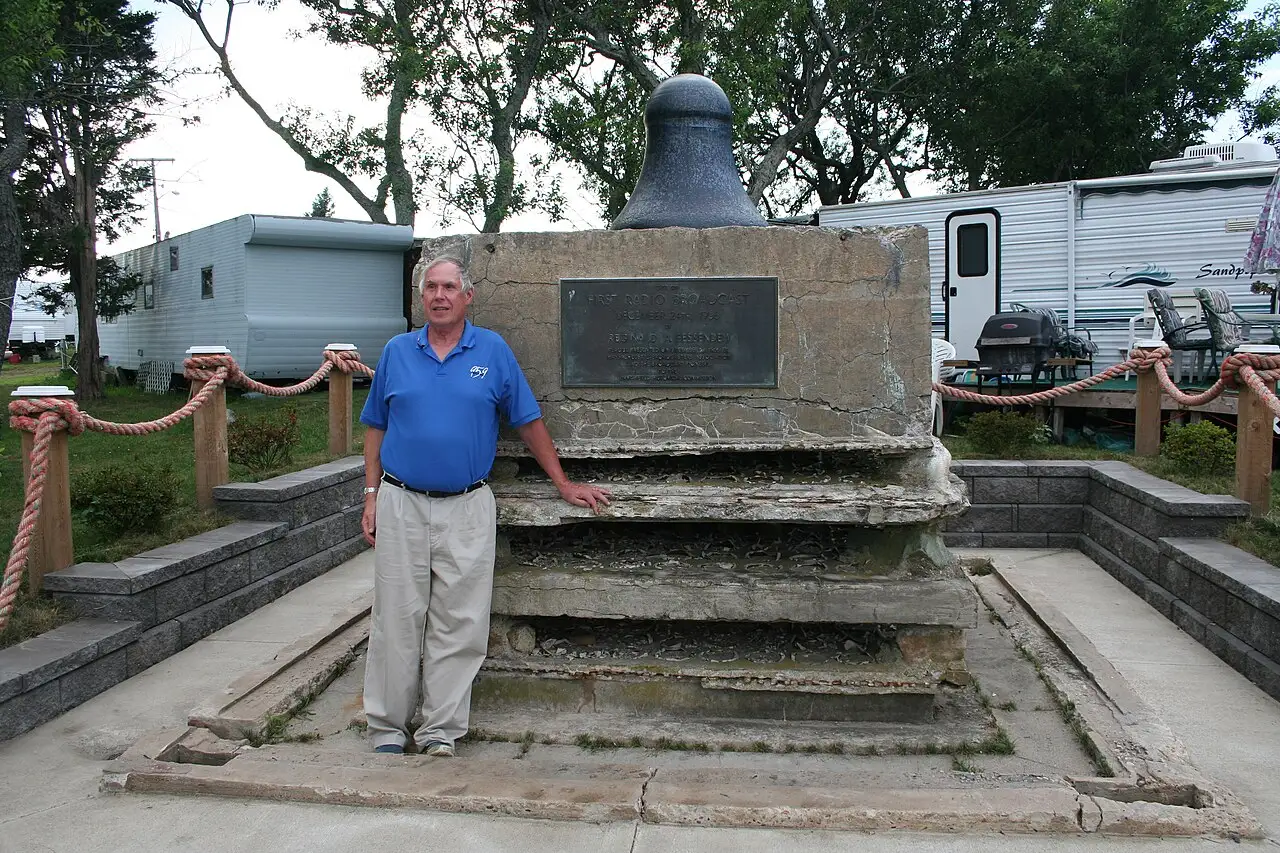
On Christmas Eve 1906, a few shipboard wireless operators off the Atlantic coast heard something impossible: music, drifting out of the night air. Then a voice, reading from the Bible. It was, as far as anyone knows, the first radio broadcast in history.
The man behind it was Reginald Fessenden, a Canadian inventor who had once worked as chief chemist in Thomas Edison's laboratory and would eventually hold more than 500 patents. Fessenden had become obsessed with a radical idea: instead of sending wireless signals as Morse code dots and dashes, why not send the human voice itself? He developed the principle of amplitude modulation - AM - that made it possible.
From a towering antenna station he had built at Brant Rock, Massachusetts, Fessenden transmitted a short Christmas program to the ships at sea. By his own account, it opened with a phonograph record of Handel's "Largo," followed by Fessenden himself playing the carol "O Holy Night" on the violin, then a song - and closed with the words from the Gospel of Luke: "Glory to God in the highest and on earth peace to men of good will."
The audience was tiny - wireless operators on U.S. Navy and United Fruit Company ships, some as far south as Norfolk, Virginia. But they were stunned: voices and music where only Morse code had ever been. Fessenden repeated the trick on New Year's Eve.
Fessenden never became a broadcasting mogul. His backers cared about Morse code services, not music, and the partnership eventually dissolved into a long lawsuit. But he kept inventing - wireless signals, radio compasses, submarine signaling devices, even early forms of sonar - until his death in 1932. The Christmas Eve broadcast remained his most poetic achievement: a scientist who believed the air itself could carry a human voice, proving it on a silent winter night.
A note of honesty: the details come from Fessenden himself, in a letter he wrote in 1932 describing that night - the first widely publicized account appeared only then, a quarter-century later. Historians still debate parts of the story. But the engineering milestone behind it is not in doubt: the IEEE has designated the Brant Rock broadcast a milestone in electrical engineering, and Fessenden's work on voice transmission led directly to the AM radio that would fill the twentieth century with music, news, and ballgames.
Why it matters: before that Christmas Eve, wireless was a telegraph - point to point, dots and dashes. After it, the idea of broadcasting existed: one voice, sent into the air for anyone to hear. Every radio station, every podcast, every livestream descends from a violin playing a Christmas carol over the Atlantic.
Photo: Garrett A. Wollman, CC BY 2.5 (via Wikimedia Commons).