The Night Mars Came Closer Than Ever
On August 27, 2003, Mars swung closer to Earth than it had in nearly 60,000 years — and millions of people stayed up to watch the red planet blaze.
For weeks, the red planet had been swelling in the night sky — brighter and bigger than anyone alive had ever seen it. Backyard telescopes were selling out. Planetariums were booking overflow crowds. And on August 27, 2003, at 5:51 in the morning Eastern time, Mars reached its closest approach to Earth in nearly 60,000 years: a mere 34.6 million miles away.
To put that in perspective: Mars and Earth are dance partners that never quite touch. Their orbits bring them relatively close every 26 months, but most of those meetings are distant affairs — 60 million miles or more. The 2003 encounter was special because Mars was near the closest point of its orbit to the sun at the same time Earth swung by, closing the gap to the tightest it had been since the Stone Age. The last time the two planets were this close, Neanderthals still walked the Earth.
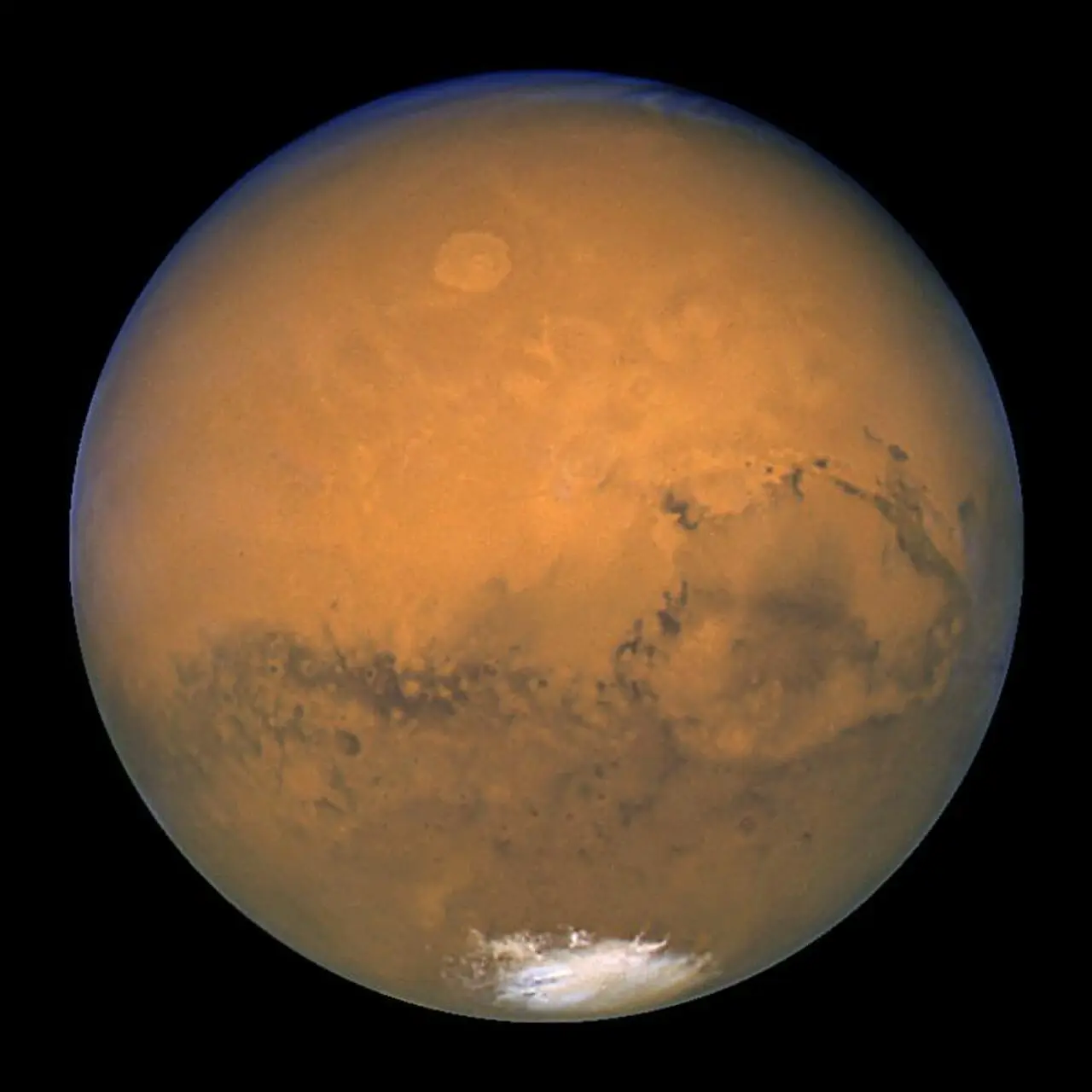
Astronomers were thrilled. The Hubble Space Telescope turned its unblinking eye toward Mars — the image above, taken on August 27 itself, shows the planet in remarkable detail, its polar ice cap gleaming white at the bottom. For observers on the ground, Mars blazed at magnitude minus 2.9, outshining everything in the night sky except Venus and the Moon. All you had to do was look southeast after dark, where an impossibly bright orange-red "star" hung low and steady.
Not everyone got the science right. A breathless email began racing around the internet that summer, claiming Mars would appear as large as the full Moon to the naked eye. It was nonsense — Mars never looked bigger than a bright star — but the email proved immortal, resurfacing and going viral again with every close approach for years afterward. Astronomers spent the next decade patiently debunking it, and newspapers had to explain, over and over, that no telescope on Earth could make Mars look moon-sized.
The 2003 close approach was more than a skywatching party. It was a reminder of how the clockwork of the solar system can still surprise us — and of how a little red dot in the sky can unite millions of strangers in a shared moment of wonder. Mars won't come this close again for centuries. Everyone who looked up that August night saw something no human had seen in 60,000 years — and no human will see again anytime soon.
Photo: NASA Hubble, CC BY 2.0 (via Wikimedia Commons).