The Nickel That Invented Paid Parking
On July 16, 1935, the world's first parking meter was installed in Oklahoma City — the brainchild of a newspaperman who had once helped expose the Teapot Dome scandal.
The next time you feed a parking meter, you can curse a man named Carl C. Magee.
By the early 1930s, downtown Oklahoma City had a problem familiar to every American city: too many cars, too few parking spaces. Store owners fumed as office workers parked in front of their shops all day, while shoppers circled the block. The city asked its Chamber of Commerce to find a solution, and the Chamber turned to Magee, the editor of the Oklahoma News.
Magee was a character. As a young reporter in Albuquerque, he had helped uncover the Teapot Dome scandal, the bribery scheme that sent a U.S. cabinet secretary to prison. He had exposed corruption in the New Mexico court system — and had once been tried and acquitted of manslaughter after shooting at one of the judges he had written about during a hotel altercation. Inventing the parking meter was, by his standards, a quiet chapter.
Magee sponsored a contest at the University of Oklahoma for a timing device to allocate parking time, then developed his own design and filed for a patent on May 13, 1935. With a partner he formed the Magee-Hale Park-O-Meter Company. On July 16, 1935, the first production model — Park-O-Meter No. 1 — was installed on the southeast corner of First Street and Robinson Avenue in Oklahoma City. By the end of the day, 175 meters lined downtown curbs, charging a nickel an hour.
Earlier attempts to tame the curb had been clumsy: in 1920 Los Angeles simply banned all daytime parking downtown, sparking parades of protesting motorists until the ban was lifted within the month. Magee's answer was mechanical and precise — early meters ran on a clock-type mainspring that needed periodic winding, charged a nickel an hour, and were set at 20-foot intervals along the curb.
Not everyone was thrilled. Opponents called paying for parking un-American — a tax on their cars, depriving them of money without due process. Lawsuits followed. But the meters worked: turnover improved, shoppers found spaces, and within three days merchants on the meterless side of the street were demanding meters of their own. By the end of the 1940s, more than 100,000 parking meters stood on curbs across America.
Why it matters: The parking meter was one of the first machines to automate city life — a coin-operated referee for the most contested real estate in town: the curb. We're still arguing about it.
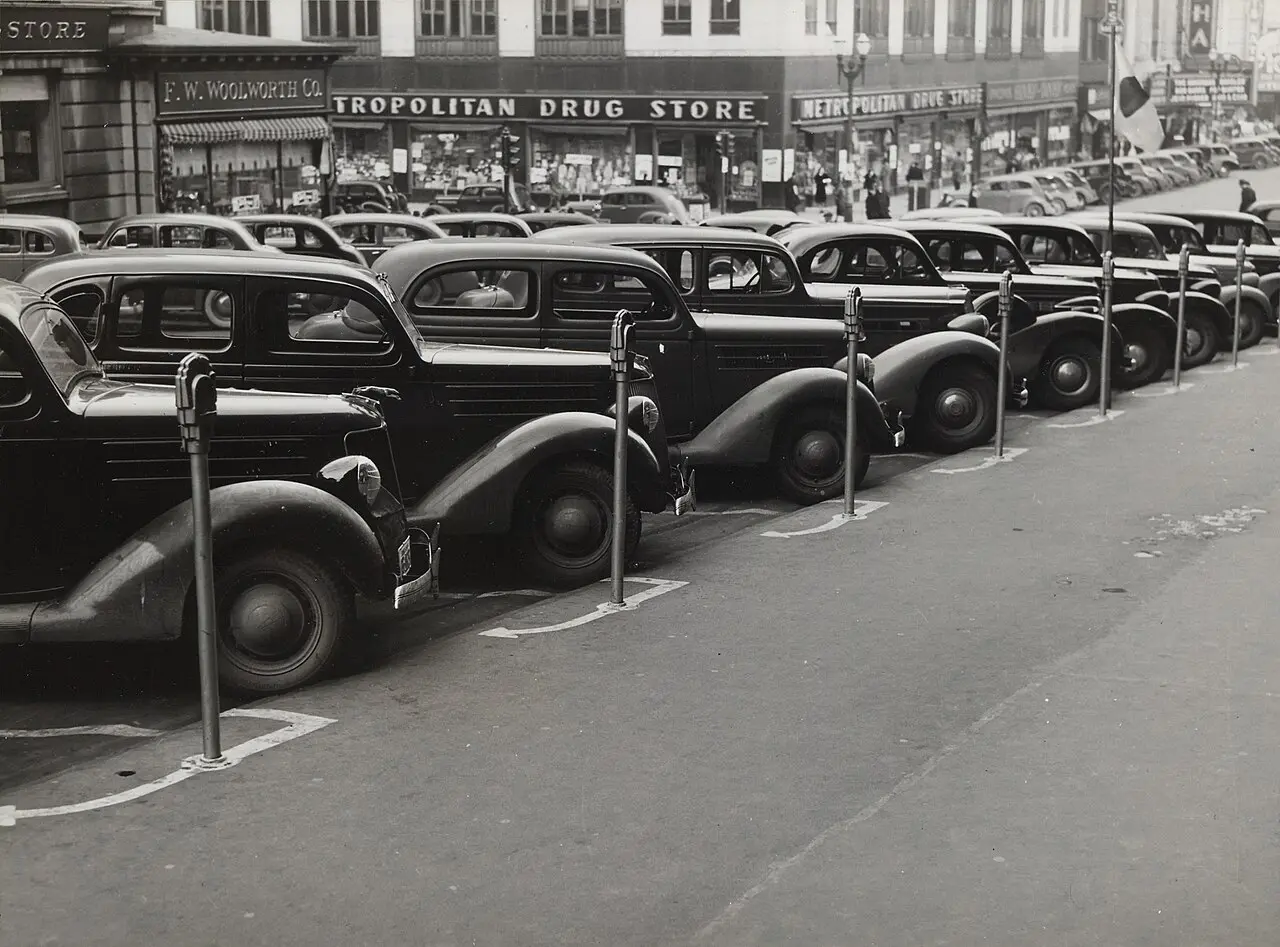
Photo: John Vachon, public domain via the Library of Congress / Wikimedia Commons. The 1938 photo shows cars parked diagonally along parking meters in Omaha, Nebraska, in the early years of metered parking.