The Dinner-Table Deal That Built Washington, D.C.
On July 16, 1790, George Washington signed the Residence Act, creating a brand-new national capital on a swampy stretch of the Potomac River.
The capital of the United States was chosen the way most important things in politics get chosen: as part of a deal.
In 1790 the young republic's government was essentially homeless. Congress had met in New York and Philadelphia, and everybody agreed a permanent capital was needed — but nobody could agree where. The fight got tangled up with an even bigger fight: Treasury Secretary Alexander Hamilton wanted the federal government to assume the states' Revolutionary War debts, and Southern leaders, led by Secretary of State Thomas Jefferson and Representative James Madison, hated the idea.
So they made a trade. Over a private dinner, Jefferson agreed to round up Southern votes for Hamilton's debt plan. In exchange, Hamilton agreed to support a capital on the Potomac River, in the South, between Maryland and Virginia. The bargain passed Congress, and on July 16, 1790, President George Washington signed it into law: the Residence Act, formally "An Act for establishing the temporary and permanent seat of the Government of the United States."
The Act was remarkably specific. The new federal district would be a square, ten miles on each side — 100 square miles — on the Potomac. Washington himself would pick the exact site and appoint commissioners to oversee construction. It had to be ready by December 1800. Until then, Philadelphia would serve as the temporary capital.
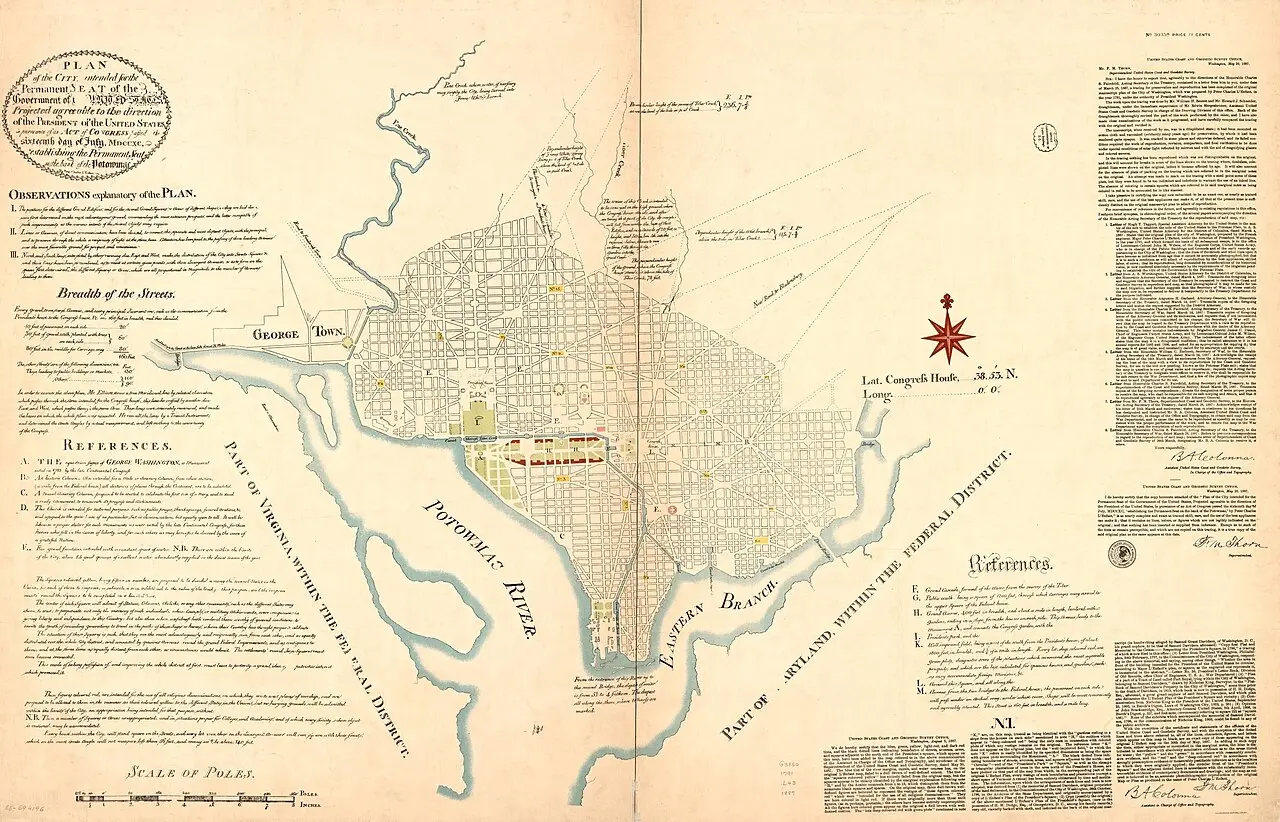
Washington chose the site, hired French-born architect Pierre Charles L'Enfant to design the city, and watched a swampy, mosquito-infested riverbank transform on paper into grand diagonal avenues. The commissioners named the federal district "The Territory of Columbia" and the new city "The City of Washington." L'Enfant placed the Capitol on Jenkins Hill with wide diagonal avenues cutting across the street grid — a plan you can still read in the city's bones today, even though L'Enfant was fired before it was finished and his assistant Andrew Ellicott completed the engraving. The city was named Washington; the district, Columbia. Washington never lived in the mansion he commissioned — it wasn't habitable until 1800, and John Adams became its first resident.
The compromise that built the capital is still visible in the city's DNA: a planned city, designed from scratch, sitting on land both Maryland and Virginia gave up.
Why it matters: Washington, D.C. exists because two political rivals each wanted something badly enough to give the other something. Every law made in that city since has been, in some way, a descendant of that deal.
Photo: plan of Washington, D.C. by Pierre Charles L'Enfant, 1791, public domain via Wikimedia Commons. The image shows L'Enfant's original street plan for the federal city.