
Liftoff: The Day Apollo 11 Left for the Moon
On July 16, 1969, a 363-foot Saturn V carried Neil Armstrong, Michael Collins, and Buzz Aldrin off Launch Complex 39A, beginning the first mission to land humans on the Moon.
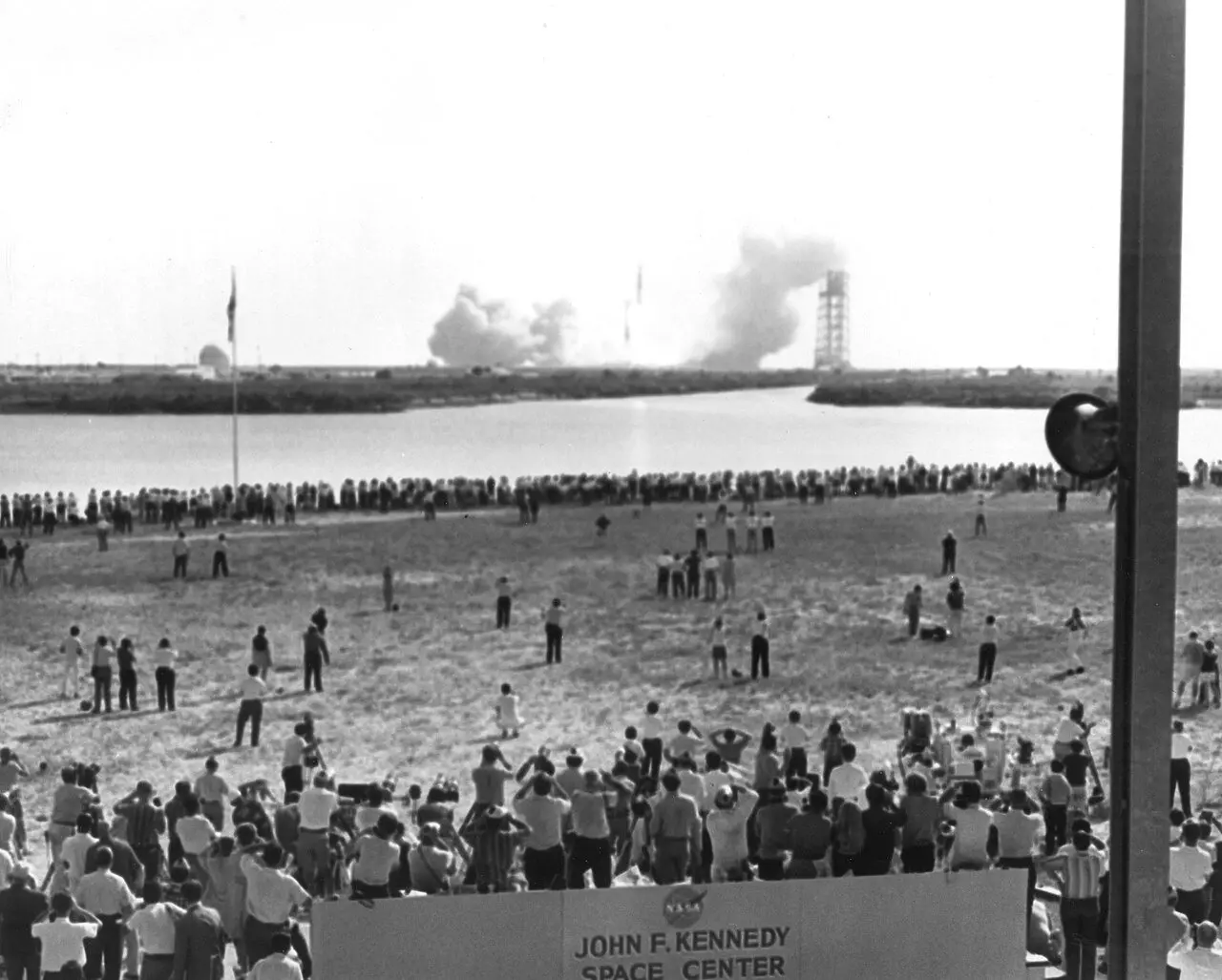
At 9:32 on a bright Wednesday morning in Florida, the ground began to tremble. On Launch Complex 39A at the Kennedy Space Center, a 363-foot Saturn V — the most powerful rocket NASA had ever built — held three men in its nose cone: mission commander Neil Armstrong, command module pilot Michael Collins, and lunar module pilot Edwin "Buzz" Aldrin. NASA's public-affairs voice, Jack King, counted it down, and then the roar began: "Liftoff! We have a liftoff."
Apollo 11 was the fifth crewed mission of NASA's Apollo program, and the first that would attempt to land on the Moon. The spacecraft had three parts: the command module Columbia, which would carry the crew home; the service module, which supplied power, oxygen, and propulsion; and the lunar module Eagle, a spidery two-stage craft designed to descend to the surface and then lift its crew back to lunar orbit.
The mission was the answer to a dare. On May 25, 1961, President John F. Kennedy had told Congress the nation should commit itself to "landing a man on the moon and returning him safely to the earth" before the decade was out. Eight years later, some 400,000 engineers, technicians, and contractors across the country had made it possible. The Soviet Union had led the early Space Race — first satellite, first human in orbit — and now, in front of the world, America was going for the grand prize.
The flight to the Moon began methodically. Twelve minutes after liftoff, Apollo 11 was in Earth orbit. After nearly two orbits, the third-stage engine reignited for the translunar injection burn, accelerating the spacecraft to about 25,000 miles per hour — fast enough to break Earth's grip and fall toward the Moon. Roughly half an hour later, the command and service module pulled away from the spent stage, turned around, and docked with the lunar module still folded in its adapter. The stack was on its way.
Three days later, the crew would slip into lunar orbit. On July 20, Armstrong and Aldrin would descend in Eagle to the Sea of Tranquility while Collins waited alone in Columbia. On July 24, all three would splash down in the Pacific Ocean and be picked up by the aircraft carrier USS Hornet. Every step of that journey — the first steps on another world — began with this one thunderous morning.
Apollo 11's launch remains the moment the impossible became a schedule. It was proof that a nation could set a deadline for the absurd — land on the Moon within the decade — and meet it, with slide rules and nerve and 7.5 million pounds of thrust. Every later mission, every rover on Mars, every plan to return to the Moon traces its lineage to 9:32 a.m. on July 16, 1969, when three men rode a tower of fire off the Florida coast and pointed it at the Moon.
Photo: NASA, public domain (via Wikimedia Commons).