The Morning an Entire Country Switched Sides of the Road
On September 3, 1967, at 5 a.m. sharp, all of Sweden moved its cars from the left side of the road to the right — and pulled it off.
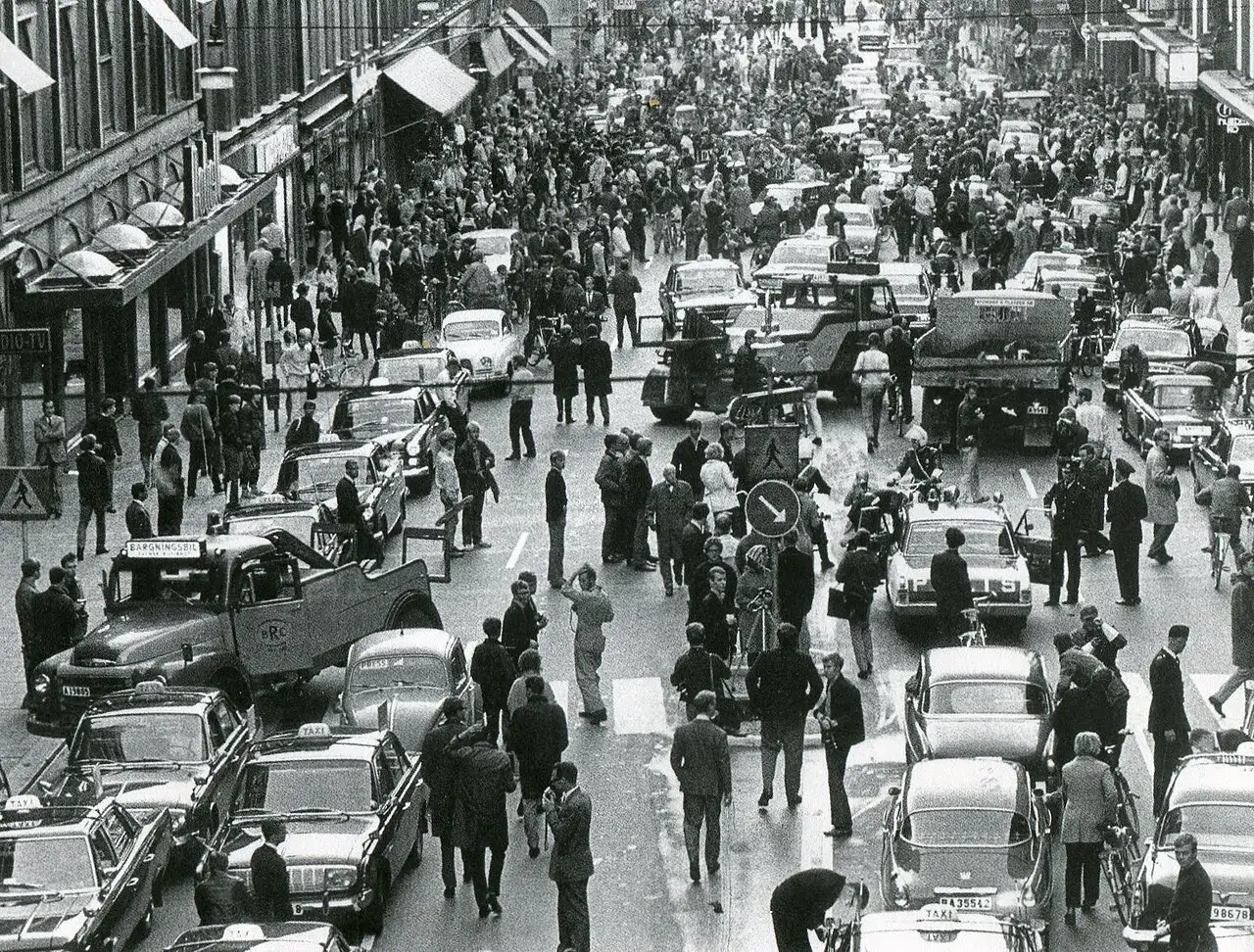
At five o'clock on a Sunday morning, an entire country pulled over — and switched sides.
Sweden had driven on the left since about 1734. By the 1960s this had become absurd. Every neighboring country — Norway, Finland, Denmark — drove on the right. Millions of vehicles crossed Sweden's borders each year, swapping sides at every crossing. And roughly 90 percent of Swedish cars were left-hand drive, built for right-side roads. Swedish drivers sat on the wrong side of their own vehicles, peering around the steering wheel into oncoming traffic every time they overtook.
Something had to give. In 1955 the government held a referendum, and 83 percent of Swedes voted to keep driving on the left. Eight years later, parliament overruled them and ordered the switch anyway.
What followed was one of the most meticulous operations in peacetime history. A special commission spent four years planning it. A national information campaign put the new logo on milk cartons, billboards, and television; a songwriting contest produced a theme tune. Road signs were covered, then uncovered overnight. Even the elk hunting season was rescheduled, so no distracted hunters would be on the roads.
The day was called Dagen H — H for högertrafik, right-hand traffic. In the small hours of Sunday, September 3, 1967, all non-essential traffic was banned. Vehicles on the road came to a complete stop. And then, at 5 a.m. sharp, on signal, every car in Sweden moved to the right-hand side of the road.
The British press had gathered, expecting carnage. They were disappointed. The accident rate dropped sharply after the switch — drivers were suddenly, wonderfully careful — and no fatal accidents were blamed on the changeover. Insurance claims fell by about 40 percent. The whole operation cost hundreds of millions of kronor. The following year, Iceland followed Sweden's example.
The campaign left behind some charming relics. Swedish drivers were issued pairs of colored gloves — right hand, right side — to drill the new habit into their hands. Headlamps sold in the months before Dagen H came with opaque decals stamped with a warning: not to be removed before September 3, 1967, so beams would not blind oncoming traffic after the flip. Sweden was taking no chances.
Behind the scenes, an army of workers spent the night before covering thousands of old road signs and uncovering thousands of new ones. Bus stops were moved. Intersections were repainted. Trams that could only open their doors on the old side were retired or rebuilt. When the first Monday morning rush hour arrived, the country ran on the right as if it had always done so — the accident count that day was unremarkable, which was the whole point.
Why it matters: Dagen H was the largest logistical event in Sweden's history — proof that with enough planning, an entire nation can change a centuries-old habit overnight. It remains the textbook example of how to do the impossible: carefully, all at once, and with everybody watching.
Photo: Unknown photographer, public domain (via Wikimedia Commons).