America's Second Landing on Mars Was a Rocky One
On September 3, 1976, NASA's Viking 2 lander touched down on Mars at Utopia Planitia, tilted on a rock, and began the first serious hunt for Martian life.
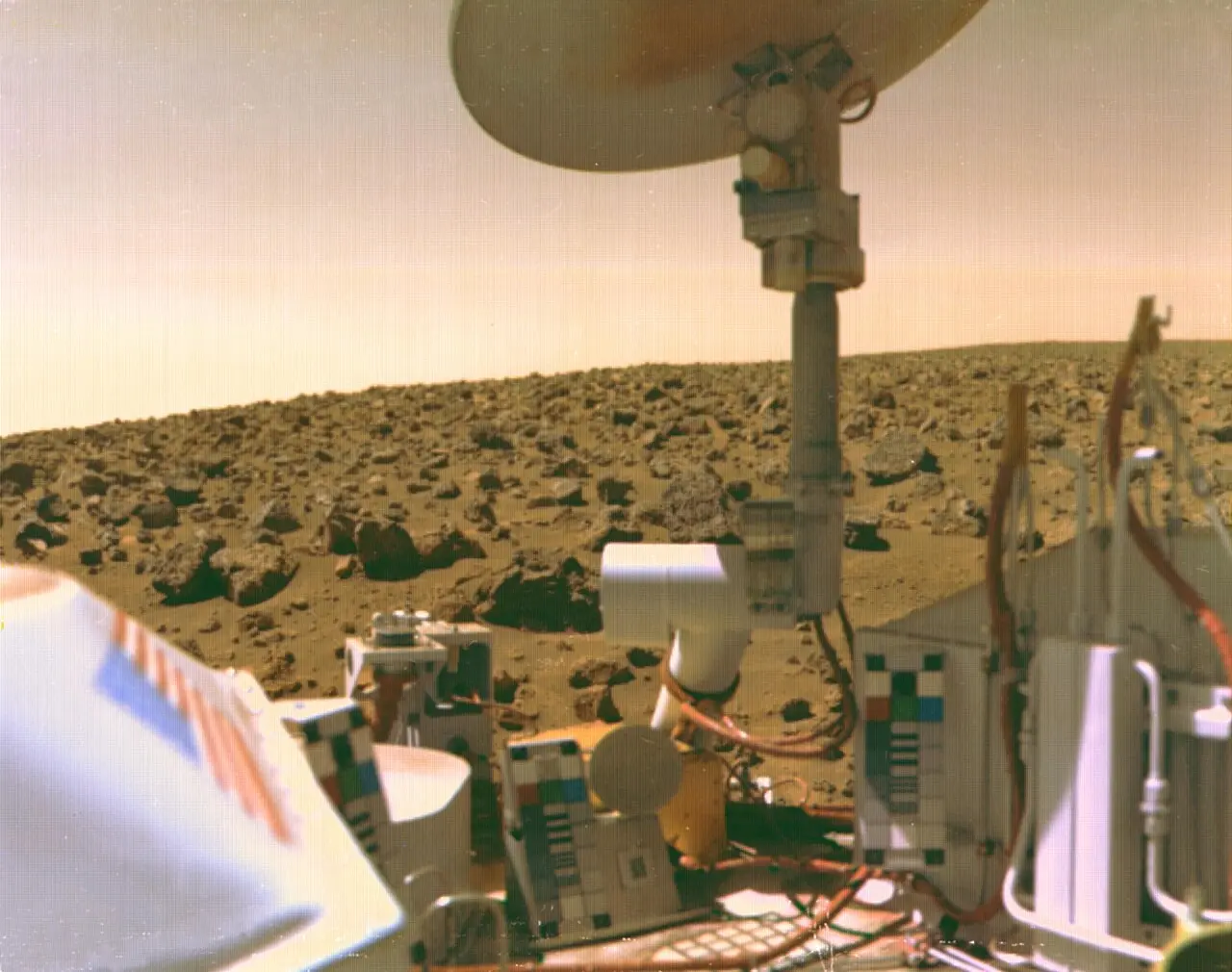
Six weeks after America first touched Mars, it did it again — and this time the landing was a little crooked.
The Viking 2 lander separated from its orbiter on September 3, 1976, and dropped through the thin Martian atmosphere toward a broad plain called Utopia Planitia, near the edge of the planet's north polar cap. Mission planners had chosen the spot carefully: water was thought to linger near the pole, and where there was water, there might — just might — be life.
The landing did not go exactly to script. The lander's radar mistook a rock, or some unusually reflective patch of ground, for the surface below. Its thrusters fired an extra burst four-tenths of a second too early, kicking up dust and cracking the soil. Viking 2 settled down with one leg resting on a rock, tilted at a jaunty 8.2 degrees. Its cameras started taking pictures immediately anyway.
Viking 2 was the twin of Viking 1, which had landed at Chryse Planitia on July 20, 1976. The two spacecraft, launched a few weeks apart in the summer of 1975 from Cape Canaveral, were the most ambitious planetary probes ever flown: each carried an orbiter for mapping and a lander packed with cameras, weather instruments, and a miniature biology laboratory.
The biology experiments were the heart of the mission — and its great unresolved argument. Three separate tests scooped up Martian soil and probed it for signs of life. They found unexpected, puzzling chemical activity, but nothing that clearly said living things are here. Scientists are still debating what Viking saw, nearly half a century later.
The lander was built to work for 90 days. It kept going for nearly four years, sending its last data home in April 1980. Its orbiter operated until July 1978. In 2001, the landing site was formally named the Gerald Soffen Memorial Station, for the Viking program's project scientist.
Viking 2 also left behind one of space exploration's most famous red herrings. While in orbit, its cameras photographed a region called Cydonia, where one blurry image showed a mesa that looked uncannily like a human face. The 'Face on Mars' launched a thousand conspiracy theories. Later, sharper spacecraft photos revealed it for what it was: an ordinary eroded hill, and a trick of light and shadow.
And the tilted lander kept its poise to the end. Somewhere out there, at the edge of the Martian polar cap, the little lander still sits on its rock, tilted at 8.2 degrees, waiting out the centuries in the thin red air.
Why it matters: the two Vikings were the first long-term science stations on another world — the first weather reports from Mars, the first soil chemistry, the first serious hunt for Martian life. And every American spacecraft that has landed on Mars since, from Pathfinder to the rovers, has ridden down on entry-and-descent designs descended from Viking's.
Photo: NASA, public domain (via Wikimedia Commons).