The Last Man to Fly Solo Around the Earth
On May 15, 1963, Gordon Cooper flew 22 orbits in Faith 7 — the last time an American ever launched alone into orbit.
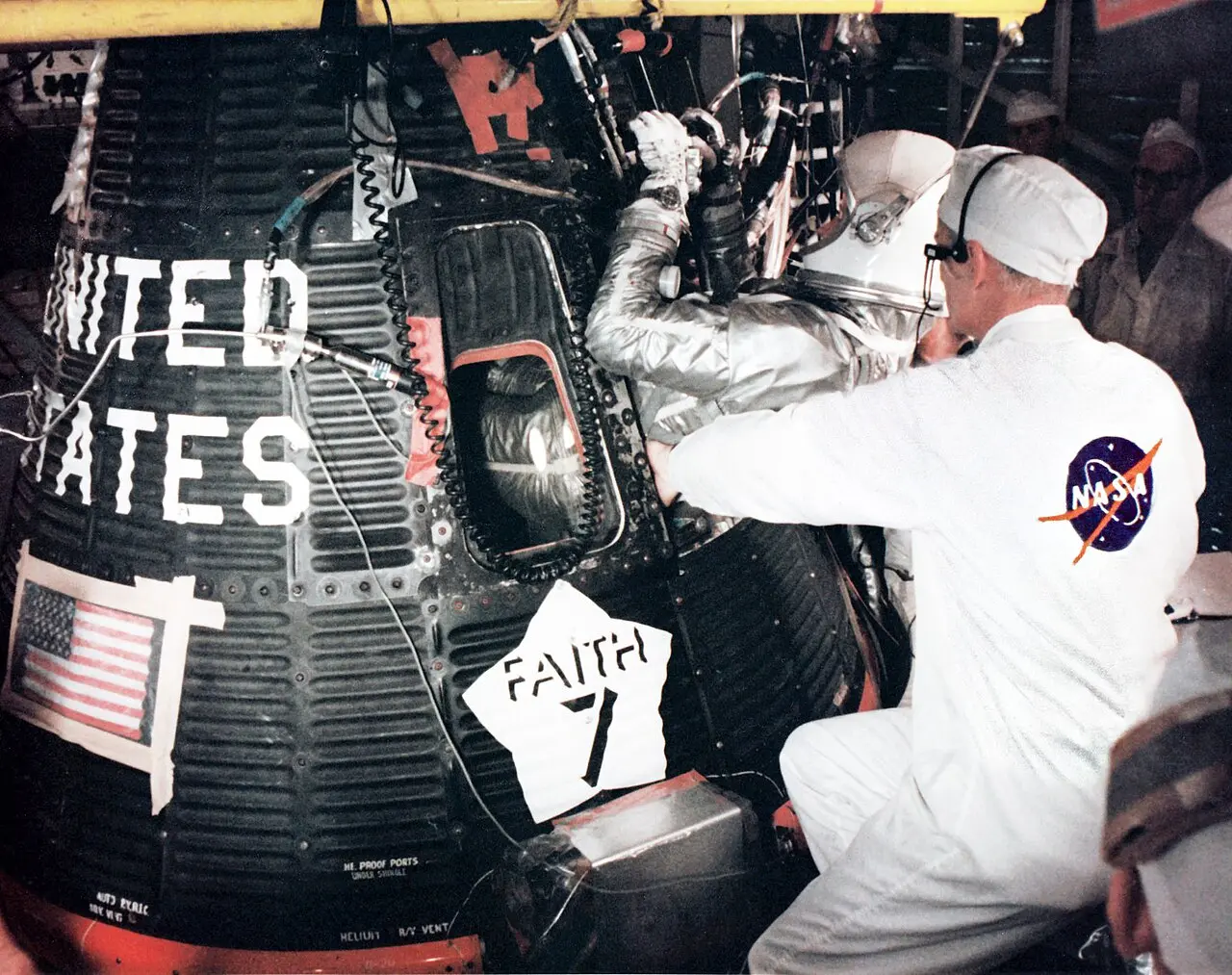
On the morning of May 15, 1963, Gordon Cooper squeezed into a capsule barely bigger than a phone booth and prepared to do something no American has ever done since: orbit the Earth entirely alone.
Mercury-Atlas 9 was the final crewed mission of Project Mercury, America's first human spaceflight program. Cooper's spacecraft, Mercury capsule No. 20, was named Faith 7 — every Mercury astronaut named his capsule with a '7,' for the Mercury Seven. The Atlas rocket, No. 130-D, lifted off from Launch Complex 14 at Cape Canaveral at 8:04 that morning. After a scrubbed launch the day before, the flight went.
It was the longest American flight yet: 22 orbits over 34 hours, 19 minutes, and 49 seconds — nearly four times the length of Walter Schirra's mission the year before. Cooper ran eleven experiments, ejected a flashing beacon from the capsule's nose to test whether an astronaut could track objects in space, and carried the first in-flight television camera flown on a U.S. mission. Mid-flight, with little left to do, he let the capsule drift and slept as best he could — the first man to sleep in space.
Then things broke. Late in the flight, the automatic control system and then the electrical system malfunctioned. Cooper had trained for exactly this. He took the controls and flew the re-entry by hand — by eye, by wristwatch, by feel — the way the Mercury astronauts had insisted a pilot should be able to. He still made one of the most precise splashdowns of the program, landing in the Pacific Ocean near the recovery carrier Kearsarge.
The mission mattered for the Space Race. The Soviets had already flown multi-day missions, and NASA was eager to close the gap. Some had argued the flight was unnecessary — Schirra's mission had gone nearly perfectly, and Gemini was waiting. But NASA needed to know whether a human could function for a full day in orbit, and Cooper answered it.
Faith 7 closed out Project Mercury on a triumph. Within a few years, two-man Gemini crews and then Apollo would make solo flight ancient history. Gordon Cooper's 22 orbits remain the last time an American was launched alone to fly an entirely solo orbital mission — the end of the era when one man, one capsule, and a steady hand were all the space program had.
Photo: NASA, public domain (via Wikimedia Commons).