The Jumbo Jet That Became a Glider
On July 23, 1983, Air Canada Flight 143 ran out of fuel at 41,000 feet — and its crew glided the powerless Boeing 767 to a miraculous landing on a Manitoba drag strip.
At 41,000 feet over northern Ontario, both engines went silent.
It was July 23, 1983, and Air Canada Flight 143 — a nearly new Boeing 767 bound from Montreal to Edmonton, with a stop in Ottawa — had run out of fuel. Not low on fuel. Out. The cockpit filled with warning lights, the electronic displays went dark, and the great airliner, one of the most advanced jets in the sky, became the world's largest glider.
How does a modern jetliner run dry? It took a chain of small failures. The plane's fuel-quantity indicator had broken, and the only spare was broken too, so the crew measured the fuel by hand with a dripstick. Then came the fatal arithmetic: Canada was switching from imperial to metric measurements, and the ground crew and pilots confused pounds with kilograms when converting the fuel load. The 767 took off carrying only about 45 percent of the fuel it needed.
In the cockpit were Captain Robert Pearson and First Officer Maurice Quintal. When the left engine flamed out, Pearson immediately turned toward Winnipeg. Then the right engine died too. At 35,000 feet, with no power, most of the instruments dead, and 61 passengers and 8 crew aboard, the two men had to find somewhere — anywhere — to land.
Here, luck and preparation collided. Quintal had once been stationed with the Royal Canadian Air Force at Gimli, Manitoba, and he knew of a decommissioned airfield there. Pearson, it turned out, was an experienced glider pilot. Together they aimed the silent 767 at Gimli, gliding it down in a long, powerless descent. To lose height without gaining fatal speed, Pearson performed a maneuver called a sideslip — skidding the giant jet sideways through the air, the way glider pilots do.
There was one problem: the old airfield had been converted into the Gimli Motorsports Park. As the 767 dropped toward the runway, the crew could see it — the strip was in use that day as a drag-racing track, with spectators and cars near the runway. Pearson set the plane down hard; the nose gear collapsed on impact. The jet screeched to a stop just short of the racing crowd.
All 69 people aboard survived. There were no serious injuries — not among the passengers and crew, and not among the stunned spectators on the ground. The aircraft, nicknamed the "Gimli Glider," was repaired and went on to fly for Air Canada for another 25 years, until its retirement in 2008. Today, an exhibit in Gimli, Manitoba, commemorates the landing.
Why it matters: the Gimli Glider is aviation's great parable of how a stack of small, ordinary errors can line up to create a catastrophe — and how human skill can still snatch survival from the jaws of one. It changed fueling procedures around the world, and it remains the most famous powerless landing in commercial aviation history: a 130-ton airliner, no engines, no instruments, brought home by two pilots who refused to give up.
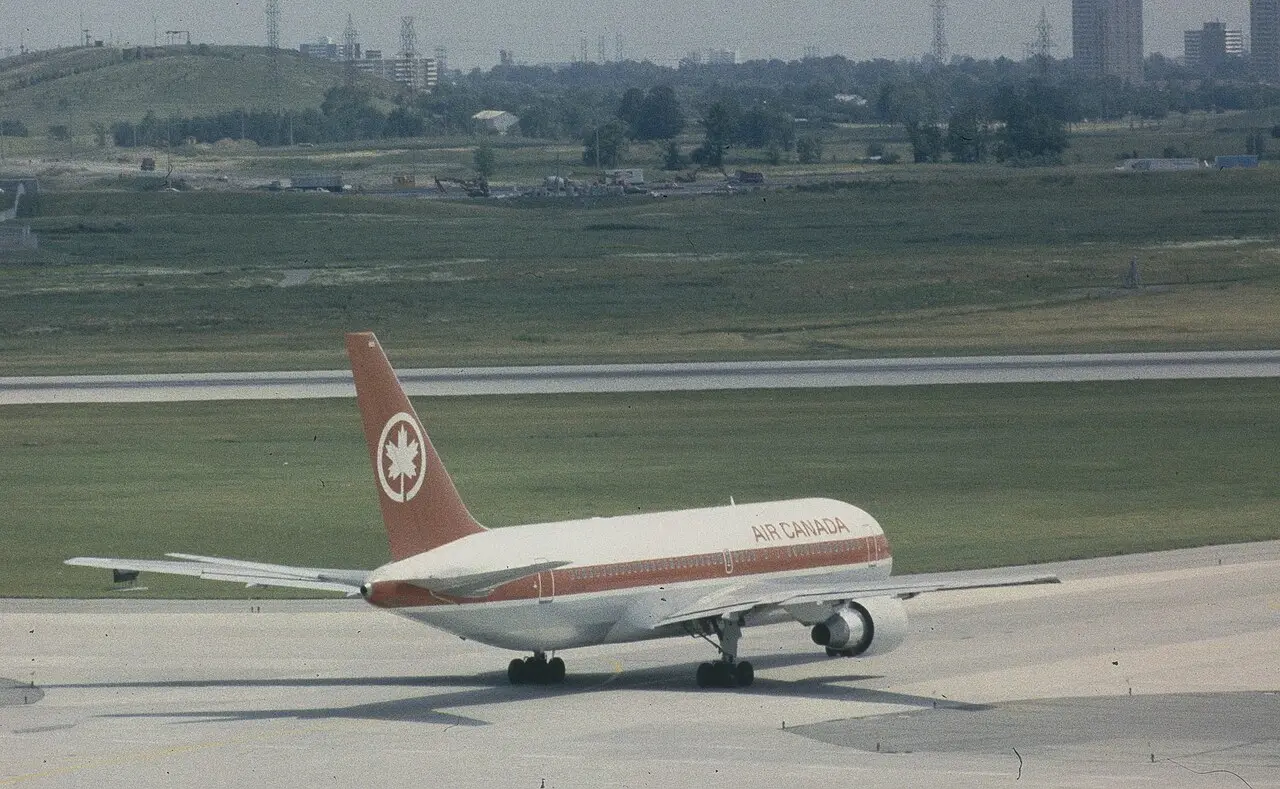
Photo: Air Canada Boeing 767 C-GAUN — the Gimli Glider itself — on the tarmac in Toronto in 1984, a year after the incident. Photograph by Andrew Thomas, licensed under CC BY-SA 2.0 via Wikimedia Commons.