The First American Typewriter — Patented in the Michigan Woods
On July 23, 1829, Michigan surveyor William Austin Burt patented the 'Typographer' — the first working typewriter built in America, though its own demonstrator apologized for the crooked letters.
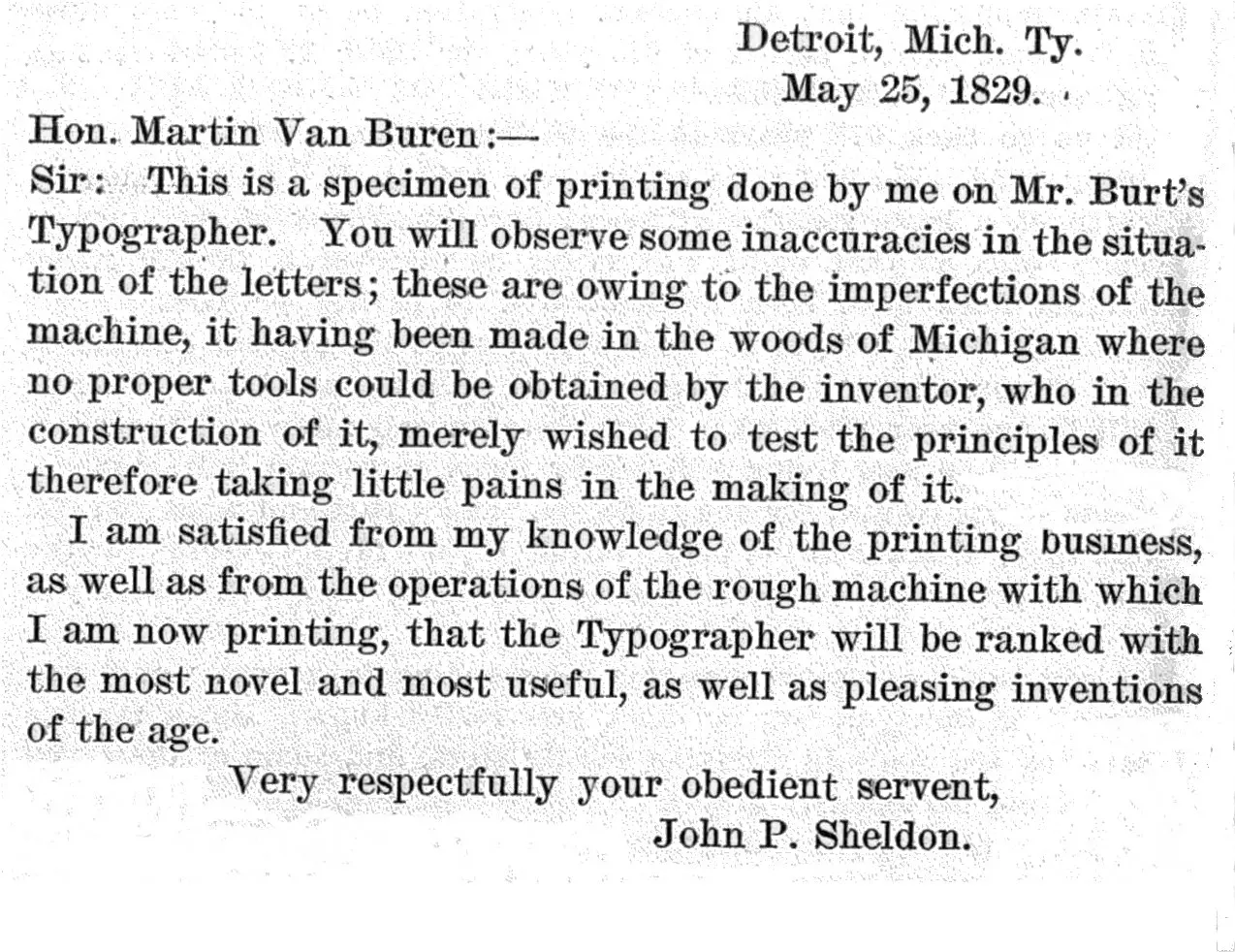
The machine was built in the woods of Michigan, where no proper tools could be found.
William Austin Burt was a surveyor from Detroit — one of the men who mapped the wild frontiers of Michigan and Wisconsin in the 1820s, a profession that demanded patience, precision, and ingenuity. Somewhere along the way, Burt began to wonder: why should every letter, every contract, every government form have to be written out by hand, slowly and full of errors? What if a machine could do the writing?
On July 23, 1829, Burt received a United States patent for his answer. He called it the "Typographer." The patent — signed by President Andrew Jackson himself — described a mechanical device that could press individual letters of type onto paper, one at a time, at the pull of a lever. It was the first typewriter ever constructed in America, and according to the Patent Office's own records, "the actual construction of a type writing machine for the first time in any country."
Burt was not the first person to dream of such a machine. In 1714, an English engineer named Henry Mill had been granted a British patent for a writing device — but he never built it. An Italian inventor, Pellegrino Turri, had constructed a machine in 1808, but it never caught on. Burt's Typographer was the first one actually built and put to practical work on American soil.
How rough was it? We know, because a sample survives. In May 1829, a man named John P. Sheldon typed a letter to Secretary of State Martin Van Buren on Burt's machine as a demonstration. Sheldon apologized in the letter itself for the crooked letters: the inaccuracies, he explained, were "owing to the imperfections of the machine, it having been made in the woods of Michigan where no proper tools could be obtained by the inventor." Still, Sheldon told Van Buren he believed the Typographer would rank "with the most novel and most useful, as well as pleasing inventions of the age."
Burt's machine never became a commercial product, and the original working model was destroyed when the U.S. Patent Office burned down in 1836. For decades, Burt was nearly forgotten — until his own great-grandson built a working reproduction of the Typographer for the 1893 Chicago World's Fair, based on a surviving copy of the patent. That model eventually found its way to the Smithsonian Institution, where it still testifies to Burt's achievement. The word "typographer" itself stuck: for decades, every writing machine was called a typographer, until "type-writer" took over in the 1870s.
Burt, meanwhile, went on to an extraordinary career: he patented a solar compass for surveying, and in 1844 he discovered the great Marquette iron-ore range in Michigan's Upper Peninsula. But his Typographer — patented on a July day in 1829 — was the seed of an idea that would transform offices, newsrooms, and literature itself.
Why it matters: every keyboard you have ever touched descends from machines like Burt's. The typewriter gave the world legible documents, faster business, new jobs for a generation of typists, and eventually the computer keyboard under your fingers today. Burt built his in the Michigan woods with no proper tools — and changed how humanity writes.
Photo: A letter typed by John P. Sheldon on William Austin Burt's Typographer in May 1829 as a demonstration for Secretary of State Martin Van Buren (public domain via Wikimedia Commons).