The Iron Lady Takes Downing Street: Thatcher Wins, 1979
On May 3, 1979, Margaret Thatcher won Britain's general election, becoming the country's first female prime minister.
On Thursday, May 3, 1979, Britain went to the polls — and changed history. When the votes were counted, Margaret Thatcher's Conservative Party had ousted James Callaghan's Labour government with a parliamentary majority of 43 seats. The Conservatives took 43.9 percent of the vote, and the general election was held on the same day as local elections across Britain. The next morning, invited by Queen Elizabeth II to form a government, Thatcher walked through the door of 10 Downing Street as Britain's first female prime minister — and Europe's first elected woman head of government.
The road there had been long. Born in 1925 above her father's grocery shop in Grantham, Thatcher studied chemistry at Oxford — where she became the first woman president of the university's Conservative Association — and was elected to Parliament for Finchley, in north London, in 1959. She rose quickly through the ranks, serving as education secretary under Edward Heath, and in February 1975 she became the first woman to lead the Conservative Party.
She was married to businessman Denis Thatcher, and the couple had twins. In opposition she had already remade her party's politics, calling for the privatization of national industries and a resolute defense of Britain's interests abroad. The 1979 victory would be the first of four consecutive Conservative election wins.
By 1979 Britain was in crisis. The "Winter of Discontent" — months of crippling strikes through the winter of 1978–79 — had paralyzed the country, inflation had recently topped twenty percent, unemployment was above 1.5 million, and Callaghan's government fell to a vote of no confidence that March. Thatcher promised national renewal: taming inflation, curbing the power of the unions, and selling off state-owned industries.
Standing outside Downing Street on May 4, she borrowed the words of St. Francis of Assisi: "Where there is discord, may we bring harmony." What followed was more than a decade of transformation — privatizations, fierce battles with the unions, victory in the 1982 Falklands War, and re-election in 1983 — that made her one of the most influential and controversial leaders of the 20th century, and a model for a generation of politicians worldwide.
Why it matters: Thatcher's election proved that the highest office in the land was open to anyone — even a grocer's daughter from Grantham. Love her or loathe her, no one disputes that she changed what leadership could look like.
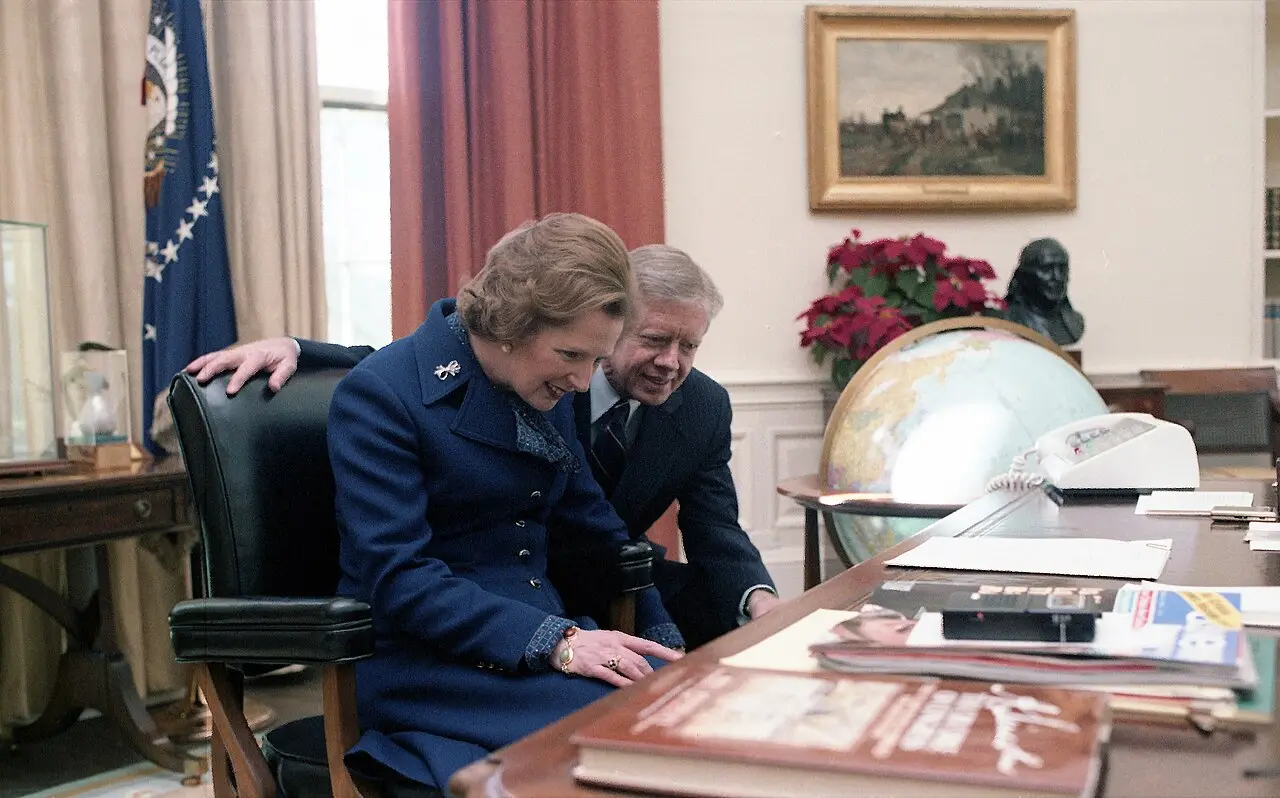
Photo: White House photo office, public domain (via Wikimedia Commons). (Thatcher with U.S. President Jimmy Carter at the White House in 1979.)