The Great Comet of 1997 Came Closest on This Night
On March 22, 1997, Comet Hale-Bopp made its closest approach to Earth — the dazzling visitor that won't return for another 2,400 years.
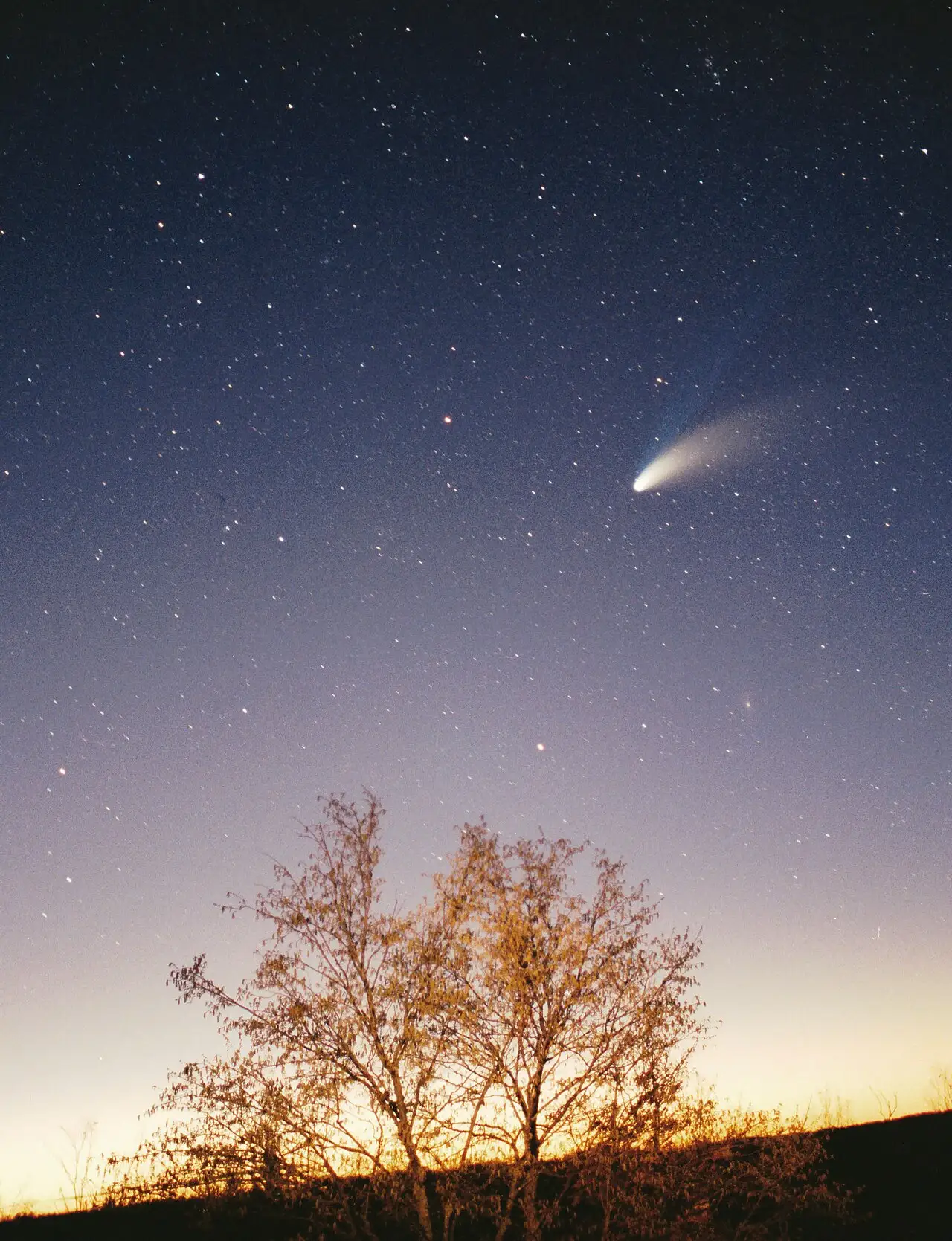
On the night of March 22, 1997, if you stepped outside and looked up, you couldn't miss it: a blazing star with two tails — one blue, one golden — hanging over the rooftops like a celestial exclamation point. Comet Hale-Bopp was making its closest approach to Earth, and much of humanity was watching.
The comet had been a long time coming. On July 23, 1995, two amateur astronomers — Alan Hale in New Mexico and Thomas Bopp in Arizona — independently spotted a fuzzy blob near the globular cluster M70 and reported it the same night. It was the farthest comet ever discovered by amateurs, and even at that great distance it shone a thousand times brighter than Halley's Comet had at the same range. Astronomers held their breath: comets are famously unpredictable — "like cats," as comet discoverer David Levy once quipped, "they have tails, and they do precisely what they want." After the fizzle of the overhyped Comet Kohoutek in 1973, nobody wanted to promise a show.
Hale-Bopp delivered. Visible to the naked eye from May 1996, it emerged from behind the sun in January 1997 already bright enough to spot from light-polluted cities. By February it glowed at second magnitude with a growing pair of tails — the straight blue gas tail pointing directly away from the sun, the curving yellowish dust tail sweeping along its orbit. On March 9, eclipse watchers in China, Mongolia, and Siberia even saw it in broad daylight during a total solar eclipse.
Then came March 22: closest approach, 1.315 astronomical units — roughly 122 million miles, a little farther from us than the sun is. The comet kept brightening toward perihelion on April 1, when it outshone every star in the sky except Sirius, its dust tail stretching 40 to 45 degrees — nearly a quarter of the heavens. Unlike most great comets, which hug the sun, Hale-Bopp hung high and visible all night for Northern Hemisphere watchers, glowing well before the sky was fully dark.
It was also the first great comet of the internet age. Websites tracking its progress drew enormous audiences, and daily photos poured in from around the world — an unprecedented global skywatch. Scientists got their share too: space telescopes studied a nucleus some 19 to 25 miles across — gigantic by comet standards — and discovered a thin third tail made of sodium atoms, never seen before in any comet.
Hale-Bopp won't be back for roughly 2,400 years; its next return is expected around the year 4397. For the generation that watched it in the spring of 1997, it was a once-in-a-civilization sight — a reminder that the sky still holds wonders no screen can fully contain. Step outside on a clear March night and look up: the universe is still putting on shows.
Photo: Philipp Salzgeber, CC BY-SA 2.0 Austria, via Wikimedia Commons.