The East Is Red — Broadcasting from Orbit
On April 24, 1970, China launched Dong Fang Hong 1, a 173-kilogram satellite that broadcast 'The East Is Red' from orbit, making China the fifth nation to reach space on its own rocket.
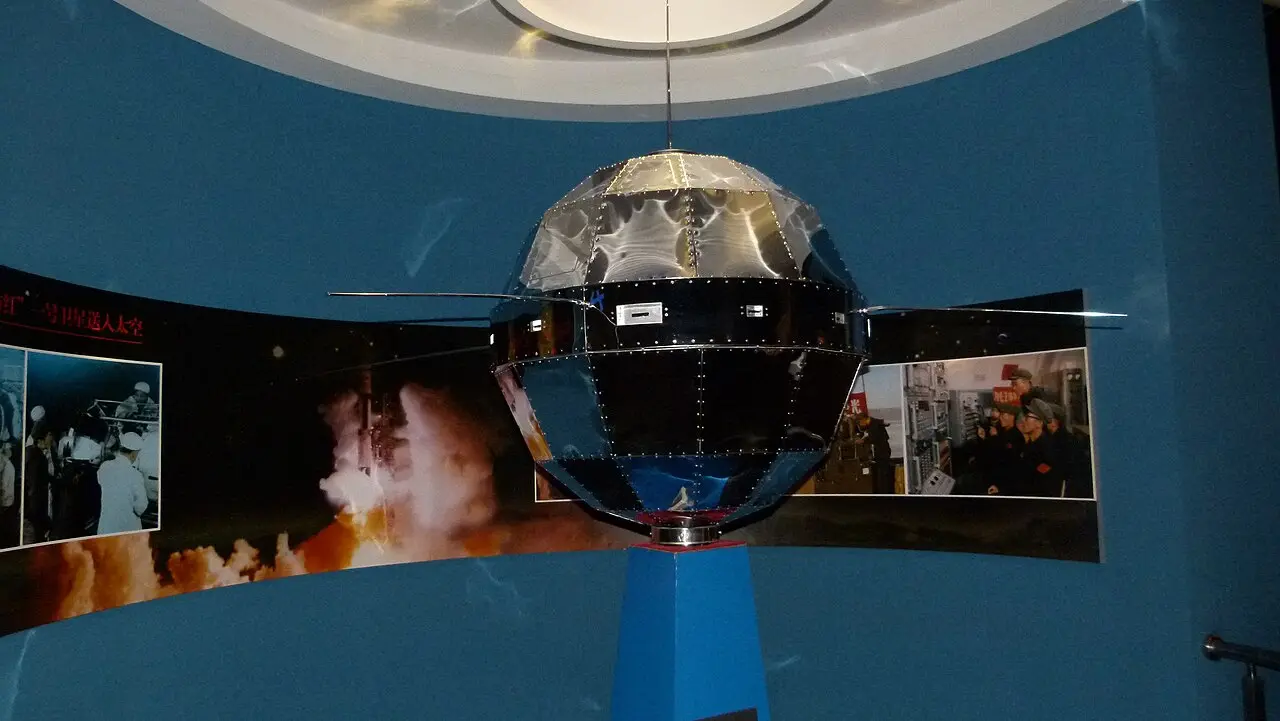
At 9:35 on the evening of April 24, 1970, a Long March 1 rocket rose over the Gobi Desert from the Jiuquan launch center, carrying a polished metal sphere about a meter across. Thirteen minutes later, China had its first satellite in orbit — and anyone with a shortwave radio could hear it. Looping from the little spacecraft, over and over, came the melody of "The East Is Red."
Dong Fang Hong 1 — "The East Is Red 1" — weighed 173 kilograms (381 pounds), heavier than the first satellites of the other spacefaring nations combined. Its body was a symmetrical 72-sided polyhedron, spinning 120 times a minute for stability, with four whip antennas more than two meters long. Aboard was a simple radio transmitter with an unusual payload: a music player loaded with "Dong Fang Hong," the revolutionary song that served as China's unofficial anthem. For twenty days the satellite broadcast the tune along with streams of telemetry, falling silent on May 14.
The mission was officially about engineering — testing satellite technology and taking readings of the ionosphere and upper atmosphere. But nobody missed the symbolism. The Soviet Union had stunned the world with Sputnik in 1957; the United States had answered; France and Japan had joined the club. The flight was also the maiden voyage of the Long March 1 rocket. Now, thirteen years after Sputnik, China became the fifth nation to put a satellite into orbit with its own rocket — built under the direction of Qian Xuesen, the rocket scientist often called the father of China's space program, with Sun Jiadong responsible for the satellite itself.
The satellite settled into an elliptical orbit swinging from 441 to 2,386 kilometers above the Earth. Emboldened by the triumph, Qian Xuesen proposed that China develop a crewed space program — and Mao Zedong himself signed his approval on the report. The launch had the atmosphere of a state secret wrapped in a parade: the satellite traveled to the launch site by train, with armed guards posted between every pair of electricity poles along the route.
The satellite that sang for three weeks founded a space program that, decades later, would put astronauts in orbit, a station in the sky, and rovers on the Moon and Mars. On April 24, 1970, the newest member of the space club announced itself the only way it knew how: with a song, circling the Earth every 114 minutes.
Photo: Brücke-Osteuropa, CC0 (via Wikimedia Commons).