The Day the World Drew a Line in the Stars
On January 27, 1967, the United States, the Soviet Union, and Britain signed the Outer Space Treaty — the law that still keeps nuclear weapons off the Moon and out of orbit.
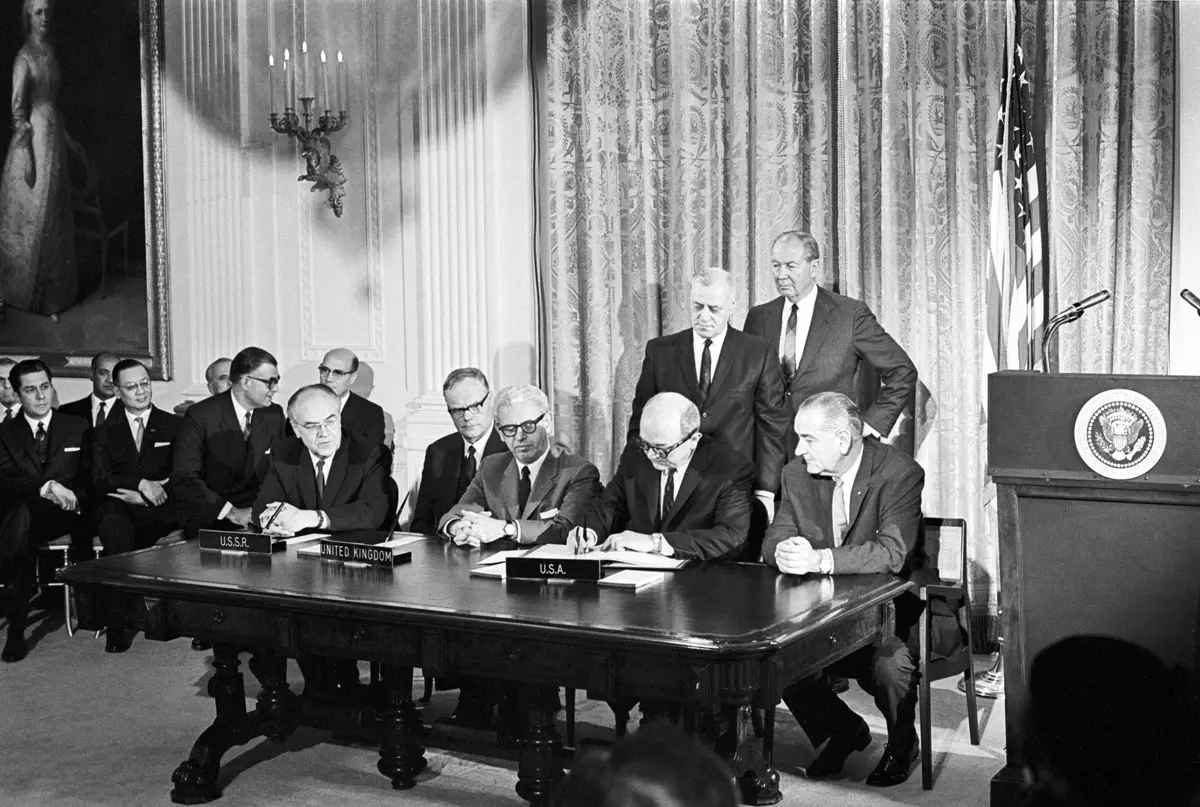
On January 27, 1967, in the East Room of the White House, President Lyndon B. Johnson watched as the United States, the Soviet Union, and Britain put their names to a document that drew the first legal borders in outer space. That same day, in London and Moscow, more pens signed the same text: the Outer Space Treaty, the foundation of all space law.
The timing was no accident. A decade after Sputnik, the space race was accelerating toward the Moon — and so was the fear that the Cold War would follow humanity into the heavens. What if the superpowers put nuclear weapons in orbit, or claimed the Moon as territory? In December 1966, the United Nations General Assembly approved the treaty text by acclamation, and on January 27 it was opened for signature in the three capitals. Around the table in Washington sat figures like U.S. Secretary of State Dean Rusk, Soviet Ambassador Anatoly Dobrynin, and Britain's Sir Patrick Dean.
Its rules were revolutionary in their simplicity. No nation may place nuclear weapons or other weapons of mass destruction in orbit, on the Moon, or anywhere else in outer space. The Moon and other celestial bodies may be used only for peaceful purposes — no military bases, no fortifications, no weapons tests, no war games. No country can claim sovereignty over the Moon or any part of space; exploration must be carried out "for the benefit of all peoples." Nations are responsible for their space activities, and liable for damage their objects cause.
The treaty entered into force on October 10, 1967. Today, 118 nations are party to it — including every country capable of reaching space.
Its promise has held through every era since: the Apollo landings, the Space Shuttle, the International Space Station, and now the age of private spaceflight and planned Moon bases. Even as new questions arise — who owns resources mined from asteroids? — the treaty's core principle stands: space belongs to no one, and to everyone.
The signing came on a somber day for spaceflight: that same morning, three American astronauts — Gus Grissom, Ed White, and Roger Chaffee — died in the Apollo 1 launch-pad fire at Cape Kennedy. Their sacrifice helped make the program that would carry humanity to the Moon safer. And the treaty signed that day helped ensure that when humanity arrived, it came in peace.
Photo: ITU, CC BY 2.0 (via Wikimedia Commons). The Outer Space Treaty signing ceremony on January 27, 1967.