
The Baby Genius of Salzburg
Wolfgang Amadeus Mozart, born January 27, 1756, in Salzburg, was composing by age five and grew into one of the most beloved composers in history.
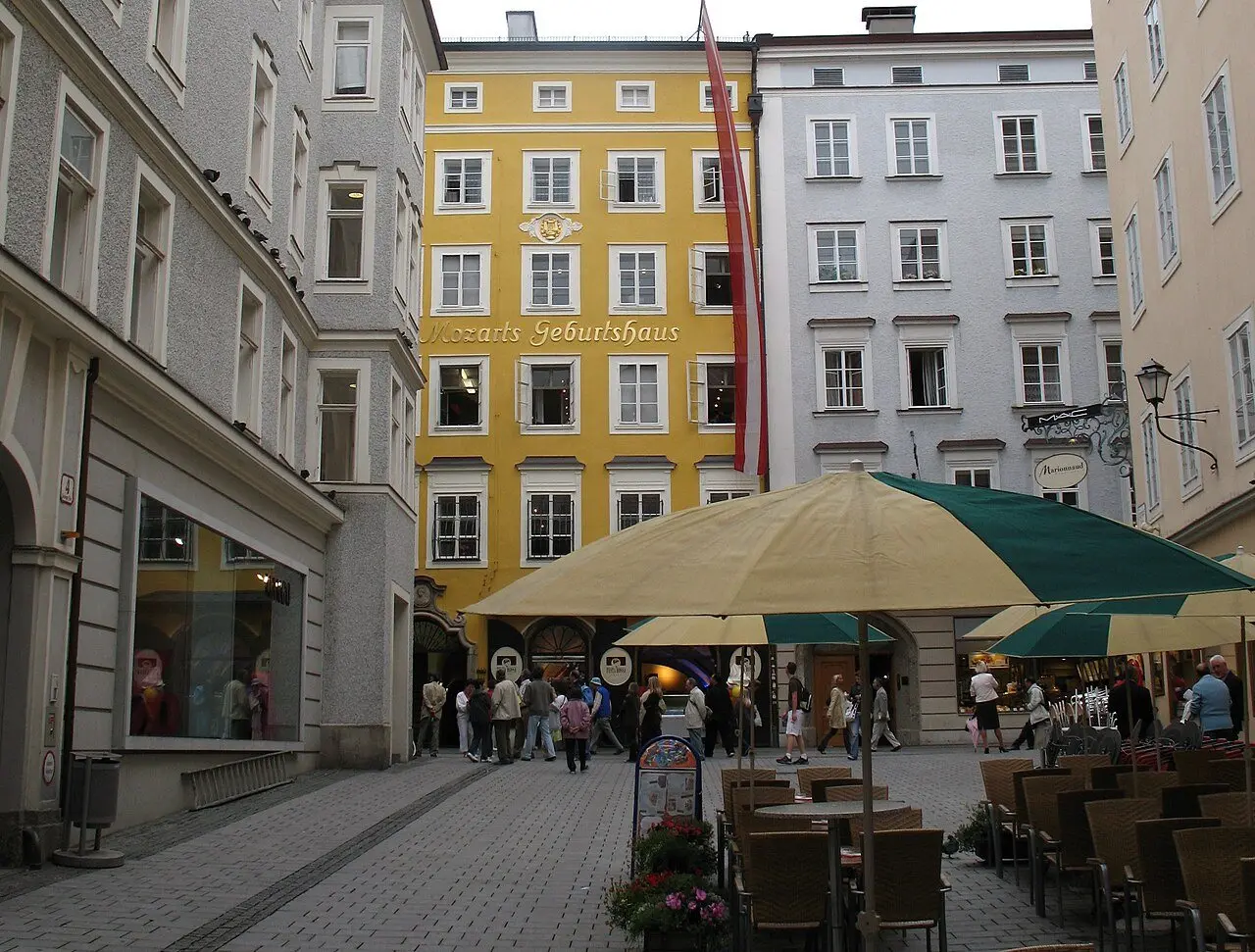
In a yellow house on Salzburg's Getreidegasse, on January 27, 1756, a baby was born who seemed to hear music before he could talk. His name on the baptismal record the next day — written in Latin, as church records were — was Joannes Chrysostomus Wolfgangus Theophilus Mozart. The world would come to know him simply as Wolfgang Amadeus Mozart.
He was the youngest of seven children, though only he and his older sister survived childhood — five of the seven died in infancy. His sister, Maria Anna, nicknamed Nannerl, was a gifted musician herself. Their father, Leopold Mozart, was a composer, violinist, and teacher who, in the very year of Wolfgang's birth, published a successful violin textbook.
The legend of the child prodigy started almost immediately. As a small boy, Wolfgang would spend long stretches at the keyboard picking out harmonies, and when Nannerl began her lessons, he watched and absorbed everything. His sister later recalled that he could play little minuets faultlessly and with perfect timing as a tiny child, and by the age of five he was already composing pieces that his father had to write down for him.
Leopold soon realized he had something extraordinary on his hands and took the children on concert tours across Europe, where the boy performed before royalty in Munich, Vienna, London, and Paris. The tours were grueling — years on the road — but they made the young Mozart famous across the continent while he was still in his teens.
What followed is one of the great artistic runs in history: symphonies, concertos, chamber music, and operas, more than 600 works in all, composed in a life that ended in Vienna in 1791 when he was only 35. Joseph Haydn, the older composer who befriended him, reportedly said that posterity would not see such a talent again in a hundred years. The music suggests he was right.
His final year alone was astonishing: in 1791 he completed the Clarinet Concerto, the opera The Magic Flute, and began the Requiem he would leave unfinished — an output that would be a career for most composers.
Today, the house at Getreidegasse 9 is a museum, and Mozart's music — from the playful opening of Eine kleine Nachtmusik to the storm of the unfinished Requiem — remains among the most performed and beloved on earth. He reminds us that genius can arrive early, but it still takes a lifetime of work to unfold.
Photo: Andrew Bossi, CC BY-SA 2.5 (via Wikimedia Commons).