The Day the Sky Went Dark: Mount Pinatubo Erupts
On June 15, 1991, Mount Pinatubo exploded in the second-largest volcanic eruption of the 20th century — and a daring evacuation saved thousands of lives.
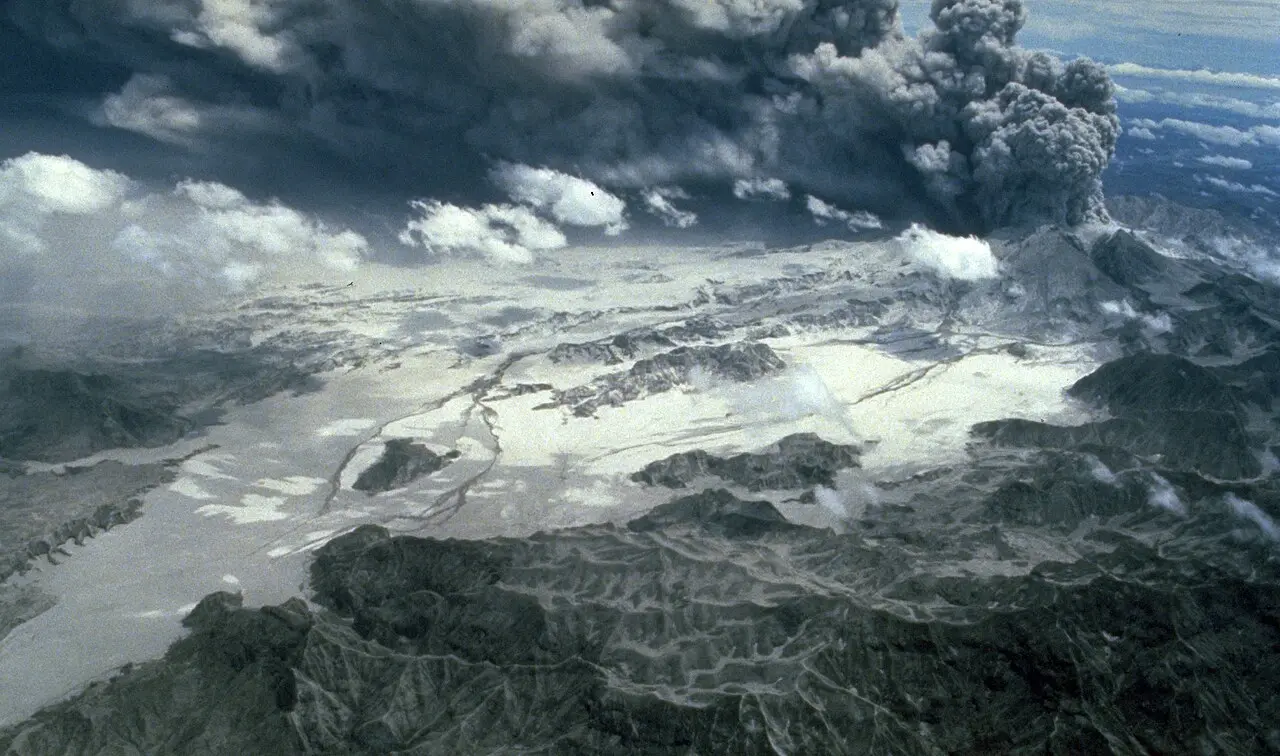
After sleeping for 500 years, a quiet Philippine mountain woke up — and on June 15, 1991, it blew its top in one of the biggest eruptions of the century, darkening skies around the globe.
Mount Pinatubo, on the island of Luzon in the Philippines, had been restless since April 1991. Scientists from the Philippine Institute of Volcanology and Seismology and the U.S. Geological Survey rushed in, installing seismometers and watching the mountain swell. Small eruptions began on June 7; on June 12 — Philippine Independence Day — the first spectacular explosion sent an ash column 12 miles high. Convinced the worst was coming, authorities ordered sweeping evacuations of the surrounding towns and the nearby U.S. Clark Air Base.
Then, early on the afternoon of June 15, the climactic eruption began. In a cataclysmic blast, Pinatubo ejected more than a cubic mile of rock and ash — over five cubic kilometers of material. The ash column towered more than 20 miles into the stratosphere, and searing avalanches of hot gas and ash called pyroclastic flows roared down the slopes, burying valleys under deposits up to 660 feet thick. So much material left the mountain that its summit collapsed, leaving a caldera a mile and a half across.
As if the eruption were not enough, Typhoon Yunya struck Luzon the same day. Its rains mixed with falling ash into a heavy, concrete-like mud that collapsed roofs across the region — even in Manila, far from the volcano. Fine ash drifted as far as the Indian Ocean, and satellites tracked the cloud as it circled the planet. In the years that followed, volcanic particles high in the atmosphere cooled the entire planet by about half a degree Celsius.
The danger did not end with the eruption. In the rainy seasons that followed, giant mudflows called lahars washed the loose ash off Pinatubo's slopes and buried towns that had survived the blast — the lahars ultimately caused more destruction than the eruption itself. And at least 17 commercial jets flew unknowingly through the drifting ash cloud, sustaining about $100 million in damage.
Pinatubo was a triumph of science. Because volcanologists forecast the eruption and leaders acted on the warning, thousands of lives were saved and hundreds of millions of dollars in property were spared — proof that watching a mountain closely can be the difference between catastrophe and survival. It remains the textbook case for volcano monitoring worldwide.
Photo: U.S. Geological Survey, public domain (via Wikimedia Commons).