The Day the Iron Horse Left the Station
On September 27, 1825, George Stephenson's Locomotion steam locomotive hauled a cheering crowd through the English countryside — and the railway age began.
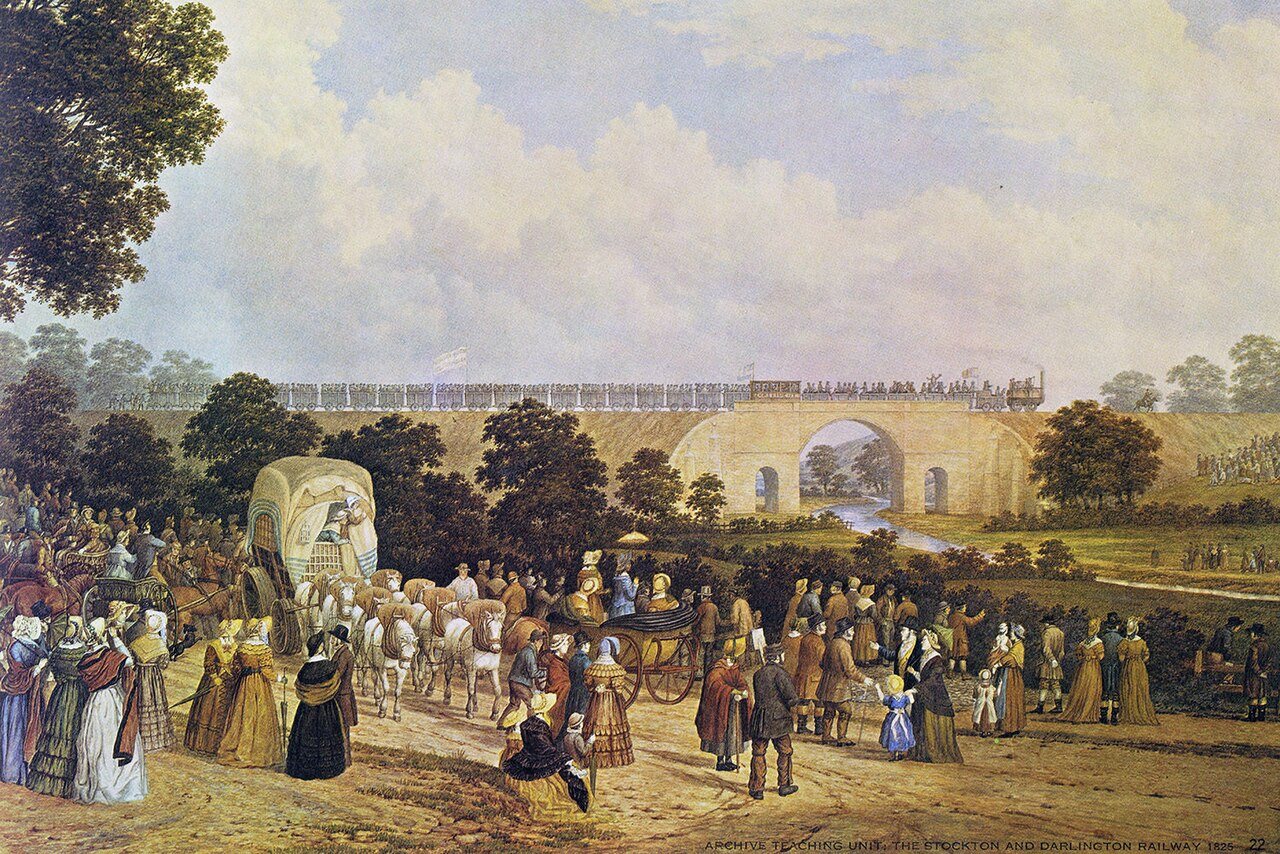
On a misty morning in September 1825, a man on horseback waving a flag led a strange parade through County Durham. Behind him came a hissing, clanking iron machine riding on rails — and behind that, hundreds of ordinary people hanging off wagons, waving hats, cheering. None of them knew they were riding into history.
The Stockton and Darlington Railway had been built for a humble purpose: hauling coal from inland pits to the ships of Stockton-on-Tees. The Quaker businessman Edward Pease championed the scheme, and George Stephenson — a colliery enginewright who believed passionately in steam — was hired as engineer. Parliament authorized the line in April 1821, and a second act in 1823 allowed something almost untested: steam locomotives.
The engine was Locomotion No. 1, fresh from the Newcastle works of Robert Stephenson and Company, built by George's own son. On the night of September 26, the experimental coach Experiment arrived, and Stephenson's team took the locomotive on a trial run to Darlington. Everything worked. The opening was set for the next morning.
Between seven and eight that morning, coal wagons were drawn up an incline by a stationary rope engine, rolled down the other side, took on a wagon of flour bags, crossed the Gaunless Bridge, and were hauled up the Brusselton incline as thousands watched. At Shildon Lane End, Locomotion No. 1 waited with the Experiment coach and twenty-one brand-new coal wagons fitted with makeshift seats. The directors had made room for three hundred passengers. Between 450 and 600 squeezed aboard anyway — riding in empty wagons and on top of coal, wherever they could cling.
Stephenson himself was at the controls. The train set off at a walking pace, led by the horseman with the flag, then steadily gathered speed — ten miles an hour, then twelve, outpacing men on galloping horses who tried to keep alongside. A wagon lost a wheel and had to be left behind; the locomotive needed a thirty-five-minute repair; then it surged to fifteen miles an hour. Eight and a half miles later, an estimated ten thousand people cheered the train into Darlington — a two-hour journey that had begun a revolution.
After refreshments — and six wagons of coal distributed to the poor — the train pressed on toward Stockton with some 550 passengers, finally halting at St John's Well three hours and seven minutes after leaving Darlington, because the last stretch of track to the quayside wasn't finished. That evening, 102 people sat down to a celebratory dinner at the Town Hall.
Amid the joy came one sobering note: a man clinging to the outside of a wagon fell off, and his foot was crushed by the following vehicle. The new speed carried new dangers, and safety on the railways would have to be learned the hard way.
The Stockton and Darlington was the world's first public railway to use steam locomotives. At first passengers still traveled in horse-drawn coaches while steam hauled the coal, but the proof was undeniable: coal in Stockton grew dramatically cheaper, the line made money, and the idea spread like wildfire. Stephenson's track gauge — four feet eight inches — would become the world's standard. Within a generation, railways would redraw the map of every continent, carry the freight of the industrial revolution, and shrink distance itself. All because, on one September morning, a flag-man on a horse led a smoking engine out of Shildon.
Photo: John Dobbin, public domain (via Wikimedia Commons).