"I've Got It!" — The Shout That Unlocked Ancient Egypt
On September 27, 1822, Jean-François Champollion read his breakthrough on hieroglyphs to the Paris Academy — with his great rival sitting beside him.
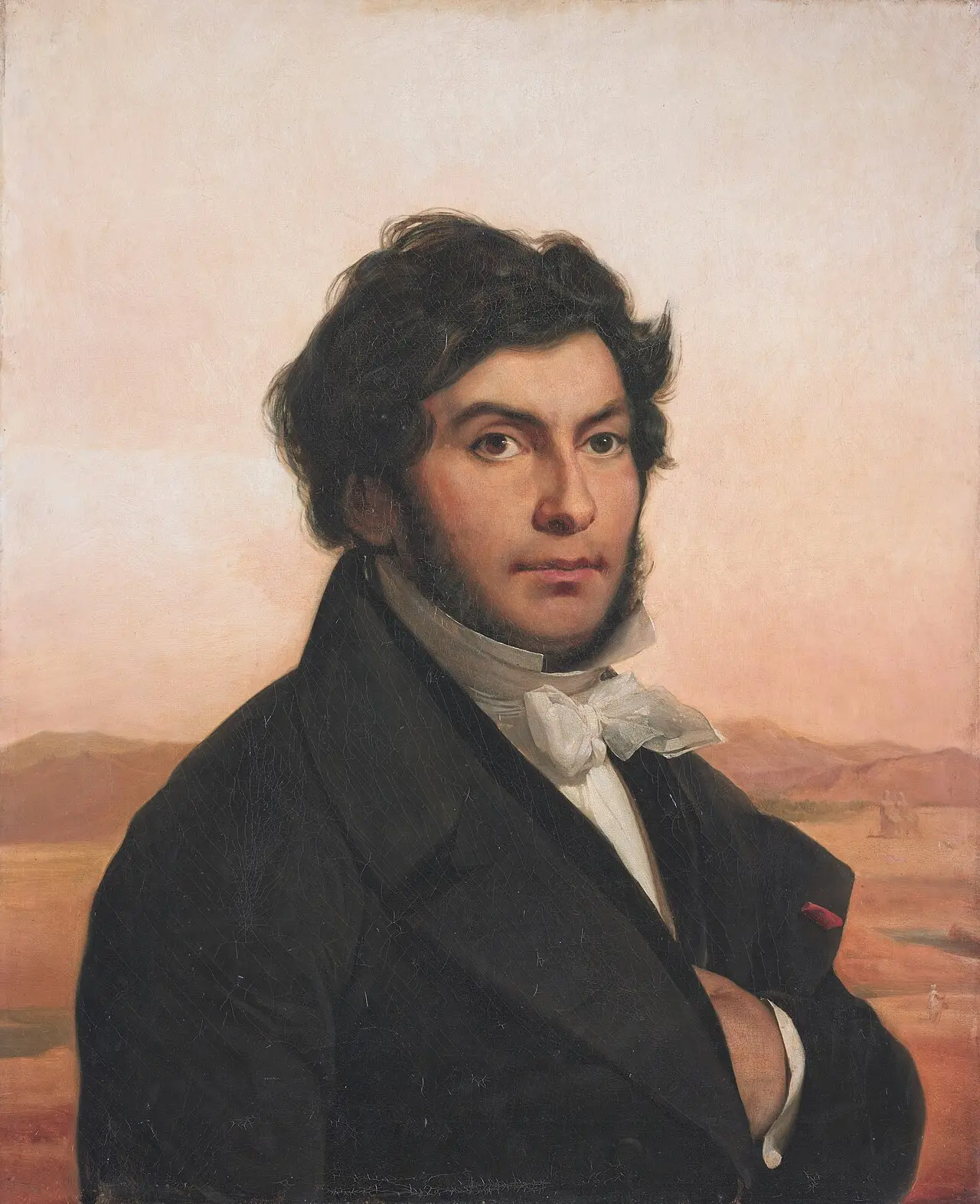
On September 14, 1822, a young French scholar burst into his brother's office in Paris, shouting, "Je tiens mon affaire!" — I've got it! — and collapsed in a dead faint. He had just cracked a code that had defied the world for fourteen centuries.
Jean-François Champollion was thirty-one, and he had been obsessed with ancient Egypt since childhood. The key was the Rosetta Stone, discovered by Napoleon's soldiers in Egypt in 1799: a slab of dark stone carved with the same decree in three scripts — Egyptian hieroglyphs, everyday Demotic script, and ancient Greek. If the Greek could be matched to the Egyptian, the dead language might speak again.
Others had tried. The English polymath Thomas Young had shown that the oval rings — cartouches — around some hieroglyphs contained royal names, like Ptolemy, spelled out phonetically. But the reigning theory held that hieroglyphs were mystical picture-symbols, not a real writing system. Champollion's flash of insight was that the script mixed both: signs that stood for sounds and signs that stood for ideas, woven together. Comparing the cartouches of Ptolemy and Cleopatra, the pieces fell into place.
He had barely a week to write it all up. The result was the "Lettre à M. Dacier" — the Letter to M. Dacier — addressed to Bon-Joseph Dacier, the secretary of the Académie des Inscriptions et Belles-Lettres. The surviving manuscript shows it was first addressed to his mentor-turned-rival Silvestre de Sacy; Champollion crossed the name out and substituted Dacier, who had faithfully supported him.
On September 27, 1822, Champollion read the letter before the assembled Academy. And by an extraordinary fluke, Thomas Young happened to be in Paris with his wife — and was in the audience. The two great decipherers met for the first time that day; Young was even invited to sit beside Champollion as he read. Introduced afterward by their mutual friend, the physicist François Arago, they parted on friendly terms, Champollion sharing his latest notes.
The letter was cautious in places — Champollion had not yet worked out every detail — but it laid the foundation of Egyptology. Within a few years, scholars could read temple walls, tombs, and papyri that had been silent since the fourth century. An entire civilization got its voice back.
It began with a shout in a Paris office, and a faint. Some breakthroughs arrive quietly. This one arrived all at once — and thirteen days later, it was read aloud to the world.
Photo: portrait by Léon Cogniet, public domain, via Wikimedia Commons.