The Civil War's Last Battle — Fought After the War Ended
On May 13, 1865, Union and Confederate troops fought the last land battle of the Civil War in Texas — more than a month after Lee surrendered.
The American Civil War was over. Everyone knew it. Robert E. Lee had surrendered the Army of Northern Virginia at Appomattox more than a month earlier, and Abraham Lincoln had been dead for weeks. And yet, on May 13, 1865, hundreds of men were shooting at each other on a salt prairie at the southern tip of Texas.
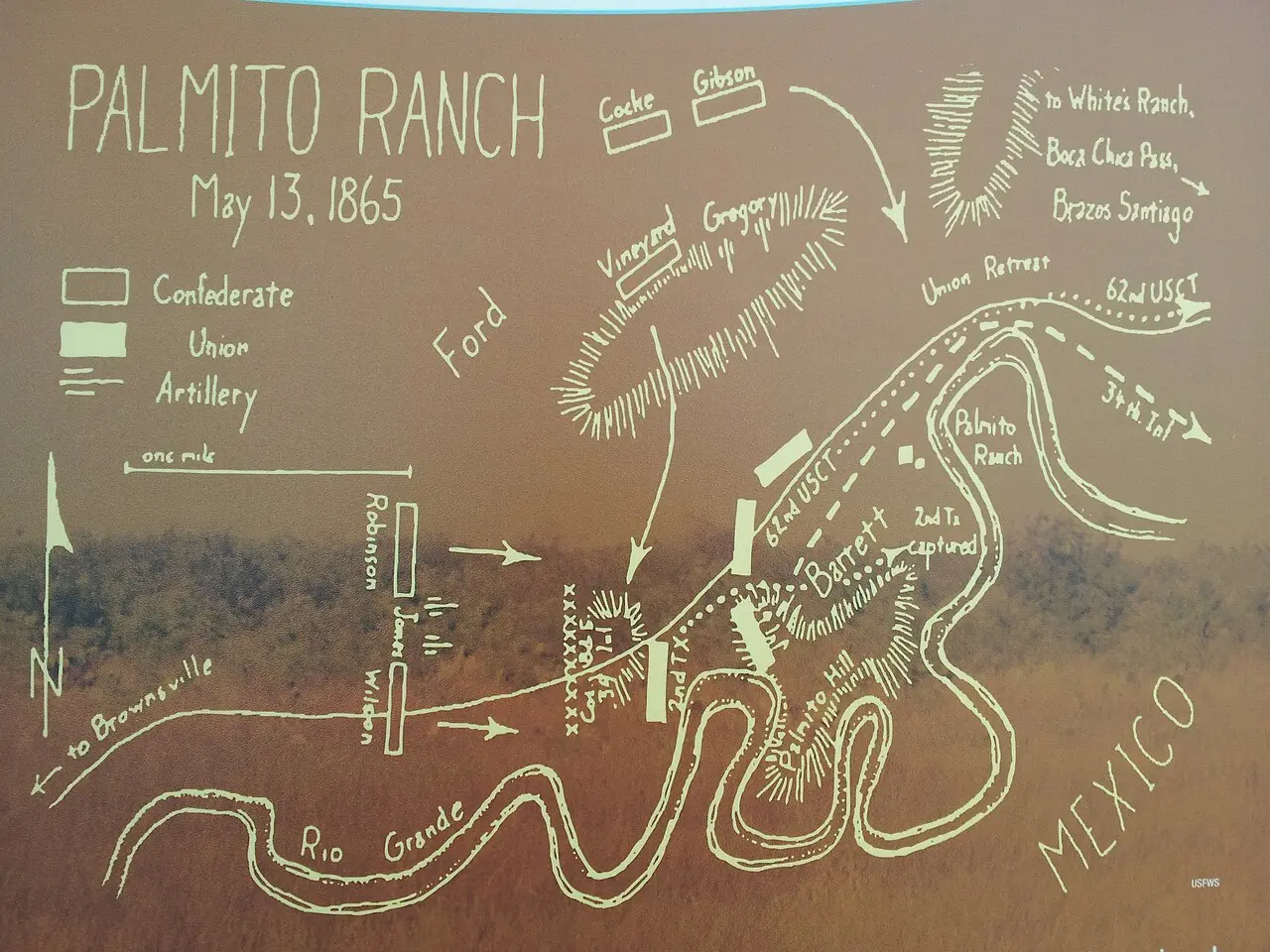
The Battle of Palmito Ranch was fought on the banks of the Rio Grande, just east of Brownsville — within sight of Mexico. Since March, Union and Confederate forces along the river had been observing an unofficial gentlemen's agreement: no more fighting; the war was decided. Then Union Colonel Theodore H. Barrett, newly assigned to command and never yet in combat, ordered an expedition against Confederate camps near Fort Brown. On May 11, Lieutenant Colonel David Branson led out 250 men of the 62nd U.S. Colored Infantry — Black soldiers — and 50 men of the 2nd Texas Cavalry. Why Barrett ordered the attack, knowing of Lee's surrender, remains a mystery. Historian Bruce Catton later called it a 'final, lonely, meaningless little spatter.'
On May 12, the Federals found White's Ranch deserted and pushed on to Palmito Ranch, skirmishing as they went. Confederate forces returned that afternoon and drove them back. The next day, both sides reinforced — about 500 Union troops against some 300 Confederates — and the Federals advanced again. Then, around 4 p.m., Colonel John Salmon 'Rip' Ford's Confederate cavalry, supported by artillery, hammered the Union line and drove Barrett's men back toward the coast. The last land battle of the Civil War ended as a Confederate victory.
The cost was small by the war's standards but real: Union losses were around 30 killed, wounded, and missing, with about a hundred men captured. Private John J. Williams of the 34th Indiana is believed to have been the last man killed in the engagement — which would make him, arguably, the last man killed in the American Civil War.
The ironies pile up. The final battle of a war fought over slavery featured Black Union soldiers prominently in the ranks — the 62nd US Colored Infantry — and was, by one account, among the war's most racially diverse battles, with African Americans, Tejanos, French nationals, and Yankees all in the fight. No other land battle of the war was fought so close to a foreign border. And the last gasp of the rebellion was a victory: the Confederates won the field, then melted away anyway. Confederate General Kirby Smith formally surrendered the Trans-Mississippi Department on June 2, three weeks later.
Palmito Ranch matters not for what it decided — it decided nothing — but for what it shows: that wars don't stop when the treaties say so. They stop when the last commander decides to stop fighting, and in Texas, on a May afternoon in 1865, that commander hadn't yet decided.
Photo: Pi3.124, CC BY-SA 3.0 (via Wikimedia Commons).